

New York City
Council passes bills to regulate protests outside schools and houses of worship
There was veto-proof support for the bill pertaining to churches and less support for restricting protests at schools.
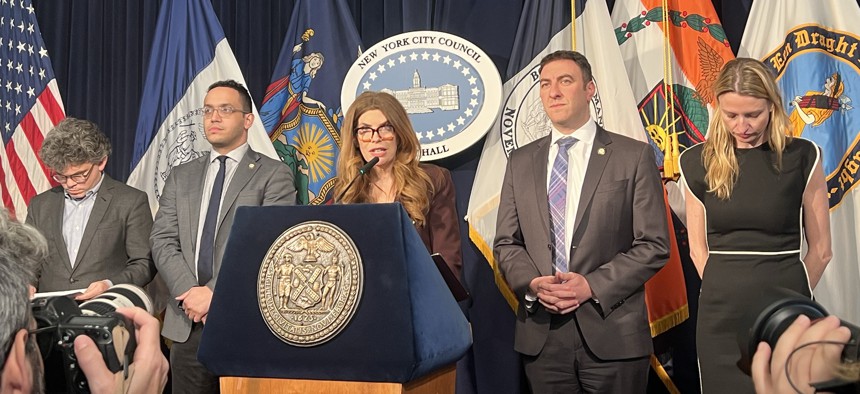
From left, Council Members Lincoln Restler, Shaun Abreu, Julie Menin, Eric Dinowitz and Virginia Maloney Sahalie Donaldson



The New York City Council passed legislation Thursday requiring the police department to develop a plan for protest “buffer-zones” outside houses of worship and schools, setting up a potential clash with Mayor Zohran Mamdani if he vetoes either of the controversial bills.
With 44 votes, Council Speaker Julie Menin’s house of worship bill passed easily, garnering a veto-proof majority. Council Member Eric Dinowitz’s bill pertaining to educational facilities, however, passed with a 30-19 margin – meaning Mamdani may be able to successfully veto it if he chooses to do so. The difference in support is partly because policing students is controversial, partly because council members are loath to vote against the speaker’s bill.
As of Thursday afternoon, it was unclear what action the mayor might take, if any. While he’s previously expressed skepticism about the bills – and many of his allies oppose them – he hasn’t taken an official position.
“The mayor is keenly aware of the serious concerns regarding these bills' limiting of New Yorkers' constitutional rights,” City Hall spokesperson Dora Pekec said in a statement. “He wants to ensure both the right to prayer and the right to protest are protected here in New York City.”
Zara Nasir, executive director of The People’s Plan NYC, said the coalition plans to organize its members to lobby the mayor to veto the bill pertaining to schools. “We’re going to be pushing for a veto and we’re going to be building on the 20 folks that voted no or abstained and trying to find more folks who can add to the majority to make sure that the bill does not have a chance to pass the second time around” she said. Under city law, Mamdani has 30 days to sign the legislation, veto it, or allow it to automatically take effect.
The bills, which are part of a broader plan championed by Menin to combat antisemitism and other forms of hate, have been significantly diluted from their original form. The initial proposal would have created buffer zones up to 100 feet barring protests outside of houses of worship and schools – an idea that followed a controversial protest late last year outside of Park East Synagogue in Manhattan. At that demonstration, protesters gathered close to the synagogue entrance and chanted “globalize the intifada” to disrupt an event held by the nonprofit Nefesh B’Nefesh that promoted emigration to Israel and the occupied West Bank.
After getting feedback from the New York City Police Department that the legislation’s one-size-fits-all approach might not withstand a legal challenge, the council softened the bills. The final version that passed Thursday directs the NYPD to create “a plan to address and contain the risk of physical obstruction, physical injury, intimidation, and interference at places of religious worship, while also preserving and protecting the rights to free speech, assembly, and protest.”
A broad spectrum of advocates have continued to push back against the watered-down version of the proposals, pointing to free speech issues. Some have argued that the legislation would not actually make Jewish New Yorkers safer and that it is instead intended to quell the voices of pro-Palestinian protesters. “This is no time for the political leaders of our city to be pressing for legislation that could put our right to protest in danger,” NYCLU Executive Director Donna Lieberman said during a rally outside of City Hall. “But that’s precisely what they’re doing right now.”
Menin, who is Jewish, told reporters ahead of the vote that the mayor has not indicated that he would veto the measures nor did he share any particular concerns in conversations she’s had with him about the bills. “We had great conversations with the law department, they certainly had input on the bill as did the NYPD,” Menin said, noting that the council implemented feedback after the mayor directed the agencies to review the proposals’ legality. “We took those comments and those are reflected in the current version.”
Asked whether there was enough support to overturn a potential veto, Menin declined to elaborate beyond saying, “We have tremendous support for this package.”
The vast majority of the council’s Progressive Caucus voted against the buffer-zone bill pertaining to schools, voicing concerns about overly relying on police and quelling New Yorkers’ right to protest. A handful voted against both measures.
“Overreliance on the police will not squash hate,” said Progressive Caucus co-chair Tiffany Cabán, addressing her fellow council members at the Thursday vote. “We have to address hate at its root, and there are no shortcuts.”