

Budget
Mark Levine has questions about Zohran Mamdani’s math
At a preliminary budget hearing Wednesday, the comptroller will outline his two-year budget gap estimate of at least $7.3 billion, and explain why he’s skeptical about the mayor’s revenue projections.
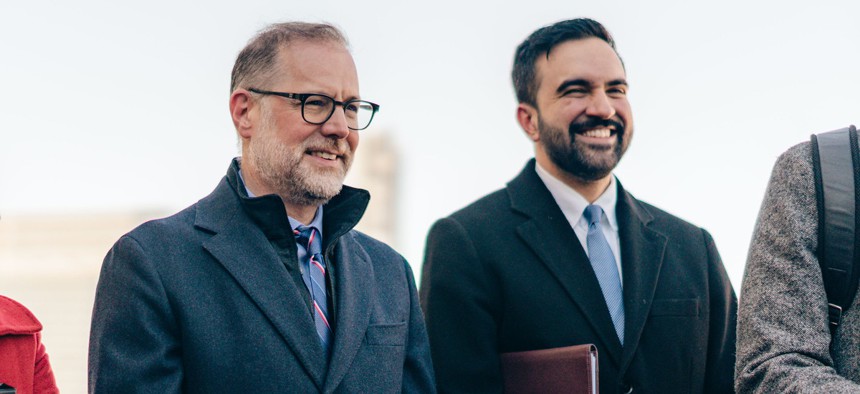
Comptroller Mark Levine, left and Mayor Zohran Mamdani, right. Ayman Siam/Office of NYC Comptroller


Up until now, Mayor Zohran Mamdani has taken the lead in New York City’s annual budget dance. That changes this week, as the City Council kicks off its preliminary budget hearings and Comptroller Mark Levine releases his own financial analysis projecting a deficit nearly $2 billion larger than Mamdani’s.
There are still nearly four months to go until the city actually passes its fiscal year 2027 budget, and major questions remain about what, if any, additional state funding Gov. Kathy Hochul will kick in, whether Mamdani’s push to raise taxes on the wealthy will go anywhere, and how exactly city agencies will find a projected $1.7 billion in savings between this fiscal year and next.
Those open questions leave the other players in the budget cycle staking out some areas of opposition to and concern with Mamdani’s preliminary budget proposal, while stopping short of detailing a full plan of their own. (The responsibility to present a balanced budget lies squarely with the mayor, though the council will make additional recommendations in its preliminary budget response by April 1.)
City Council Speaker Julie Menin is saying that the city doesn’t need to drain nearly $1 billion from a reserve known as the Rainy Day Fund, as Mamdani has proposed to close the budget gap this fiscal year, which ends June 30.
And in a lengthy new analysis, Levine is projecting a larger budget deficit than Mamdani in both this fiscal year and next. The mayor’s Office of Management and Budget has projected a $5.4 billion budget gap over two years, while Levine’s projection is at least $7.3 billion. Of course, all these estimates remain purely preliminary until the state budget is completed. That’s due April 1.
While Levine credits Mamdani with presenting a budget that is more realistic about the costs of programs that are driving the city’s growing spending, he’s warning that some of the steps the mayor has proposed to close the deficit rest on aggressively optimistic assumptions about tax revenue and risky tactics, including drawing down from budget reserves while prepaying a much smaller amount than previous years toward future costs.
“We don’t feel this is a good year to be passing all the heavy lifting forward,” Levine told reporters in a briefing on Tuesday.
While Mamdani said in his preliminary budget proposal that savings initiatives across agencies are projected to generate $1.7 billion across this fiscal year and next, agencies have not yet presented those plans in detail. And Levine said those savings will likely need to be more aggressive than the Mamdani administration has planned for, though he declined to say how much more aggressive they should be.
Both Levine and Menin were also noncommittal on the prospect of Albany raising income taxes on the rich and raising corporate taxes, which are Mamdani’s preferred solutions to raise revenue, alongside additional state funding commitments. (Mamdani has said that city property tax hikes would be the only alternative to raise revenue, though such a move is politically toxic enough to make it extremely unlikely, if not impossible, for Mamdani to pursue.)
“I think it’s good that they’re putting everything on the table. You always want to have everything on the table,” Menin said in an unrelated press briefing on Tuesday, when asked about the state Legislature one-house budget proposals, which include raising taxes on the wealthy. (Gov. Kathy Hochul has been firm in her opposition to tax hikes.)
“It’s the debate we need to have,” Levine said, though he declined to take a side in that debate on Tuesday. “On the one hand, equity demands that we have a more progressive tax structure and that the wealthiest do more to help us. But we also need to interrogate the extent to which that could undermine the success we need in the financial sector.” (Projected tax revenue growth is largely reliant on Wall Street, a sector that would be hit by a tax hike on the wealthy.)
Levine will testify at the City Council’s first preliminary budget hearing on Wednesday, as will leaders from the Independent Budget Office and the Department of Finance. The mayor’s budget director, Sherif Soliman, is not expected to testify until later in the month however because he will be fasting for Ramadan, and other officials from the Office of Management and Budget are not listed on the council’s schedule.
Grace Thomas contributed reporting.
NEXT STORY: State legislators gear up for budget fight with one-house proposals