

Policy
Planned Parenthood: Hochul’s buffer zone bill may be unconstitutional
Reproductive health centers worry the proposal to restrict protests would violate New Yorkers’ First Amendment rights.
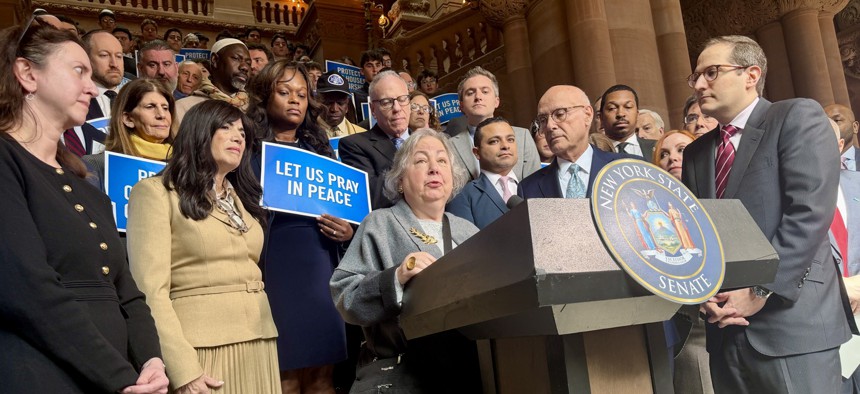
State Sen. Liz Krueger speaks at a rally in support of buffer zone legislation. Kate Lisa


New York’s Planned Parenthood affiliates are concerned that Gov. Kathy Hochul’s budget proposal to create protest buffer zones around houses of worship and reproductive health facilities is unconstitutional. The governor and state Legislature are expected to strengthen protections for worshippers after a sharp rise in hate crimes.
Hochul said state law must be changed to prevent protestors from intimidating or harassing worshippers, particularly on the heels of Thursday’s targeted attack on a Michigan synagogue.
“Whether a synagogue, church or a mosque, it doesn’t matter,” Hochul told reporters at an unrelated event in the city on Friday. “People have a right to feel protected.”
Hochul also said she spoke with Michigan Gov. Gretchen Whitmer – a fellow Democrat whom she has a close relationship with – about the attack on the synagogue.
The conversation is about to get serious in three-way budget talks starting next week. Although Hochul and legislative leaders broadly agree on increasing protections for houses of worship, they disagree on key points of the proposed law, which will impact the likelihood it could withstand legal scrutiny. The governor put forth broad legislation in her executive budget in January that’s tied to state Clinic Access law. It would regulate demonstrations, obstruction and violence outside both houses of worship and reproductive health sites and impose stronger criminal penalties for violations.
Planned Parenthood affiliates across the state have deep concerns about Hochul’s idea.
“Planned Parenthood believes everyone has a right to safely enter reproductive health care facilities and houses of worship,” Planned Parenthood Empire State Acts President & CEO Robin Chappelle Golston said in a statement to City & State. “At the same time, it is critical that any policy intended to protect safe entry is effective, legally durable and respects our long-held right to free speech. We have serious concerns about whether the proposed buffer zone legislation would withstand judicial scrutiny, and more so, chill the constitutionally protected activity of protest, which has been central to our efforts to secure the rights and freedoms we hold dear.
“We look forward to engaging with policymakers to explore alternative approaches that protect New Yorker's ability to safely enter health care facilities and houses of worship, while upholding our First Amendment right to protest,” she added.
Hochul’s office referred to Jan. 14 comments the governor made on NY1 when asked about Golston’s concerns.
“We are just going to create a buffer zone, 25 feet from the property line, so people can be able to walk into their building, the place they want to go, and deepen their relationship with God and their community without being harassed or screamed at – and that seems like a basic right,” Hochul said at the time.
This week, the state Senate countered Hochul's proposal with a narrower approach that would make blocking doors or access to houses of worship a misdemeanor but did not include any provisions regulating protests or demonstrations. It would only apply to places of worship, not reproductive health clinics.
Lawmakers suggested the governor’s proposal would not survive legal scrutiny, pointing to the U.S. Supreme Court’s unanimous decision in 2014 to strike down a 35-foot buffer zone outside Massachusetts abortion clinics.
At a rally about buffer zones in Albany this week, state Senate Finance Committee chair Liz Krueger said the upper house’s proposal better defines a demonstrator’s illegal behavior and therefore has a stronger chance of being upheld in court.
“Ours is more value-neutral, which I think we all agree on, and would probably stand up better,” she said.
The Assembly entirely omitted the governor’s proposal from its one-house budget resolution. Assembly Speaker Carl Heastie often removes nonfiscal policy items from the governor’s budget. A spokesperson for Heastie did not return a request for comment about his position on buffer zones outside houses of worship.
The New York Civil Liberties Union and civil rights groups have fought the idea from the start – citing the earlier Supreme Court ruling, and arguing the law would be anti-speech and violate New Yorkers’ First Amendment rights. Justin Harrison, senior policy counsel with ACLU of New York, said the change is unnecessary because state and federal law already prohibit intimidation, violence and threatening behavior outside houses of worship and abortion clinics.
“This is also not, I think, a moment in our nation’s history when we want to be further criminalizing protest,” Harrison told City & State.
He pointed to recent fatal immigration protests in Minneapolis and said more interactions between demonstrators and police would increase opportunities for violence.
“A sidewalk is a sidewalk as far as the First Amendment is concerned,” Harrison said. “Those protections have been part of our constitutional history as long as the country has been around … That’s why we are very, very wary of anything that criminalizes or punishes protests, particularly in the form of laws like this that are ripe for viewpoint or content-based discrimination.”
Hochul on Friday said that the 25-foot protest buffer zones would keep people away who could harm worshippers.
“I’ll protect the right to protest – time, place and manner restrictions over here – not to harass people when they’re going in for their worship services.”
State Sen. Sam Sutton and Assembly Member Micah Lasher carry a standalone bill that’s similar to the governor’s bill, and applies to the entrances, exits and access areas of reproductive health facilities and houses of worship. They’re angling to get their version of the proposal in the state budget, which is due April 1.
“Hate crimes in New York City increased by 152% this January from last January – 152%,” Sutton said at the same rally in the Capitol. “We cannot ignore what is happening at the very doors of the places that should feel safest. No one should have to walk through a crowd of harassment just to be able to practice their faith.”
The New York City Council is also considering similar legislation. Speaker Julie Menin originally proposed a bill to keep protesters 100 feet away from schools and houses or worship, though she revised her legislation last month to remove the mandated protest barrier and instead leave regulation of protests up to New York City Police Commissioner Jessica Tisch.
Lasher, who is running in a competitive Democratic primary to replace Manhattan Rep. Jerry Nadler in Congress, said Menin’s original proposal for a 100-foot barrier was completely unrealistic.
“We’ve all been hearing a lot about 100 feet,” Lasher said. “Something we don't always do very well up here is be honest with people. And the honest truth is that a 100-foot buffer zone would not stand the snowball's chance in hell of surviving in a court.”
New York City Mayor Zohran Mamdani has so far declined to take a position on the buffer zone bills. When asked about Menin’s proposal, he has said he is waiting on constitutional analysis from the NYPD and city Law Department.