

Policy
Rather than weaken climate law, Assembly proposes $500 checks to cover higher energy bills
The Protecting Our Wallets Energy Rebate would send one-time checks to more than 5 million New Yorkers.
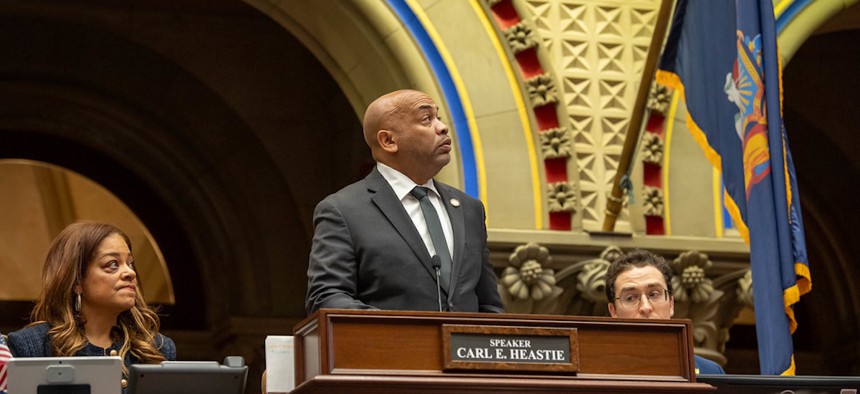
Assembly Speaker Carl Heastie presides over the chamber on February 10, 2026. NYS Assembly Majority


The Assembly’s state budget proposal released Tuesday includes one-time checks of up to $500 meant to combat rising utility bills.
The “Protecting Our Wallets Energy Rebate (POWER)” program would provide $500 checks to households with annual incomes under $150,000 and $300 checks to households with annual incomes between $150,000 and $300,000. That’s an estimated $2.6 billion payout to 5.4 million households, who pay some of the highest prices for energy in the nation. The Assembly is also proposing a two-year freeze on utility rates and the creation of a commission to study the origins and reasons for rising prices.
Electricity costs have risen across the United States, fueled by increased demand from AI-focused data centers and higher costs to upgrade electricity infrastructure. In New York, an especially harsh winter led to a surge in demand for heating and furthered the strain on family budgets, prompting the Assembly’s direct relief proposal.
The governor has her own plan to address costs. Last month, she announced an initiative to require data centers to pay their share of costs related to energy grid updates. She also wants to scale back the 2019 Climate Leadership and Community Protection Act..
Hochul has said that full compliance with the landmark climate law could cost the average New Yorker up to $3,500 per year. The governor has also said the law’s emissions reduction mandates are unrealistic given the effects of tariffs and the Trump administration’s efforts to cut down on renewable power.
Hochul has suggested that the current law’s emissions measurement standards have set the state up for failure. Under the CLCPA, greenhouse gas emissions must be reduced by 40% from 1990 levels by 2030. Depending on how you measure methane emissions, the state has so far reduced greenhouse gas emissions by either 15% or 24% compared to 1990 levels. Proponents of changing the law say meeting the original emissions targets would require near-term investments that could threaten present affordability, even if they may reduce fuel costs later.
Climate advocates aren’t so sure. Pete Sikora, climate and inequality campaigns director at New York Communities for Change, said investing in clean energy now is essential. “The governor's position and misrepresentation of what the climate law is inducing is in line with Republicans’ (position). And it's just a shameful pack of nonsense,” he said.
“Portraying this as affordability versus pollution reductions is not true.” He sees Hochul using conservative talking points in an election year, potentially catering to a moderate crowd as she campaigns to keep her seat.
Hochul has not yet formally proposed any changes to the CLCPA – another source of frustration for Assembly members. The governor could have included her desired changes in her executive budget proposal or in her 30-day amendments to that proposal, but she did not. Instead, she seems to be waiting until she has maximum leverage in budget negotiations to push for changes to the law.
Lawmakers are not happy. “We should be having a thorough conversation about the climate goals, and if we want to amend them, we should do this in the public purview, not behind a budget process,” Assembly Member Michaelle Solages told City & State.
The governor’s team countered that her approach prioritizes costs. “Making New York more affordable for families is her top priority,” a spokesperson for the governor said. “The Governor and her team will continue to negotiate with the Legislature in good faith to advance her all-of-the-above approach to energy and keep the lights on and costs down for New Yorkers.”