

Immigration
Report finds immigrant legal services under stress in New York
Immigrant rights advocates want state leaders to approve landmark new funding and legislation to improve access to attorneys for immigrants amid a hostile federal government
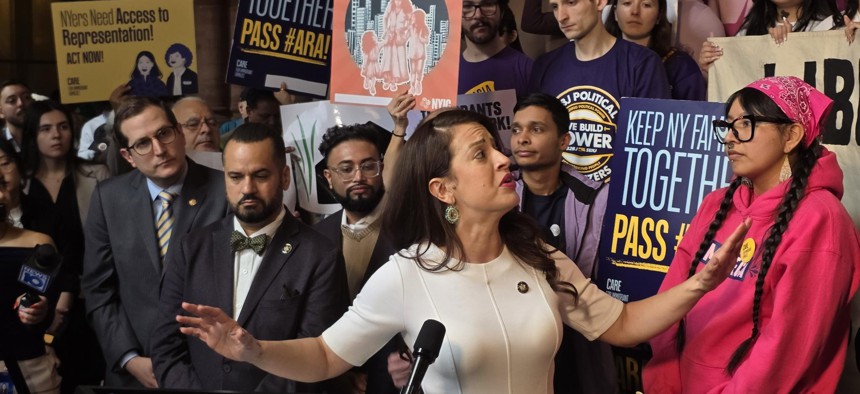
Assembly Member Catalina Cruz speaks at a rally in support of the Access to Representation Act and increased funding for immigrant legal services. Rebecca C. Lewis



As immigrant rights advocates push state leaders to increase funding for legal services for immigrant communities, a new report highlights the necessity of those services – and the stress that legal service providers have been under since the start of the second Trump administration, especially upstate.
The New York Legal Services Coalition released a new report, shared exclusively with City & State, detailing “an urgent surge in demand” for immigrant legal services as President Donald Trump makes good on his mass deportation agenda since taking office again last year. According to the report, immigration legal aid attorneys served over 65,000 immigrants in New York across the state in the past year. The cases ranged from obtaining work authorization to green cards to even having deportation cases terminated. “Research shows that represented immigrants are dramatically more likely to be released from detention, appear in court, and secure relief, while unrepresented individuals – especially children – face near-certain deportation regardless of the validity of their claims,” the report reads.
The report applauded the $64.2 million the state has invested in immigrant legal services already – a nation-leading amount – but said the need for legal services outpaces the current resources. “The scale and intensity of current enforcement have placed unprecedented strain on this system, exposing structural funding limitations that now threaten its sustainability,” the report reads. That’s why the report called for the passage of the Access to Representation Act, which would create a state-funded right to a lawyer in immigration court, and the BUILD Act, which would strengthen the immigrant legal services field with better recruitment and training efforts. The report also demanded state leaders include $175 million for immigrant legal services.
Sal Curran, the executive director of the Volunteer Lawyers Project of Central New York, said the new state dollars would be a major game changer for organizations like theirs. The state funds about 60% of their organization, leaving the remaining 40% up to private fundraising. “It is really touch-and-go,” Curran told City & State. “And it makes it so that we are running a very, very thin program, and we have more turnover of our attorneys because we're not able to pay our attorneys even the amount that they would get paid if they worked for the state.”
Events in the past year have shown the dire need for attorneys who specialize in deportation proceedings in areas far from where detention centers exist, like Batavia. “What we found is that in other regions, like Syracuse, our clients are being put into detention in ways that they never were before,” Curran said. “So we need deportation defense attorneys too, whereas in the past, we would just say, ‘Oh, you're detained. Work with the Buffalo attorney.’” According to Curran, such attorneys are exceedingly hard to come by in Central New York.
The New York Legal Services Coalition report included testimony from immigrants who benefited from access to legal assistance, and one of Curran’s own clients spoke with City & State about the difference an attorney can make. After living in the United States for two decades with legal work authorization and citizen children, Adelso – who asked not to have his last name used – said he never expected to be detained by immigration agents. “I was on my way to work, and when this happened, I froze. They surrounded the car,” Adelso said in Spanish through a translator. “They yelled at me that they were (Immigration and Customs Enforcement), and they asked for an ID. I showed them my ID. They told me that was no good.”
ICE picked up Adelso earlier this year, and he spent 20 days in detention before being released. He has a scheduled check-in with immigration officials in just a couple of days, which he remains uncertain about. But Adelso counted himself fortunate that despite the trauma he went through, he was at least able to get out as quickly as he did.
Adelso said he would likely still be detained if it weren’t for his access to the necessary legal resources to navigate a complex and abusive system. “There were people there … they have been there for over a year,” he said through the translator. “The person who had less time detained there was – he had been there for four months. I had told him that I was going to fight my case, and he told me just to be prepared to be there for months.”
Adelso described poor conditions and abusive and coercive behavior from immigration agents both at the initial processing near Syracuse and the detention center in Batavia, located in Western New York. “At the (Batavia) processing center, we slept on the floor,” he said. “They just give us one pillow and a sheet, and we were there for like four days.” Adelso said at one point, up to 80 people needed to share a single bathroom, and people were told showering was a “privilege.”
Curran said that while downstate and the conditions at 26 Federal Plaza have gained significant attention, including from multiple elected officials on numerous occasions, plights of immigrant communities upstate can get comparatively overlooked. “Upstate immigrants are so much more vulnerable, you know, especially in rural communities” they said. Reporting from The Investigative Post found that the Batavia detention center regularly held well over its capacity of detainees.
Curran relayed what a North Country colleague had described about the situation up there. “This person was telling me that there were immigrants that worked on a local farm that would bike to the local grocery store to get their food,” they said. “And the environment had become so anti-immigrant there, that every time they would bike to the grocery store, (Customs and Border Patrol) would be called and come out.” Curran described a “major uptick” in immigration enforcement in Central New York as well that available legal services have struggled to keep pace with as immigrants continue to be packed into limited holding facilities.
“We are beyond capacity at all times,” Curran said. “Our wait list is so long, and we try so hard to be responsive to the community needs.” They said when a high-profile raid occurred in September last year that drew national attention, legal aid immigration attorneys tried to respond as rapidly as possible. “But the reality is, what we can do is so limited because we don't have staff to take those cases,” Curran said.
The requested funding and passage of new bills would help address at least some of those issues, according to both Curran and the report. This is the first year that both the state Senate and Assembly included the full $175 million in their one-house budget proposals. Gov. Kathy Hochul had included a slight increase in funding compared to what leaders agreed upon last year, though still far less than the total advocates have requested. She has expressed commitment to passing new immigrant protections with legislators, but has declined to say whether she supports additional immigration legal funding.