

Health Care
Helen Keller’s family members irate over changes to communication bill of rights proposal
The proposed changes to the bill have also caused a rift between the chairs of the Assembly and Senate committees on disabilities.
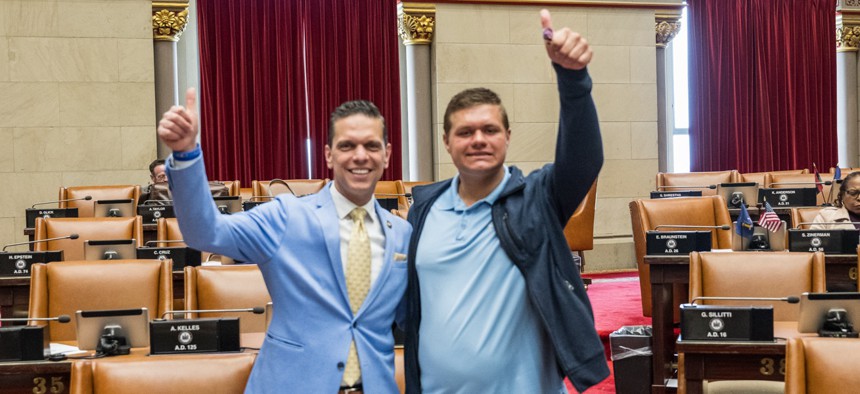
Assembly Member Angelo Santabarbara, left, and his son Michael, who suffers from autism, pose together in the Assembly chamber. Office of Assembly Member Angelo Santabarbara


Proposed changes to a bill aimed at guaranteeing people with developmental disabilities – especially nonverbal people – the right to choose their preferred way to communicate has caused outrage in the disability community, including from members of Helen Keller’s family.
The state Senate Disability Committee tabled a measure this week that intends to safeguard the communication rights of minimally or nonverbal speakers. State Sen. Pat Fahy, the bill sponsor and committee chair, amended the bill last week, which caused a rift between her and Assembly Disabilities Committee Chair Angelo Santabarbara and other disability advocates.
Last year, the Assembly passed a version of the measure that concerns the state Office for People With Developmental Disabilities. Santabarbara said the department was concerned his bill would impose stricter regulations on state-run facilities and would open up the state to liability, but he resisted agency pressure to weaken the bill.
“The agency’s happy with her version – the Senate version,” Santabarbara told City & State. “They don’t want to change what they have in place. Their bill sets us back, they will have complete control over everyone's communication device, everybody's communication method, and exactly the opposite of what everybody was fighting for.”
For her part, Fahy believes the Assembly bill would not hold up in court and is heeding the warnings of the state Office for People With Developmental Disabilities. Agency leaders contacted her to express concerns about the bill and told her it needed more legal safeguards.
Fahy tweaked the legislation last week to require the protected communication methods be “validated,” and include a requirement for “autonomous” authorship. The language was added to narrow the bill’s scope about communication that could inadvertently reflect the thoughts of a support person instead of the person with developmental disabilities.
“I talk to all the agencies, of course we get technical assistance,” Fahy said. “I’ve talked to all sorts of people – that’s why we have three-way negotiations on anything.”
Fahy said it’s her job to listen to attorneys and experts.
“It has to be grounded in evidence-based practice,” she said, adding that Medicaid eligibility requires that communication methods must be verified to belong to a patient.
“It gets into a lot of legal nuance,” she said. “In the end, it has to be the individual who is actually doing the talking.”
A spokesperson with OPWDD said the department is deeply committed to the rights of people with disabilities, including the right to autonomously communicate.
“While OPWDD does not comment on pending legislation, as a state agency that supports people with developmental disabilities, we take seriously the responsibility to provide education and to clarify policy positions when there are public misconceptions,” the agency spokesperson said in a statement. “There is nothing more person centered than the right of people to communicate their own thoughts and we are grateful to partners in the Legislature who have taken an interest in fully understanding this important issue and its potential impacts.”
Margot Keller and Brooks Hamilton, living relatives of Helen Keller, wrote a letter to Fahy this week blasting the amendments, arguing they weaken protections for the very people the measure is meant to support.
“For many, communication is not an autonomous act at the outset; it is something built through support, trust and partnership,” they wrote. “By narrowing what qualifies as acceptable communication, these amendments risk closing the very door that once opened Helen Keller’s world.”
Hundreds of advocates have flooded Fahy’s office with calls and letters criticizing the changes and contacted other members of the Senate Disability Committee urging them to vote against the measure. It had originally been scheduled for a committee vote on Tuesday but was pulled from the agenda.
“No professional organization, no state agency, can categorically refuse a type of communication,” Evelyn Yang, a Hell’s Kitchen mother of two children with autism, told City & State. “It is against the law, but it was happening in the state of New York.”
Yang, the wife of 2020 Democratic presidential candidate Andrew Yang, said the recent changes to the Senate bill are ableist and discriminatory, and violate communication standards protected under the federal Americans with Disabilities Act, such as spelling boards or other devices that give nonverbal speakers the ability to advocate for themselves.
“This is really problematic, because you basically have a single gatekeeper who is taking orders from an unelected agency, undermining the entire democratic process,” Yang said of Fahy.
Fahy did not inform Santabarbara she was changing her version of the bill. Santabarbara, whose son Michael has autism, said he’s in the Legislature to stand up for the disabled community – not government agencies.
“If all the agencies dictated our legislation, what are we doing here?” he said. “That is our job, not their job. It seems that they think it's their job to tell us what should be in the bill and what shouldn't be.”
Santabarbara’s office had not heard from Fahy about the amended legislation as of Wednesday, a week after it was introduced. Fahy said she is open to working on a solution that protects communicators.
“I really try to get it right,” she said. “We’ll work with central staff and work with some of the groups, probably post-budget.”
Santabarbara said he looks forward to hearing from Fahy’s team, and working to get the bill over the finish line this year.