

Policy
Lawmakers, local electeds make final budget plea for more housing vouchers
Municipalities and local governments say more is needed to combat increased homelessness, but housing has not been a main focus of this year’s budget negotiations.
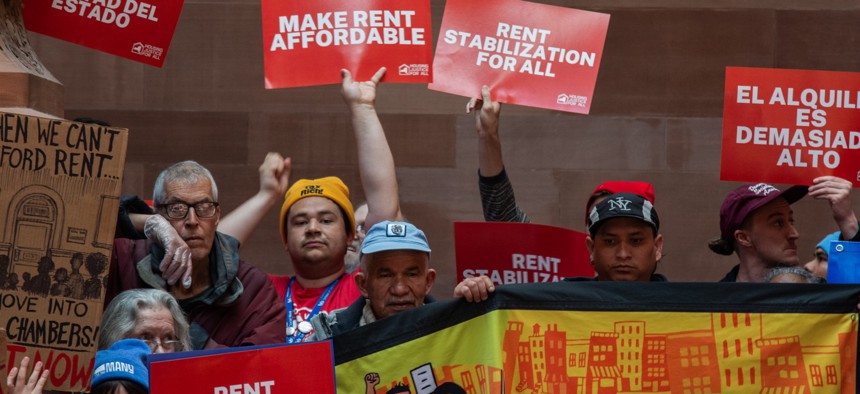
Advocates rally in the state Capitol on Wednesday for more rent assistance in the next state budget. Courtesy Housing Justice For All


The New York State Association of Counties and the New York State Conference of Mayors are making sure state leaders don’t forget about rental assistance as they negotiate a budget focused on addressing the high cost of living.
The Legislature included a four-year pilot for the Housing Access Voucher Program in last year’s budget to secure permanent housing for low-income people who are homeless, or at risk of becoming homeless. This year, Gov. Kathy Hochul sought to continue that commitment, including $50 million in her executive budget proposal to fund 2,000 vouchers. But local officials argue that’s not enough.
The New York State Association of Counties and the New York State Conference of Mayors want Hochul to match both the state Senate and Assembly one-house budgets and quintuple that – giving $250 million to the HAVP.
“The pilot is a strong strategy that will, unfortunately, be unable to meet the immense and urgent needs across the state without a larger investment,” NYCOM Executive Director Barbara Van Epps and NYSAC Executive Director Stephen Acquario wrote in a letter to Hochul and legislative leaders last month.
More than 158,000 people across the state experienced homelessness in 2024, including 50,733 children, according to the letter. About 46% of tenants are rent-burdened, with 20% severely rent burdened or one unplanned event away from becoming homeless.
The mayors of Albany, Rochester, Kingston and Syracuse, all Democrats, penned a similar letter about the program to Hochul and legislative leaders last week – arguing rental assistance distributed through the program prevents evictions and allows New Yorkers to find permanent, stable homes.
Westchester County reported 1,611 people experiencing homelessness, but Hochul’s budget would only give the county 78 vouchers.
“Without increased funding for the program, the vouchers cannot go nearly as far as we need them to,” the mayors wrote. “In the crises exacerbated by federal cuts, well-funded solutions are scarce for people in search of homes, and many are at risk of losing the housing they have.”
State budget negotiations continue to drag on – now 36 days past the April 1 deadline – but outside of Hochul’s proposal to modernize the State Environmental Quality Review Act to accelerate housing and other local projects, leaders have barely mentioned housing initiatives or new investments.
“While building more affordable and supportive housing is a necessary step for these communities, it should be coupled with increased investment in rental assistance to holistically address the problem,” according to Van Epps and Acquario.
While state leaders are moving to resolve most outstanding policy items in the budget – expected to be at least $263 billion – it’s unclear how close leaders are to closing down overall housing talks. That includes discussions about more funding for state-funded vouchers.
Senate Housing Committee Chair Brian Kavanagh told City & State the final spending plan will have significant housing items – including an expansion of the J-51 program, which offers a tax reduction up to 70% of construction costs to renovate qualified affordable rental properties, co-ops and condos to spur improvements. Even so, Kavanagh said pushing for millions more for state-funded housing vouchers remains a top priority.
“Vouchers are going out the door throughout the state, but there’s enormous need,” Kavanagh said Wednesday.
The program is set to expire in 2030, but the state senator said discussions to push back that sunset date are not on the table this year. “We know we have an enormous challenge of far too many people homeless in the state, and HAVP is a big part of our plan to address that.”
Likewise, Assembly Housing Committee chair Linda Rosenthal said the state must invest millions more in aid for HAVP to offset cuts to the federal emergency housing voucher program.
“While we cannot backfill every funding gap caused by the dangerous policies of the Trump administration, we can prevent thousands of families from being kicked out on the streets when federal EHV funding runs out later this year,” Rosenthal said. “The Assembly and the Senate both included $250 million in our one-house budget proposals to fully fund HAVP and we remain hopeful that the governor will also see the dire need.”
In a statement, a spokesperson with Hochul’s office said the housing agreement negotiated in the budget two years ago is the state’s most significant housing plan in 50 years.
“In addition to proposing meaningful reforms to SEQRA, the governor has proposed to address rising home insurance costs, increase income eligibility limits for New York’s Rent Freeze Program for seniors and people with disabilities and incentivize major repairs and upgrades for apartment buildings in exchange for becoming or staying rent-regulated — all to boost housing affordability for New Yorkers,” according to a spokesperson with Hochul’s office. “Gov. Hochul continues to negotiate in good faith with the legislature to deliver a budget that makes New York more affordable and livable.”