

New York State
State Dems move to quickly advance upstate rent control bill
With days to spare in Albany – and primaries just around the corner – lawmakers have to choose their affordability measures wisely.
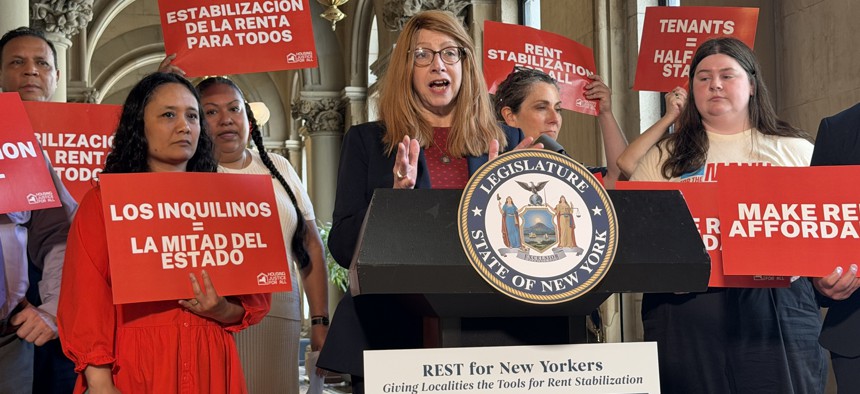
Assembly Member Linda Rosenthal said there was momentum to bring the REST Act to the floor before the end of session. Kate Lisa / City & State



As the number of scheduled session days dwindles to the single digits, leaving little time for lawmakers to advance nonbudget bills before they leave Albany on June 4, several Democrats have made it clear they have their sights set on expanding rent stabilization outside New York City. And state legislative leaders are seriously considering taking it up.
“Yeah, we’re talking about it,” Assembly Speaker Carl Heastie told reporters Wednesday as lawmakers started to debate and pass budget bills.
Current law, or the Emergency Tenant Protection Act of 1974, lets localities outside the five boroughs adopt rent stabilization, or place an annual limit on rent hikes, if they declare a state of housing emergency, or prove a housing vacancy rate of 5% or less through a vacancy study.. But state Senate Housing Committee Chair Brian Kavanagh sponsors a bill known as the Rent Emergency Stabilization for Tenants, or REST Act, that would allow localities to use more public data and tools to declare a housing emergency, like rates of homelessness or eviction rates, rather than a costly study.
“New York is really an outlier in terms of focusing so heavily on that one metric,” Kavanagh told City & State, later adding, “The bill is pretty straightforward and we think it does the job.”
Upstate municipalities have sparsely utilized rent stabilization despite a statewide housing crisis. The city of Ithaca funded a vacancy study, but it has not been done; while Albany conducted a vacancy study in 2024 that came back above the 5% threshold, or ineligible for rent stabilization. In 2020, the mayor of Hudson vetoed a resolution authorizing a $15,000 study citing cost concerns. The city of Kingston has imposed local rent control, but continues to battle litigation from landlords. Similar policies were struck down in the cities of Poughkeepsie and Newburgh.
In anticipation of similar legal battles, the REST Act was amended last month to no longer let upstate localities choose which buildings could be eligible for rent stabilization, and require buildings with four or more units to be included.
With that addition, it cleared both the Assembly Housing and Codes committees Wednesday – indicating momentum to be brought to the floor for a vote.
“It’s definitely showing movement,” Assembly Housing Committee Chair Linda Rosenthal told City & State.
Housing advocates joined Kavanagh, Rosenthal and several other lawmakers in the Capitol on Wednesday afternoon to rally for the bill’s passage in the next two weeks.
Democrats choosing to prioritize the measure in the end-of-session dash doesn’t come as a surprise after they made a point of holding a public hearing on upstate rent stabilization last fall. And it’s in keeping with the party’s political focus on affordability, both in Albany and on the campaign trail ahead of the June primaries. Housing Providers of New York State Executive Director Rich Lanzarone said that’s why Democrats are in a rush. “It’s politically sexy if you’re only thinking short-term,” he said.
But landlords and small property owners – including members of the coalition Homeowners For An Affordable New York – are ready to go to war over the proposal, and argue that rent stabilization has not worked in New York City and would only exacerbate the statewide housing crisis.
“New York cannot afford to turn the entire state into New York City’s housing disaster,” the organization said in a statement. “After more than 80 years of rent regulation, New York City still faces chronic housing shortages and deteriorating buildings—and the REST Act would export that failure statewide. It will mean less housing, less investment and higher costs for everyone.”
Lanzarone said upstate cities like Albany, Rochester, Utica and Syracuse desperately need reinvestment in housing to preserve existing units or to encourage new construction, and local rent control is the last thing struggling upstate localities can shoulder. The median gross rent in the city of Albany is $1,216, $1,046 in Buffalo and $1,469 in Kingston, according to a new report by the Community Service Society of New York.
Lanzarone said rents in those cities are already so low that buildings can’t support themselves. “It’s an income problem, not a rent problem,” he said. “If you’re thinking about the next election, this is great, because in a lot of these cities there’s more renters than landlords or property owners, so it buys votes. And by the time the buildings fall apart, those legislators are long gone.”
But Kavanagh, Rosenthal and other Democratic lawmakers argue landlords are just lying to pad their pockets.
“It’s not true,” Rosenthal said Wednesday. “No one’s forcing you to be a landlord, no one’s forcing you to reap millions. They want to jam us in the rest of the state. I say, mind your business, stay in the city, do your fight, which is what they do every year, but let the rest of the state thrive.”