

Albany Agenda
Confusion, legal questions surround ranked choice voting effort in city of Albany
Ranked choice, but no primaries? Albany Dems and progressives are teaming up to defeat a proposal that would end them.
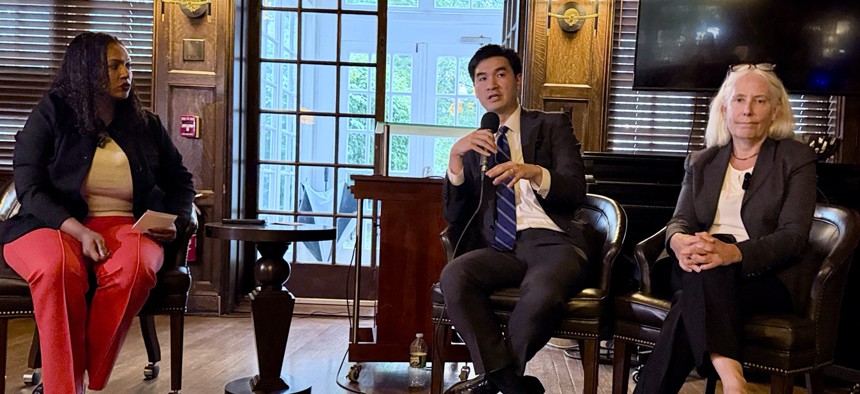
Attorney and Westchester County Legislator David Imamura, center, and election attorney Amy B. Marion, right, attended a forum in Albany on July 29 about a legal roadmap to achieve ranked choice voting. Unite NY Statewide Organizing Director Sherrise Palomino, left, moderated the panel. Kate Lisa / City & State New York


Advocates for ranked choice voting are making themselves known in Albany – but the version of the system they’re pushing looks very different from the one New York City adopted in 2019, the only other example in the state. And the effort’s getting messy after some residents and local officials signed a petition to put the issue on next year’s ballot without realizing exactly what it would do. Now, progressives groups who championed the system downstate have suddenly found themselves opposing a version that would outright eliminate primaries in the capital city.
The Albany City Clerk’s Office certified a petition last week circulated by the coalition Ranked Choice Voting Albany that would bring ranked choice voting to the capital city. But that’s not all: It would create a single, nonpartisan general election for local city races to be held on Election Day each November, and would completely abolish party primaries. Candidates from all political parties and independent candidates would appear together on the same general election ballot with party registrations listed next to their names.
“We really like the idea that it lets everybody have a voice,” said Dorian Solot, co-chair of Ranked Choice Voting Albany. “There are a lot of uncontested elections (here), and we realize with this small number of candidates in a small city, we really could save resources and have a simpler process.” She added the cities of Minneapolis, Minnesota; San Francisco, California; Portland, Maine; Burlington, Vermont; and others successfully use a similar ranked voting model that forgoes a primary.
The problem, however, is that New York City is not among the municipalities that use the nonpartisan system. Voters in the city adopted a version in 2019 that introduced ranked choice voting for municipal primary elections, leaving the general election contests untouched. And it’s the main – and highest profile – example others around the state have to go on.
Both Democratic and Capital District Working Families Party leaders initially signed on to the petition assuming Albany’s ranked choice voting would resemble New York City’s version – but now both have egg on their faces after realizing the proposal would eliminate primaries altogether. They expressed concern that doing away with primaries would violate the state constitution. And now they’ve joined forces to defeat the proposal in a rare partnership.
Multiple sources told City & State the Albany County Democratic Committee plans to sue the coalition over its proposal if it reaches the ballot over constitutional concerns. The Albany city clerk certified the petition and sent it to the common council, which could vote to put it on the ballot. Otherwise, the Ranked Choice Albany coalition would need to gather roughly 1,200 additional signatures before Nov. 1 to get a place on the ballot next year.
Solot defended the petition, and said election attorneys have advised the counsel it will hold up in court. “Just because the Constitution tells you how to run a primary, it doesn’t anywhere specifically say that a primary is required,” she said.
Albany Common Council Member Jack Flynn broadly supports ranked choice voting, and said he signed the coalition’s petition in the spring without realizing it would eliminate primaries in the capital city. “Then I started researching my own self, and I realized that the primary would be gone, and I was dumbfounded,” he told City & State in an initial interview. “I don’t think that the voters are even aware of this.”
(In a subsequent text to City & State, Flynn tried to walk back his comments, saying he did know the Ranked Choice Albany proposal would end primaries when he signed the petition.)
Yet Flynn introduced an Albany Common Council ranked choice voting proposal last month that would adopt New York City’s system, and keep both the primary and general elections intact. He initially said he introduced the measure to combat the Ranked Choice Albany proposal.
But many misunderstood the petition’s fine print. Ivette Alfonso, co-chair of the Capital District Working Families Party, said she also signed the petition without realizing it wasn’t modeled after New York City’s system. Alfonso said she was approached by a woman at a public event in the spring who asked if she supported rank choice voting, and signed the petition.
“Then I come to find out that it included eliminating primaries – they’re calling it ‘one unified election,’” Alfonso said. “I blank on that phrase because it’s so silly. I regret having just signed it.”
Another Albany resident who signed the petition, but declined to be named, said she too signed because she supports ranked choice voting, and the volunteer who approached discussed supporting “a single unified election,” but did not make it clear that meant ending primary day for city races.
Solot said the coalition has been clear about its proposal – its signs read “One election, everyone votes” – and members have given dozens of presentations about it around the city, including to every neighborhood association.
Other leaders from the Capital District Working Families Party were originally part of the coalition’s steering committee as well and were in favor of its proposal, but have since come out against it. Capital District Working Families Party Secretary Andy Kaier said primary elections have been critical in electing progressive candidates endorsed by the party. The party also supports fusion voting, where two or more political parties list the same candidate on a ballot, which RCV Albany’s proposal eliminates.
“We’re much more worried about the primary system in general because it's no secret that that's how the WFP has built its political power, both in Albany, in the Capital Region, and around New York state,” Kaier said.
Progressive Democratic Assembly Member Gabriella Romero, for example, ran on the Working Families Party line in a six-way primary race for the Albany Assembly seat in 2024, and won with about 30% of the vote, or 8.9% over runner-up Ginnie Farrell. Romero told City & State supports ranked choice voting as a whole to strengthen voter participation, but opposes open primaries in the state.