

Zohran Mamdani
Why is Mamdani suing the City Council?
New York City Mayor Zohran Mamdani’s office sued the City Council over legislation that would give paraprofessionals a one-time pay bump.
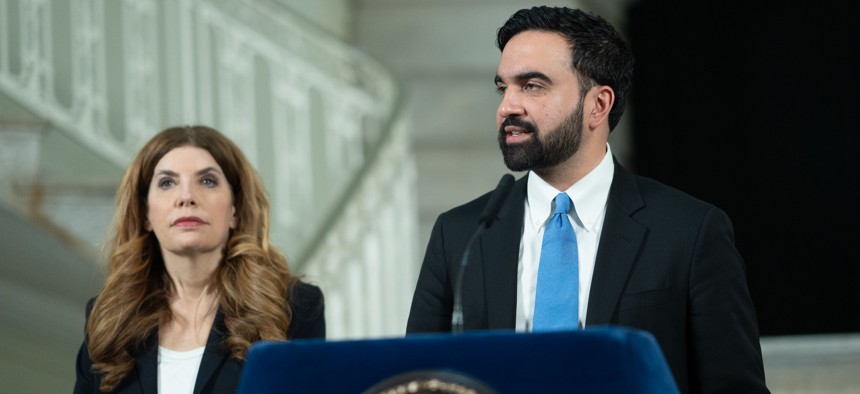
Mayor Zohran Mamdani and City Council Speaker Julie Menin hold a joint press conference in April 2026. Michael Appleton/Mayoral Photography Office


New York City’s roughly 39,000 paraprofessionals were in for a bonus of up to $10,000, thanks to a City Council bill that was set to become law this week. But an 11th hour lawsuit to block the law filed by Mayor Zohran Mamdani’s office on Wednesday has thrown those plans into a state of uncertainty.
Why is the Mamdani administration fighting a bonus for low paid unionized workers, one that’s being sold as a way to address recruitment and retention issues across city public schools? And what does it mean for the two sides of City Hall to be in a legal battle?
We broke it all down here.
What are paraprofessionals?
Paraprofessionals, sometimes called paras, are teaching assistants who mostly work in special education and early childhood education providing instructional services and supervision to students.
The city is facing significant recruitment and retention challenges for the position. Currently, paraprofessionals receive a starting pay of $32,098 and reach a top pay of $54,541 after 15 years or more of employment, per their current union contract. There are more than 25,000 full-time paraprofessionals employed by the city and an estimated 1,600 vacancies according to the United Federation of Teachers.
What is the bill that Mamdani is suing over?
Dubbed the RESPECT Check Act, this piece of legislation would require the city Department of Education to provide a one-time “workforce stabilization payment” of up to $10,000 for every eligible paraprofessional within the New York City public school system who worked within the 2026-2027 school year. The actual payments would be split among four paychecks over the upcoming school year.
The UFT has fought for paraprofessional pay raises in contract negotiations with the DOE but hadn’t come to an agreement, prompting the City Council to move forward with the bill.
“Every member of the council, in a unanimous and bipartisan vote, supported the RESPECT Check Act,” said City Council Speaker Julie Menin in a statement on the lawsuit. “The council will vigorously defend the law.”
The council also sees the bill as a way to mitigate “Carter cases” which are legal proceedings where families of children requiring special needs services seek reimbursement for private school tuition if the city cannot provide adequate accommodations. City expenditures for such proceedings ballooned to over $1 billion in 2025 according to the Manhattan Institute, a conservative public policy think tank.
Why is Mamdani fighting the bill?
The Mamdani administration has argued that the bill is illegal. Their lawsuit claims the legislation circumvents the standard collective bargaining process and undermines the DOE’s powers to negotiate and enter into agreements regarding paraprofessionals’ employment. Specifically, the administration is arguing that the bill is inconsistent with the Taylor Law, a state statute applied to all public sector employees which strictly regulates how parties negotiate terms and conditions of employment.
“The City Council has passed legislation that undermines collective bargaining and sets a dangerous precedent: allowing politicians to bypass workers and their unions and dictate the terms of employment themselves,” Mamdani spokesperson Matt Rauschenbach said in a statement this week. “A one-time payment does not solve the underlying, long-term pay inequities facing paraprofessionals. We will not allow the political process to replace the collective bargaining table.”
The administration also protests the precedent the piece of legislation would set for other unions to bypass collective bargaining and alternatively pursue pieces of legislation through the council to reach favored employment terms.
Why didn’t Mamdani just veto the bill?
Mamdani certainly could have vetoed the bill, but it wouldn’t do much besides prompt a protracted veto override process by the council, and one that was all but certain to have ended in Mamdani’s defeat. The legislation passed by a 49-0 vote in the council, which would allow his veto to be easily overridden Instead, he let it lapse into law and filed the lawsuit, leaving it up to the courts.
Who is backing the City Council?
Everyone from democratic socialist Council Member Tiffany Cabán to Republican Council Member Frank Morano voted in favor of this bill in a rare instance of unity in City Council chambers.
UFT President Michael Mulgrew isn’t exactly thrilled about Mamdani’s latest effort to stop the one-time pay raise from going through.
“The City Council would not have introduced – let alone passed – this bill if it were illegal, and we would not have supported a bill that threatened our collective bargaining rights,” Mulgrew said in a statement. “This administration must keep its promises, and we won’t stop until it does.”
The Legal Aid Society also voiced their support for the council bill in a statement released after the lawsuit came forward, saying in a statement, “We support the City Council’s efforts to ensure [paraprofessionals] they are fairly compensated for their vital work.”
Who is backing the mayor?
Despite a groundswell of support for the paras’ pay push, the mayor is not entirely on his own here.
There are some on Mamdani’s side who believe the entire process of collective bargaining in the city is in jeopardy as long as the bill passes.
“This bill and approach undermines the collective bargaining process and sets a dangerous precedent with real fiscal consequences,” said Ana Champeny, vice president for research at the Citizens Budget Commission, a budget watchdog group. “Our position has nothing to do with the merit of their claims regarding low pay and recruitment challenges. There is a fundamental process for how city and municipal labor unions set wages and terms of conditions of employment.”
And, in the odd couple pairing of the week, the New York Post Editorial Board backed Mamdani too, agreeing that the council bill improperly circumvents collective bargaining.
How rare is a lawsuit between the mayor and City Council?
Not entirely rare! Former Mayors Rudy Giuliani and Michael Bloomberg both went to court with the City Council during their respective tenures. Former Mayor Bill de Blasio faced off with a handful of City Council members who wanted to file an amicus brief in support of another party’s lawsuit against the city. And the City Council sued former Mayor Eric Adams for not implementing an expansion of a rental assistance program known as CityFHEPS.
That last suit carried over into the beginning of Mamdani’s term, giving him some experience already at facing the council in court. (Mamdani and Menin eventually came to an arrangement to end the lawsuit in the last budget deal after agreeing to increase funding to the program by $175 million.)
But this is the first fresh suit between the Mamdani administration and the City Council led by Menin. Mamdani and Menin’s relationship has experienced some recent points of tension – including the administration’s complete no-show at an oversight hearing on the pied-à-terre tax rollout this week. This lawsuit will likely cause some more tension, though neither side of City Hall is likely to say so.
What comes next in the lawsuit?
The council has 30 days to respond to the lawsuit. There is no telling how long this will play out in court, but the CityFHEPS lawsuit spanned several years.
The UFT and the city have started up talks again to resolve the paraprofessional pay issue, presumably because of the pressure the council has put on the mayor through the bill. The legislation specifies the pay bump would be repealed if a collective bargaining agreement is reached that increases paraprofessional pay at or above the level prescribed in the bill. The current UFT contract for paraprofessionals expires in 2027.
Editor’s note: The author of this article has a family member who is employed by the city as a paraprofessional.
NEXT STORY: Mamdani’s NYPD is still working with Israel