

Eric Adams
Eric Adams goes out fighting the City Council
Vetoes and a brand new charter revision commission marked the New York City mayor’s last day
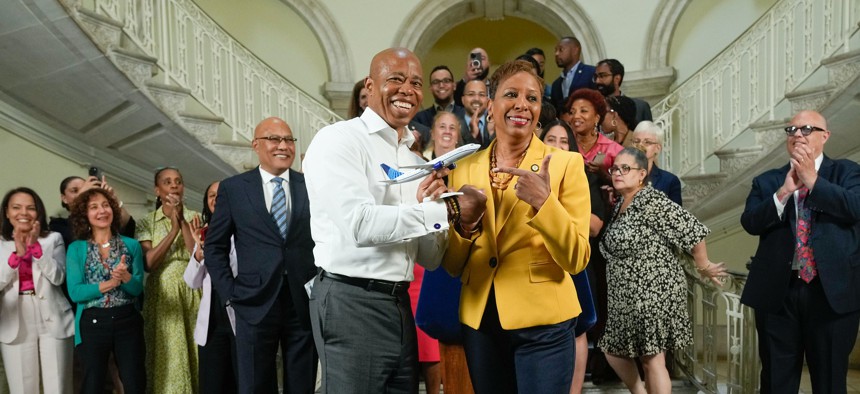
Mayor Eric Adams and City Council Speaker Adrienne Adams in happier times, shaking hands on the city budget on June 28, 2024. Michael Appleton/Mayoral Photography Office


Outgoing New York City Mayor Eric Adams did not go gentle into the good night. On his final day in office, he vetoed 19 different bills passed by the New York City Council and convened another charter revision commission – moves that'll no doubt stir controversy on his way out the door and spill out into the next administration.
Among the 19 pieces of legislation that received a last-minute veto was a bill that would expand a cap on street vending licenses, a bill that aims to protect ride-hailing drivers from unjust deactivations from their apps, a bill that would prohibit federal immigration authorities from keeping an office at Rikers Island, and a bill that would grant the Civilian Complaint Review Board direct access to police body-cam footage.
A series of bills relating to city-funded affordable housing were also vetoed. Another closely watched vetoed bill is the Community Opportunity to Purchase Act, or COPA, which would give nonprofits and other organizations a chance to purchase certain apartment buildings up for sale.
The full list of vetoed bills includes Introductions 125-A, 276-A, 408-A, 431-B, 479-A, 570-B, 902-B, 958-A, 1120-B, 1251-A, 1279-B, 1391-A, 1407-A, 1412-A, 1419-A, 1420-A, 1433-A, 1443-A and 1451-A.
In a statement, Adams explained that he vetoed the bills because they “run directly counter to (his) North Star of lifting up working-class New Yorkers.”
“These bills will worsen our affordable housing crisis with new, unfunded mandates and red tape, undermine our small businesses with an untested new licensing regime for street vendors, create entirely new bureaucratic processes when existing structures are more than up to the task, and violate state laws governing our labor and law enforcement systems,” Adams said in a statement. “My team has worked diligently and in good faith to find common ground with the City Council on our shared priorities, but the Council, once again, proved unwilling to temper its reckless legislation.”
The last minute vetoes puts presumptive City Council Speaker Julie Menin in a tough position as she enters the new year. Members will meet for the first time as a new City Council in early January, which would soon trigger the 30-day clock for members to vote to overturn the bills. At least two-thirds of the body are needed to do so successfully – though some of the bills, including the housing-related ones, were initially passed with a veto-proof majority. Ultimately, it’ll be Menin’s job to lead any override efforts, and she’s indicated she’s willing to do so on at least some bills. After the mayor vetoed a measure earlier this month that would open a new “lookback window” for victims of sexual abuse to file claims, Menin said that the City Council would vote to override.
In a short statement on Wednesday evening, Menin criticized the vetoes – and the Adams administration’s collaboration with the City Council more broadly – but stopped short of committing to fighting to override each veto.
“Rather than working collaboratively with the Council, the Adams administration has too often sidelined the legislative process. For years, agencies failed to provide basic data, commissioners skipped hearings, and meaningful negotiations were pushed to the last minute,” she said in a statement. “The Council will consider next steps on these vetoes to uphold our legislative priorities that focus on a wide range of topics, from justice for survivors of gender-motivated violence to tax lien reform to affordable housing.”
Outgoing Council Speaker Adrienne Adams, with four years of experience managing the City Hall power balance, was no less surprised. “It is unsurprising that this mayor is ending his term by demonstrating, once again, that protecting and supporting working-class New Yorkers is not his priority,” she said in a statement. “His vetoes put special interests above greater affordability and opportunity for hardworking New Yorkers, and public safety.”
Without directly calling on the next council to override the vetoes, she suggested she’d like to see as much: “These bills represent sound policies that the next Council should defend, protecting the Council’s legislative and policymaking authority.”
Adams didn’t leave his eleventh hour strike to the vetoes, though. Less than an hour before that, Adams convened another charter revision commission – one of his final acts in office, and another one that will elicit a fresh wave of outrage from the City Council.
Announcing a panel on the mayor’s last day is rare, if not totally unprecedented, and raises questions about how the commission’s work would actually proceed under a new mayor that seems likely to oppose its core mission.
Adams tasked the commission – filled with close allies of his including his former press secretary Kayla Mamelak Altus and housing activist Shams DaBaron – with exploring how to open up the closed primary election system. Democratic socialists like Mayor-elect Zohran Mamdani generally oppose such measures, which are thought to benefit candidates who are closer to the political center.
Adams spokesperson Fabien Levy disagreed with the idea Adams was hurting Mamdani by saddling him with an unwanted commission on his way out the door.
“Giving every eligible New Yorker the right to vote, how is that screwing an administration?” he said.
Mamdani’s transition committee declined to comment on either the charter revision commission, or the vetoes.
The matter of open primaries was something Adams’ last charter revision commission looked at advancing onto the November ballot alongside the housing and even election year measures that passed this fall. Commissioners opted to pull the open primary question over the summer, citing a lack of consensus.
If Adams’ newly created commission were to submit ballot questions for New York City voters, it would likely preempt the questions proposed by the charter revision commission kickstarted by Adrienne Adams in late 2024.
Her office responded to the mayor’s move with a scathing statement to cap their four years of tension where she regularly accused him of undermining the council.
“This mayor abused the charter revision process repeatedly and there are many guilty enablers of this anti-democratic conduct,” council spokesperson Mandela Jones said. “So it is no surprise that his abuses of power continued into the last day and final hours.”
This breaking news story has been updated with comments from Menin, Adrienne Adams and Levy and to clarify that Eric Adams vetoed COPA.
NEXT STORY: Eric Adams’ curtain call