

News & Politics
What does it mean to be on Mamdani’s transition committee? For most, an assembly and a 90-minute Zoom
The mayor-elect has solicited input from crowded virtual meetings and a digital recommendation form.
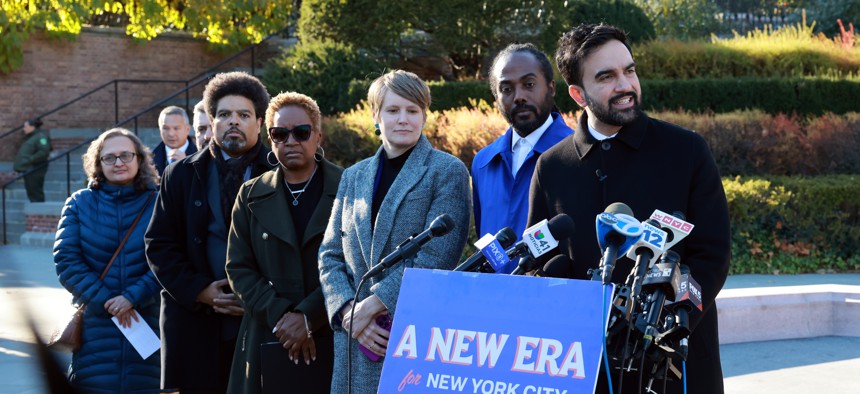
Mayor-elect Zohran Mamdani appears with transition committee members on Nov. 24. From left: Taxi Workers Alliance President Bhairavi Desai, Darrick Hamilton of The New School, Tara Gardner of the Daycare Council of NY, Open New York Executive Director Annemarie Gray, Brooklyn Children’s Museum Executive Director Atiba Edwards and Mamdani. Spencer Platt/Getty Images


In late November, New York City Mayor-elect Zohran Mamdani named more than 400 people to 17 transition committees that would be tasked with advising him as he sets up city government. He convened the chosen members at El Museo del Barrio in Upper Manhattan, and they were asked to sign nondisclosure agreements.
“I have entrusted them with a mighty responsibility to lead these committees and to provide the policy and hiring recommendations that our transition team will turn to as we prepare to begin governing on Jan. 1,” Mamdani said at a press conference after the two-hour event, which one committee member likened to a rally. “As we set a new standard of drive and dedication and a commitment to dignity from City Hall, those overseeing these committees will help lead this work.”
Each committee includes between 14 and 39 people, and they cover topic areas as broad as “social services” and “youth and education.” But interviews with 15 members sitting on 10 different committees indicate that their input has been limited. Committees are not interviewing candidates for city leadership roles or reviewing candidate resumes. They are not convening regularly to hash out policy implementation strategies.
For the vast majority of members City & State spoke to, their involvement on the transition (beyond the November event at the museum) amounts to one 90-minute Zoom call. Committee members spoke with City & State on the condition of anonymity because of their nondisclosure agreements.
The Zooms were attended by a transition co-chair and members of the transition staff, people said. Everyone was given the opportunity to speak, which sometimes strained the 90-minute planned limit. “Way way way too many fields were crammed into a committee with far too many people to accomplish anything substantive,” one member said. Several committee members, including ones who had served on previous mayoral transitions, said they felt the process lacked depth. “It seemed a little too ceremonial or symbolic,” one said. Some committee members organized meetings or outings beyond the one Zoom call – the Subcommittee on Transportation, Climate & Infrastructure field trip included a bus ride and a visit to a garbage barge – but without participation from the transition staff.
Several said that personnel recommendations, names for deputy mayors or commissioner appointments for example, were not sought at the official transition meetings. Rather, committee members were given a link to a digital form they could fill out recommending candidates for particular roles in city leadership. Another part of the digital form also allowed members to submit or reiterate their policy suggestions.
One member said the focus of the Zoom meeting was on policies that could be implemented quickly to make an impact.
“They’re looking for first 100 days stuff, no question, they’re pretty honest about that,” they said. Another said input is what the members make of it: “If you’re looking at this passively, then yes it’s a 90-minute Zoom. If you want to make it more impactful, figuring out who to refer and sending memos – all of that is available to you.” One committee member noted that people who have existing relationships with members of Mamdani’s inner circle will be able to do that follow-up more easily, but they said that transition staff who attended their meeting shared their contact information so the option was available to all.
Dora Pekec, a spokesperson for the Mamdani transition team, told City & State that all deputy mayors plan to meet with their relevant committees, and that transition work will continue until Jan. 30. She emphasized that the launch event was a meaningful gathering during which committee members connected and set up group chats where they have continued to keep in touch. She said individual committee members have been called for advice, and that several appointments, including Deputy Mayor for Housing and Planning Leila Bozorg and Corporation Counsel nominee Steve Banks, were recommended by committee members.
The Mamdani transition, like Eric Adams’ before it, is inclusive of hundreds of the city’s influencers. In addition to the 400 transition committee members, there is a 100-person elected official committee and an elite affordability loophole-hunting team led by former Federal Trade Commission Chair Lina Khan. Coordination with all of these people is happening in the span of just weeks. “It’s hard to get feedback from 400 people,” one transition committee member said.
Mamdani’s transition has opted not to hire an outside firm to manage the massive process, choosing instead to hire an in-house transition staff of about 80 people. After Mamdani’s victory, they almost immediately opened a public application portal, which Pekec said has already received at least 75,000 resumes.
“I think they had a real disadvantage in not having a broader network of people from various sectors before (the election),” one transition committee member said about Mamdani’s team. “That makes the personnel process harder.”
Two members of Adams’ transition committees told City & State they recalled a more in-depth process. “It was just nonstop meetings, countless meetings,” one said. Granted, Adams included 700 people on his committees, and there was a wide range of participation.
A few members said it’s hard to know whether their input is being applied yet because there haven’t been many major announcements about Mamdani’s administration picks or policy plans.
“I can’t tell you at this point how it’s measured up because there hasn’t been an announcement yet that has aligned with some of the things we are talking about,” one said.
Despite their limited input through the Zoom meetings, the transition committees’ 400 members have been closely scrutinized by Mamdani’s critics, including the Anti-Defamation League, and have been reported on by the New York Post. One report by the ADL contended that at least a fifth of the committee members had “a documented history of making or sharing anti-Zionist or anti-Israel statements.”
Several members said they plan to stay involved after the inauguration.
“If this administration thinks that they will have satisfied me as a committee member by having this process so far,” said one, “they are mistaken.”