

DSA
What’s a Socialist in Office?
DSA-endorsed lawmakers meet regularly with the socialist group to coordinate strategy.
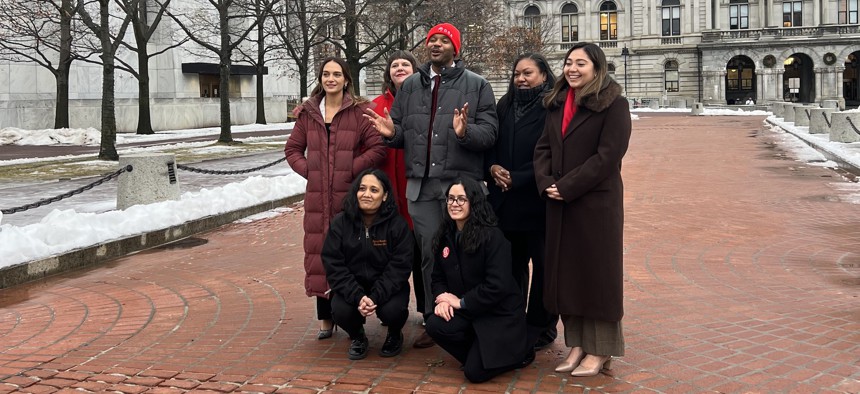
Members of DSA’s State Socialists in Office Committee pose in Albany. Back row: State Sen. Julia Salazar, Assembly Member Emily Gallagher, state Sen. Jabari Brisport, Assembly Member Marcela Mitaynes and state Sen. Kristen Gonzalez. Front row: Assembly Members Sarahana Shrestha and Claire Valdez. Courtesy of Claire Valdez


NYC-DSA’s relationship with elected officials goes well beyond endorsing candidates who seem ideologically aligned. The socialist group’s goal is to get its own members to run for office, manage their campaigns and then continue to work closely with them once they’re in office.
Once a candidate makes it through the organization’s lengthy and involved endorsement process – which involves an 87-question survey, live candidate forum and multiple internal endorsement votes – NYC-DSA will all but run their campaign. First-time DSA candidates tend to rely on fellow DSA members to staff their campaigns, run as a slate with other DSA-endorsed candidates and work closely with the DSA to organize volunteer canvasses and other campaign events. DSA candidates will also seek endorsements and support from other groups, like the New York Working Families Party and labor unions, but it’s always clear where their political home is.
If a DSA-backed candidate goes on to win, they’ll become a “Socialist in Office,” or SIO, and either join the State SIO Committee (for state lawmakers) or City SIO Committee (for New York City Council members). There are currently eight state SIOs: state Sens. Julia Salazar, Jabari Brisport and Kristen Gonzalez, and Assembly Members Emily Gallagher, Phara Souffrant Forrest, Marcela Mitaynes, Sarahana Shrestha and Claire Valdez. There are also two City SIOs: New York City Council Members Alexa Avilés and Tiffany Cabán.
Not all DSA members in elected office count as SIOs. Assembly Member Jessica González-Rojas and City Council Members Shahana Hanif and Chi Ossé are members of NYC-DSA but are not endorsed by the socialist group and have no formal relationship with the organization. Current elected officials can still apply to become SIOs – essentially, asking for a post-election endorsement. That’s how Gallagher became an SIO, and it’s a path that Ossé is now pursuing.
The SIOs work closely with NYC-DSA in ways that go far beyond the usual relationship that candidates have with community and activist groups. While plenty of lawmakers belong to caucuses and informal blocs, participate in strategy calls led by outside advocacy groups and host town halls to hear from constituents, only the DSA has created this hybrid model of “co-governance.”
The SIO committees include the elected officials themselves and their staffers (who are often DSA members), as well as representatives of NYC-DSA’s Citywide Leadership Committee, geographic branches and working groups focused on specific issues. The committees meet regularly, with the state SIO typically holding weekly virtual meetings and monthly in-person meetings. During meetings, members often discuss pending bills and strategize on how to win DSA’s legislative priorities. The committees are democratically run, with any member – not just those in elected office – able to suggest that the committee adopt a collective position on a certain issue or piece of legislation.
In some limited but very real sense, SIOs are willing to share the power they have as legislators with the DSA, agreeing to support the collective goals of the socialist organization despite their own personal beliefs. Few politicians are willing to make that sacrifice, which is why NYC-DSA is so focused on getting its own members – who believe fully in the idea of making decisions as part of a larger organization – into office.
As Zohran Mamdani once told City & State: “To be an unorganized socialist is a contradiction in terms.”
NEXT STORY: DSA members in their own words