

Budget
Ta-da! NYC budget gap is now down to $7 billion, Mamdani says
Two weeks and some budget magic goes a long way, the mayor revealed to state lawmakers Wednesday in Albany.
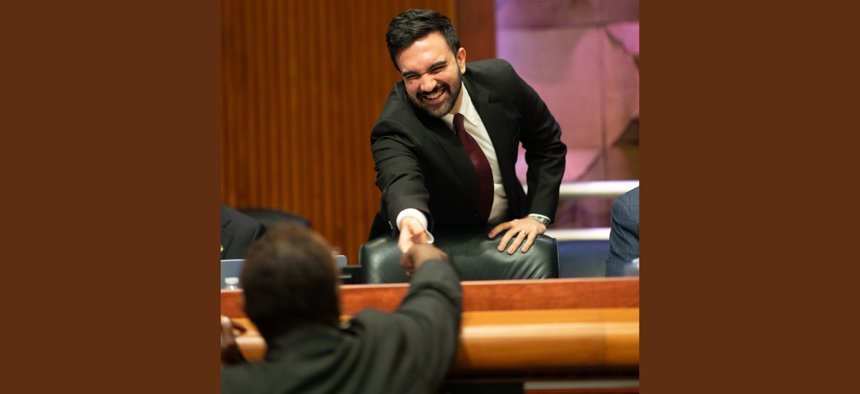
Yay! We’re magically $5 billion less in the hole. Michael Appleton/Mayoral Photography Office


Phew! What a relief! Mayor Zohran Mamdani returned to Albany Wednesday with a piece of happy news. New York City’s $12 billion two-year budget gap – presented by Mamdani just two weeks ago – has been significantly revised down to $7 billion. That’s due to an updated economic forecast including Wall Street bonuses, tapping in-year reserves and what Mamdani described as an “aggressive posture on savings” in the city’s own budget. That estimated gap is much more in line with what the Independent Budget Office, the Citizens Budget Commission, the Eric Adams administration and the previous New York City Council projected.
The less happy – but not surprising – news: Mamdani will still be asking for more state aid. “The imbalance in our relationship with the state is draining our city’s resources,” Mamdani told lawmakers, referring to his argument that the city sends more than its fair share to the state in tax revenue and doesn’t receive adequate aid in return. As he has before, he laid blame for that relationship at the feet of his mayoral race opponent and former Gov. Andrew Cuomo, rather than Gov. Kathy Hochul, with whom he maintains a delicate alliance, or the state legislators sitting before him. “We are calling to end the drain. This is not just a crucial first step, it is a key part of addressing the problem.”
Mamdani’s pitch to Albany lawmakers was familiar, mirroring the case he laid out at a budget address on Jan. 28 that blamed Mayor Eric Adams for chronic underbudgeting.
But neither Mamdani, nor the team of senior staff he brought with him, had much new information about how the city would find savings in its own budget in the near-term. City agencies were recently ordered to appoint “chief savings officers” to identify areas for savings and efficiencies within 45 days – an effort that Budget Director Sherif Soliman said Wednesday is expected to yield more than $1 billion in savings.
As for the rest of the money the city found in the last two weeks, $3 billion came from an increased revenue forecast – a combination of broader economic trends and Wall Street bonuses – and the remainder is from this year’s reserves, Soliman said at a press gaggle after Mamdani’s testimony. Overall, Soliman said that the city found $2.4 billion in additional revenue for fiscal year 2026 and $4.8 billion for fiscal year 2027. Administration officials did not immediately respond to questions about why that $7.2 billion in found revenue only amounted to a $5 billion total reduction in the expected budget gap.
Comparing this administration’s efforts to a broader savings tool under the Adams administration known as “Programs to Eliminate the Gap,” Soliman described the current efforts as going in with a scalpel rather than a “blunt instrument of across-the-board cuts.” While he mentioned as a broad example reducing spending on outside contracts as a target, Soliman offered no specifics. It’s also unclear how much the city will draw down from in-year reserves, which is a typical practice. Using in-year reserves is generally not a problem as long as there is a “sufficient cushion” left for fiscal year 2027, the Citizens Budget Commission’s Ana Champeny told City & State.
Mamdani said that he will be presenting his preliminary budget on Feb. 17, the day it is due.
Mamdani also called for a corporate tax hike and a 2% increase on income tax for people making over $1 million. That was predictably met with support by fellow democratic socialist lawmakers state Sen. Jabari Brisport and Assembly Member Claire Valdez, while Long Island state Sen. Monica Martinez and others argued that raising taxes will prompt businesses and families to leave the city. Mamdani countered that middle and working class families have already left the city due to its lack of affordability.
His testimony, the first of the day, garnered a lot of attention. Dozens of lawmakers questioned Mamdani for hours. At one point early on, Assembly Speaker Carl Heastie hovered in one of the doorways, observing the mayor’s testimony.
The tone was by and large amicable, though a few Republican lawmakers attempted to use their time to ask charged political questions rather than address budgetary matters.
Assembly Member Ari Brown asked Mamdani a series of questions about the 18 New Yorkers who died during the stretch of extreme cold, garbage on sidewalks and antisemitism before he was testily cut off by Assembly Ways and Means Committee Chair Gary Pretlow.
Allies also asked tough questions at times, seeking clarity on the Mamdani administration’s spending plans. "We are going to need details," state Sen. John Liu said, noting Mamdani has said little about his plan to ensure the city complies with a state law to lower school class sizes. Top education leaders recently testified that the city would need a significant increase in funds to be able to meet class size targets – at least $600 million a year would be needed to hire the necessary number of additional teachers alone. Anticipated construction costs to create additional classrooms would cost billions more.