

News & Politics
Amid ethics probe over Islamophobic tweets, Vickie Paladino is likely suing too early, experts say
She’s arguing her posts are protected from council discipline by the First Amendment, but, as one legal expert put it, “you can’t sue before there’s a definitive action.” Her lawyer says she shouldn’t have to go through an "unconstitutional process.”
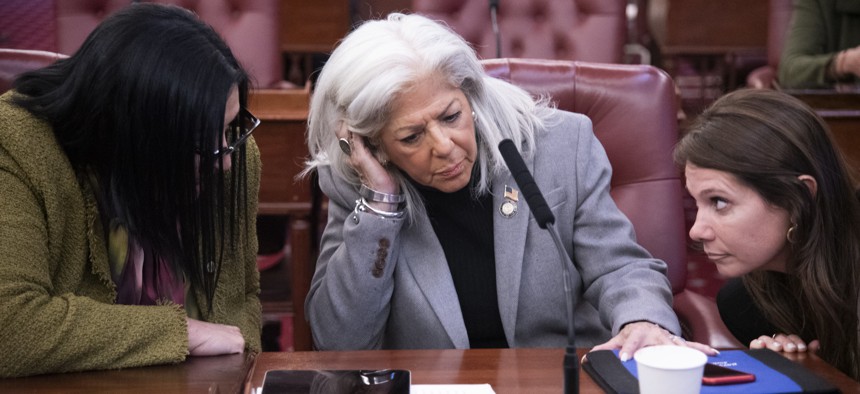
Republican City Council Member Vickie Paladino John McCarten/NYC Council Media Unit


With her free speech lawsuit, can New York City Council Member Vickie Paladino stop the council from punishing her for Islamophobic rhetoric? Experts we spoke to think probably not – at least not yet.
Paladino’s anti-Muslim social media posts are manifold. To name a few, she called for the “expulsion of Muslims from western nations,” described a photo of Mayor Zohran Mamdani praying with Muslim sanitation workers as “part of Islamic conquest,” and decried the appointment of a Muslim woman born in Brooklyn as the city’s chief immigration officer. “New York is under foreign occupation. There's really no other way to put it,” Paladino wrote. “Does this administration have one single actual American in it?”
It’s widely known in political circles that Paladino’s X posts are cowritten by her son, Thomas. Nonetheless, the council’s Committee on Rules, Privileges, Elections, Standards and Ethics charged her with “engaging in disorderly behavior” and for violating the council’s internal anti-harassment and discrimination policy. Paladino now has until April 17 to provide a written response to the charges she faces. She’ll then appear before the ethics committee in a closed door session. From there, the nine-member committee could order Paladino to complete sensitivity or ethics training, censure her, fine her, or, most seriously, expel her from the council. Any final verdict would need to be approved by two-thirds of the 51-member council.
But before the disciplinary process could continue, Paladino teamed up with attorney and former mayoral candidate Jim Walden to file a lawsuit against the council. Paladino argues the social media posts on her personal account were protected First Amendment speech and unrelated to her duties in the council. “The council intends to set a dangerous precedent for every legislator: if we don’t like your speech, we are coming after you,” her complaint states. A judge denied Paladino’s request for a temporary restraining order, but set a hearing for early April.
Legal experts we spoke to think that Paladino’s legal case faces a steep uphill battle, partly because no tangible consequences have been doled out at this point. Judges have historically had little power to halt the City Council’s internal procedures, according to Christian Browne, the former deputy director of City Legislative Affairs under then-Mayor Rudy Giuliani.
“It’s premature. You can’t sue before there’s a definitive action,” Browne said. “The judicial branch cannot enjoin the legislative branch from doing its business … A judge cannot tell the City Council ‘well you can’t hold a hearing.’ That’s a separation of powers issue.”
If the council ultimately chooses to fine or expel her, Paladino could have a case to argue her right to free speech, Browne said. Those consequences would raise tough questions about the council’s authority to enact punishments that aren’t strictly internal, like removing a duly elected council member without input from their constituents. There is far less precedent for those outcomes than there is ordering a member to complete training or censuring them.
Throughout its history, the City Council has only expelled one of its members: Andy King in 2020. The Bronx Democrat faced multiple ethics investigations for his treatment of female staffers and accusations of pocketing kickbacks. Before even getting to the point of expulsion, the council voted several times to implement less harsh punishments, such as a 30-day suspension, a $15,000 fine, and a mandate to attend sensitivity and ethics training.
Paladino by contrast has only been charged by the ethics committee this one time, though she’s previously been stripped of some committee assignments over things she’s said in the past. Several legal and council sources said they are doubtful Paladino’s first ethics investigation would culminate with her being fined or expelled from the body.
“Without knowing the specific details of the case I think that sensitivity training would be the likely outcome of what the committee determines,” said Jason Goldman, former chief of staff to then-Speaker Corey Johnson.
Asked about the decision to file the lawsuit now instead of after a specific discipline is decided upon, Walden said that “it’s not required that she endure an unconstitutional process.”
The council’s anti-discrimination and harassment policy states that the council does not “tolerate discrimination or harassment" on the basis of race, color, creed, religion, national origin, citizenship and a long list of other protected characteristics. Defining harassment as “any unwelcome conduct that negatively affects an individual,” the policy states that the council may also prohibit some “offensive acts or remarks” even if they are not severe enough to violate federal, state or local anti-discrimination laws. The policy applies to conduct that occurs at any “location that could be reasonably regarded as an extension of the workplace.” That includes calls, texts, emails and social media usage – be it from home, on personal devices or during non-work hours.
One of Walden’s central arguments is that Paladino’s social media posts “were personal advocacy on matters of public importance,” and thus protected under the First Amendment as they didn’t pertain to council business, they were made from her personal account, and they weren’t directed at current council members or staff. It’s unclear to what degree the council’s internal policy would hold up in court. Browne, the former deputy director of City Legislative Affairs, expressed doubt that it would if Paladino were actually expelled or fined by the council.
Justin Harrison, senior policy counsel at the NYCLU, said that while the First Amendment protects people’s right to free expression, it doesn’t prohibit a workplace from internally reprimanding an employee for violating legislative rules. “A government body can censure, denounce, or reprimand a lawmaker internally, but it can’t materially infringe on that individual's ability to function as a legislator,” he said.
It’s true that there’s little to no precedent of the ethics committee disciplining a council member over social media usage or speech alone. Former City Council Member Rubén Díaz Sr. was stripped from chairing a committee in 2019 for homophobic comments, and former City Council Member Kalman Yeger was removed from the immigration committee during a broader restructuring of committee assignments for saying Palestine doesn’t exist, but both of these actions were taken by the speaker outside of the formal disciplinary process.
Goldman, former council chief of staff, said Menin’s transparency about the charges Paladino faces has been “refreshing” in what’s historically been a closed-door process. The standards and ethics process has varied somewhat speaker to speaker. Menin for her part has expressed a desire to strengthen it and the council’s anti-discrimination and harassment policy.
But the lawsuit argues that Paladino is being unfairly targeted for her conservative beliefs. Describing it as “uneven enforcement,” it points to several examples of Democrats who weren’t disciplined by the ethics committee over things they said like when Council Member Chi Ossé wasn’t disciplined by the committee after he called President Donald Trump a “pedophile” or after the council’s Italian-American caucus filed an ethics complaint against him.
“It is clearly a selective prosecution," Walden told City & State. “Not only has it never been done before for the council (ethics committee) to go after someone based on their social media posts, but they selected a Republican with disfavored opinions. You can’t do that.”