

New York City
More New Yorkers voted last year than in any mayoral election since 1969
The NYCCFB’s annual Voter Analysis Report unpacks the massive surge in participation.
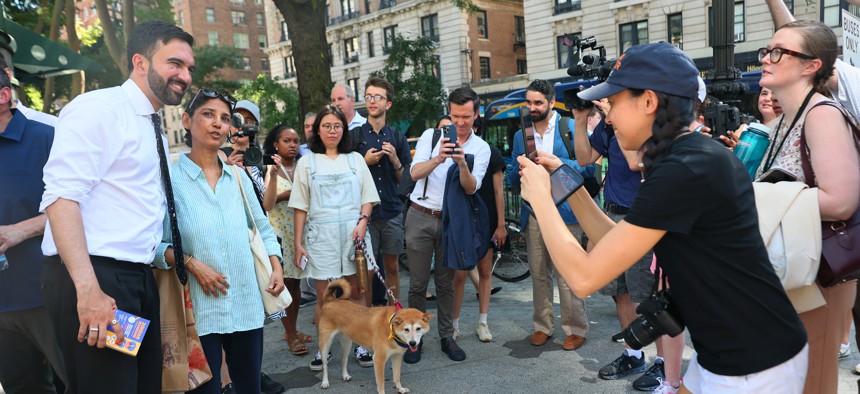
Zohran Mamdani greets voters on primary election day in 2025. Michael M. Santiago/Getty Images

Remember the 2025 New York City elections? The juggernaut campaign of Zohran Mamdani matched up against the Andrew Cuomo brand name transformed New York’s voting class, producing a surge in voter registration more typical of a presidential election year, spiking the voter turnout in both the primary and general elections, and juicing the number of voters under 40 who participated. At 2.2 million voters, overall general election voter turnout was higher than any city election since John Lindsay was reelected mayor in 1969. Almost 42% of registered voters turned out last year.
The 2025 voting figures are examined in the new Voter Analysis Report from the city’s Campaign Finance Board, the nonpartisan agency that educates voters and dispenses matching funds.
“The fact that general election turnout so far exceeded the last two citywide elections is really exciting in terms of just trying to make it more easy and accessible for more New Yorkers to participate,” said Amy Lebowitz, director of public relations at the Campaign Finance Board.
Here are some major takeaways from the report.
The DREAM slate made an impact, while many Cuomo voters only liked Cuomo
Almost 80% of voters used ranked choice voting on their ballots, slightly down from 2021, when the instant run-off voting program was first introduced. The most common single mayoral ballot cast was a ballot that ranked Cuomo first and ranked no other candidate. That combination of Cuomo and four blanks appeared on 15% of ballots. Of the ballots that used all five spots, the most common combination was a ballot that ranked Mamdani first, followed by Brad Lander, Adrienne Adams, Zellnor Myrie and finally Michael Blake. That combination appeared on 74,185 ballots. That was the “Don’t Rank Evil Andrew for Mayor” slate promoted by the DREAM for NYC super PAC – and closely matching the Working Families Party’s list as well. “That just says to me that a lot more people got a lot more organized around ranked choice voting in 2025,” Lebowitz said.
New, young voters surged
About 260,000 people registered to vote in 2025, more than twice the number who registered to vote in 2021. The total was in line with a presidential election year, when the city generally sees more participation. Almost two-thirds of those new voters were under the age of 30. Voters aged 18 to 29 turned out at triple the rate they did in the 2021 mayoral election. “We saw all of these stories about young voter enthusiasm, but when we went into the voter data, we were able to really bear that out,” Lebowitz said.
Unaffiliated voters are legion
Much of the action happens in New York City’s primaries over the summer – particularly the Democratic primary. That election takes place in June, but the deadline to register with a political party is Feb. 14, months before many voters are even aware there’s an election coming up. The Campaign Finance Board is recommending that the state Legislature change election law to align the party enrollment deadline with the voter registration deadline 10 days before the election to address that barrier. There are more than 1 million unaffiliated voters in New York City. It’s the second-most common party status behind Democratic. Almost half those unaffiliated voters are under 40. New York is one of 10 states that have closed primaries, which bar unaffiliated voters from participating, but the board stopped short of advocating for open primaries. A charter revision commission formed by former Mayor Eric Adams has been charged with considering open primaries for the city, but it may not get to put questions on the ballot, since Mamdani opposes its very existence.
Brooklyn dominates
Brooklyn led the boroughs in the number of registered voters, at nearly 1.7 million, and the percentage of eligible people registered to vote: 97.3%. About 395,000 Brooklynites voted in the primary, and 715,000 voted in the general election, more than any other borough by far.
NEXT STORY: How Mamdani was convinced to back Boylan