

Campaigns & Elections
There’s a lot of money – and competition – in the race to replace Rep. Jerry Nadler
Midtown Manhattan hasn’t had an open congressional seat in decades, so everyone’s watching NY-12.
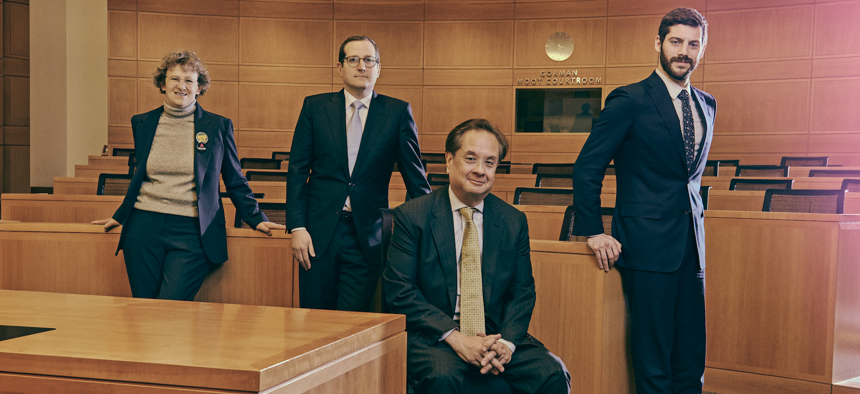
From left, Nina Schwalbe, Micah Lasher, George Conway and Alex Bores are all vying to replace Rep. Jerry Nadler. Guerin Blask

12th District
Midtown Manhattan, the Upper West and East Sides and Central Park.
TLDR: Schlossberg and Conway may have political star power, but most expect this to be another East versus West battle between Assembly Members Alex Bores and Micah Lasher.
Incumbent: None. Rep. Jerry Nadler is retiring.
Candidates: Alex Bores, George Conway, Laura Dunn, Micah Lasher, Jack Schlossberg, Nina Schwalbe, Chris Diep, Patrick Timmins and Micah Bergdale
2025 Democratic mayoral primary results (first round): Cuomo 37%; Mamdani 33%; Lander 21%; Other 10%
The Z factor: Mamdani hasn’t weighed in yet – and most expect it will stay that way, since no leading candidate is running to the left – though Mamdani political adviser Morris Katz has reportedly rallied support for Lasher.
The X factor: There is no shortage of candidates able to raise millions on their own in this race, but outside spending – by Michael Bloomberg and dueling AI PACs – will dominate.
What you need to know: There is no registered Democrat in the vicinity of Manhattan’s 12th Congressional District who has not heard about the hottest primary race in the borough this year.
You might have heard about it from the onslaught of mailers and ads warning you against the ex-Palantir employee now hypocritically (the ads tell you) calling for ICE to be abolished.
You might have caught wind of it through endless mailers paid for by former Mayor Michael Bloomberg in the past month, propping up another candidate as the only one with the track record and experience to take the district’s fight to Washington D.C.
Anyone on TikTok or Instagram has probably heard of the John F. Kennedy grandson running as both political legacy and newcomer, promising to succeed where Democrats have long failed: Messaging to voters.
And any of the district’s many Trump-hating, cable news-watching liberals will recognize the former Republican Never Trumper running as a newly registered Democrat.
These snippets of the race – driven by massive outside spending and the gravitational pull of celebrity candidates – form just part of the whole picture. The race is between nine candidates, four of whom have dominated the conversation and who promise a vision for New York that even they admit is largely similar: To fight tirelessly against an authoritarian regime in D.C., protect immigrants from deportation, champion liberal causes like abortion access and combat climate change. In short, to be the new Democratic stalwart in the deep blue, deeply affluent swath of Manhattan stretching from the Upper East Side and Upper West Side down through StuyTown and Chelsea. “This is one of the most informed, active congressional district electorates in the country,” Assembly Member Micah Lasher, a leading contender, told City & State. “Voters are looking to see which candidate can most effectively stand up to Donald Trump and reverse the destruction that he has rained down on the rule of law.”
Lasher, along with Assembly Member Alex Bores, social media commentator Jack Schlossberg and attorney George Conway, are vying to replace the existing stalwart: retiring Rep. Jerry Nadler. Nadler, represented the West Side of Manhattan for decades before the district was redrawn to include the East Side, forcing a primary contest between Nadler and longtime East Side Rep. Carolyn Maloney in 2022. (The West Sider prevailed.)
Close watchers describe it as an open race, though one that is likely between Lasher and Bores, the two current Assembly members representing the West and East sides of Manhattan respectively. There has been no independent polling, though one Conway-backed poll in February showed Schlossberg in the lead and Conway in second, likely a capture of name recognition before spending had picked up. A March poll, conducted on behalf of the Bores campaign, suggested that Schlossberg may have more staying power than some thought: he captured 22%, while Bores got 19%, followed by Lasher at 14% and Conway at 10%.
While none of the leading candidates is having any trouble fundraising on their own, spending in the race is being dominated by outside groups, including Bloomberg, who has endorsed Lasher and dropped millions to support him, and dueling PACs funding by artificial intelligence industry giants OpenAI (spending against Bores) and Anthropic (spending in support of Bores). Bloomberg’s super PAC has already spent $4.3 million in support of Lasher, while the anti-Bores super PAC has spent $2.4 million and the pro-Bores PAC has spent $1.2 million.
Some, including Bores himself, have theorized that the spending against him stands to help as much as hurt him. “It’s not fun getting negative mailers sent to my mailbox, text messages on my phone every day telling me what an awful person this mysterious Alex Bores is,” Bores told City & State. But he’s eager to publicize Trump donors who have donated millions to the umbrella group affiliated with the PAC – a fact he called “clarifying to voters” in a race where everyone is promising to fight Trump.
Despite their similar visions, the candidates have clear distinctions. Bores, a computer scientist by trade, is leaning into the AI angle, pledging to be one of very few in Congress who actually understand the global economic and social upending that AI could cause and is therefore prepared to regulate it.
Lasher, an Assembly member for less than two years, has a long career in New York politics and policy behind him, having previously served as Gov. Kathy Hochul’s director of policy and Bloomberg’s director of state legislative affairs. If anyone has an on-paper edge going into June, observers say it is Lasher, whose face and name are starting to flood the district in mailers and ads, and who not only represents the vote-rich Upper West Side but who has also pulled a few East Side Democratic club endorsements south of Bores’ Assembly district.
Schlossberg’s relative inexperience in local politics has shown in some policy forums, and he lacks the institutional backing of local power players or clubs. (Former House Speaker Nancy Pelosi, of California, has endorsed him.) His campaign has come out with a few policy proposals, including one aimed at stopping the flow of illegal guns into the state. Despite being a scion of the Kennedy family, he is making a moral high ground argument as one of the candidates not benefitting from outside spending. “I think money in politics is the reason that our party is seen as out of touch and is a real drag on our system and the credibility of our government,” said Schlossberg, who does not have a super PAC backing him (not yet, at least) and has pledged not to take money from AI companies.
Conway, meanwhile, has raised enough to fund ads highlighting his record of standing up to Trump from within his own party. That argument and his familiarity to voters, however, may struggle to stand out in a field of longtime Democrats who are also pledging to fight Trump.
Behind this throng, of course, are a handful of other drowned out candidates, whose chances of breaking through the noise are slim. While some close observers of the race have said that it lacks a real lefty candidate – notable in the age of Mayor Zohran Mamdani – Nina Schwalbe, a vaccine and public health scientist, is arguably claiming that lane. While her pitch is largely centered around bringing her health expertise to Congress, she’s declared herself a progressive who sees health care and housing as public goods and is skeptical of market-oriented solutions to those problems.