

Zohran Mamdani
Zohran Mamdani may not like Eric Adams, but he’s making many of the same choices
The mayor changes. The complex problems facing the city do not.
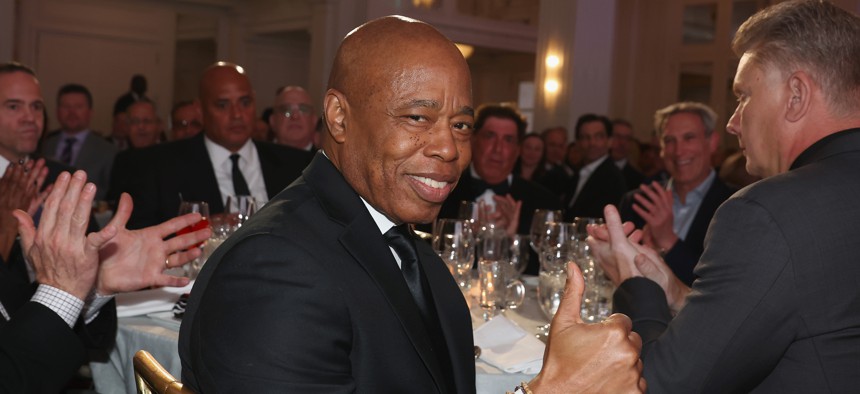
Remember that guy Johnny Nunez/WireImage



On his first day as mayor, Zohran Mamdani signed a pointed executive order reversing all of the executive orders his predecessor enacted on or after Sept. 26, 2024. That was the day former Mayor Eric Adams was federally indicted on corruption charges, “a date that marked a moment when many New Yorkers decided that politics held nothing for them,” Mamdani said.
That first action was a huge “fuck you” that drew attention to the lowest point of Adams’ one-term mayoralty and sought to assure New Yorkers that this new mayor would be different. But Mamdani’s second executive order hinted at a more complicated dynamic between the two mayors. That second, much longer directive was ostensibly meant to set up the structure of Mamdani’s administration, and that’s how it was described in his press release. But it also quietly reinstated half of the 20 executive orders from Adams that Mamdani had just repealed.
It was not the first time Mamdani tacitly decided to continue what Adams started while slamming his legacy, and it was certainly not the last, either. Though he rode into office on a wave of socialist enthusiasm and distaste for the incumbent mayor, Mamdani has, in many significant ways, carried on in Adams’ footsteps. He does this while taking swipes at Adams again and again, most notably in January, when he branded the city’s fiscal gap as the “Adams Budget Crisis.” Though that gap has shrunk from an estimated $12 billion to less than $5 billion since then, Mamdani said three months in office have given him no new sympathy for the ex-mayor.
“It’s hard to have all that much appreciation for a predecessor when you’re looking at systemic underbudgeting of long-term expenses that drive a city to face a generational fiscal crisis,” Mamdani said at an unrelated press conference Thursday. “My opinions about the mayor have not changed.”
There is little political alignment between the two men. But they are doing the same job, and the parallels in their decision-making point to the reality that the mayor has only so much power to enact structural change in New York City. The changes they can make – especially at the outset of a new administration – largely come down to comms and personnel.
On the campaign trail and early in his mayoralty, Mamdani pledged to diverge from Adams by dropping a lawsuit to stop the expensive expansion of city-funded rental vouchers. He said he would discontinue the budget games of the past and revolutionize the way the city handles public safety.
In practice, facing a multibillion-dollar budget gap, Mamdani appealed a court order to expand the rental voucher program, he made an ill-considered budget gambit in which he threatened to raise property taxes, and he has largely taken a hands-off approach to the NYPD, hanging onto Adams’ hand-picked police commissioner Jessica Tisch.
Mamdani said he would end Adams’ practice of forcibly clearing homeless encampments, then he restarted them two months later. Mamdani said that unlike Adams, he would be “Trump’s worst nightmare,” only to cultivate a similarly cozy relationship with the Republican president. He said he wanted to give up mayoral control of city schools, then reversed on that too – singing the same tune as Adams that, actually, the existing system was best for accountability.
After campaigning against him with poetry, Mamdani is now governing with some of Adams’ prose. “Mayors face many of the same structural constraints when they step into this job, whether it be around affordability, financial stability, with the city budget, public safety, relationships with other government leaders,” said Grace Rauh, executive director of the anticorruption group Citizens Union. “When you are mayor of New York City, you need the state, you need the federal government, … you need to have a balanced budget.”
And Mamdani, in the time-honored tradition of mayors, has rebranded many of Adams’ initiatives as his own. Mamdani has touted projects the Adams administration started, including legislation Adams signed to take down scaffolding (Adams called it “Get Sheds Down,” Mamdani ditched the moniker, and promoted “new efforts.”) He’s continuing the Adams administration’s trash containerization effort. Mamdani highlighted an initiative to provide free child care to city workers, which was piloted for Department of Citywide Administrative Services employees under Adams. He has trumpeted Department of Consumer and Worker Protection victories that resulted from the work of the previous administration, for example, reissuing a rule previously published under Adams to ban hidden hotel fees and theatrically celebrating a settlement with the food delivery app HungryPanda that was the result of the previous administration’s investigation. Despite this, his predecessor’s name rarely, if ever, came up.
As Mamdani makes child care his signature issue, he’s accused Adams of intentionally underselling the city’s subsidized child care programs, leaving Mamdani with another mess to clean up. In fact, Adams, who eventually touted enrolling a record 150,000 kids in the city’s early childhood programs, said the same thing about his predecessor.
The similarities even extend to snow day raunchiness. Adams famously told New Yorkers to expect a “good baby-making day” ahead of a snowstorm while Mamdani encouraged folks to stay home and read the popular hockey smut “Heated Rivalry.”
The most faithful chronicler of the legacy-busting is, of course, Adams himself. And by harping on it, the former mayor – whose credibility sunk even below rock bottom when he launched a scammy cryptocurrency this year – almost undermines himself. “1.When Eric Adams cleared homeless encampments to save lives, he was called cruel. 2.When he pushed for mayoral control, he was labeled a dictator,” the former mayor recently tweeted, characteristically referring to himself in the third person.
“I think motivation matters a ton,” said de Blasio administration alum Elizabeth Glazer, founder of the think tank Vital City. “Adams demonstrated over and over again that self interest was really what was driving things. It drove so many of his appointments of friends and family who … were not qualified, and it was manifest in the way in which he dealt with the president. So manifest that the judge reluctantly dismissing (his corruption) case … said ‘everything here smacks of a bargain.’”
Of course, there are plenty of meaningful differences between Mamdani, a millennial democratic socialist who grew up surrounded by Columbia intelligentsia, and Adams, the former cop and former Republican who grew up poor in Brooklyn and Queens. Mamdani has stacked his administration with respected bureaucrats from around the country, appointing not a single former elected official. (His appointments have included several Adams alums though, including Sherif Soliman, Vilda Vera Mayuga, Sideya Sherman, Ahmed Tigani and Leila Bozorg.) Unlike Adams, Mamdani has elevated “economic justice” over economic development, and he’s resurrected several Department of Transportation projects Adams shelved. Adams made a habit of showing up at the scene of an emergency in the middle of the night, while Mamdani tends to wait until the next day to show up in person. Adams loved schmoozing with the city’s elite at private clubs, while Mamdani, who’s skipping the Met Gala, mostly sticks to daytime appearances. And Mamdani has a very different base, a much younger one that is adept at social media and eager to amplify the narrative that he’s coming up with all these new ideas on his own.
So far, governing like Adams while criticizing Adams seems to be working OK for the new mayor. Some who worried Mamdani might lack the experience or the pragmatism to run the city are pleased he is more Adams-like than expected. “People thought (Mamdani) would be an inflexible ideologue,” said Stu Loeser, former Mayor Mike Bloomberg’s longtime press secretary. “But the really surprising part about him is how much he's changed his mind.”