

Campaigns & Elections
The rise of Tammamdani Hall
How Zohran Mamdani (and DSA) built a political machine that just can’t lose.

There's a new Tammany tiger, since the mayor’s political clubhouse is picking winners. Eric Palma



Shortly after Thanksgiving, democratic socialist Assembly Member Claire Valdez was invited to dinner at Union Square Cafe with some of the mayor-elect’s inner circle. Among them were Zohran Mamdani’s top political adviser Morris Katz, former campaign communications director Andrew Bard Epstein and policy adviser Sam McCann. This was not Valdez’s usual scene; the soft-spoken Democratic Socialists of America organizer and former union leader, then in her first year as a state lawmaker, was more used to discussing politics in Ridgewood dive bars than fancy Manhattan restaurants.
Halfway through the dinner, the mayor-elect himself showed up, fresh off a busy day of transition meetings. Mamdani was there to sell Valdez on an ambitious plan: He wanted her to run for Congress to replace Rep. Nydia Velázquez, a veteran lawmaker who had just announced her retirement. He told Valdez that she was the right person for the job, a leader of great integrity who could represent the interests of both DSA and organized labor in Congress. If she agreed to run, he said, he would be with her every step of the way.
Valdez demurred. This was not the first or last meeting that Valdez had with Mamdani’s team to discuss the prospect of running for Congress after a mere year in the Assembly, but she eventually agreed to do it. As so many New Yorkers have discovered over the past two years, Mamdani can be very convincing.
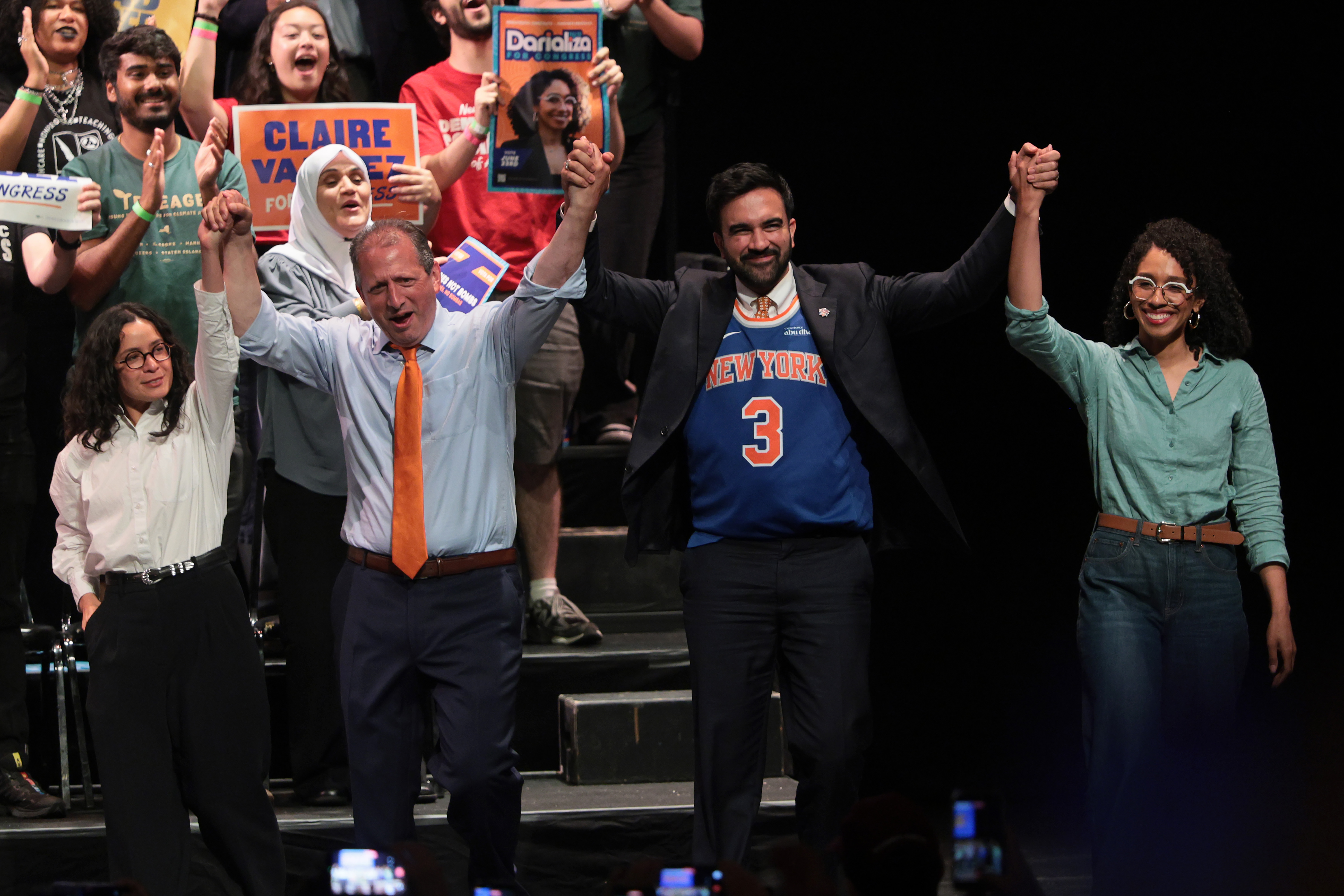
As soon as he won the mayoral election last November, Mamdani began laying the groundwork for another ambitious electoral campaign. He was not going to be content to rest on his laurels or focus exclusively on managing the city; he had a movement to help build. In addition to Valdez, whom he endorsed on day one of her congressional campaign, the mayor ultimately endorsed two other congressional candidates and five state legislative candidates.
These were not mere paper endorsements; the mayor devoted significant time and effort to assist his endorsed candidates – appearing with them in countless videos, speaking at fundraisers, hosting rallies and selfie lines, participating in canvasses and phonebanks. The work paid off; on June 23, all eight of his endorsed candidates won resounding victories.
Since winning the mayoral election, Mamdani has become the boss of a new political machine, one stronger than any mayor has had in generations. He built it by working in concert with NYC-DSA and navigating difficult relationships with other political players like the New York Working Families Party. This is the backstory of how the mayor got here, informed by conversations with those who helped build it.
Welcome to Tammamdani Hall.
***
In 1933, Fiorello La Guardia was elected mayor with a platform focused on combating the city’s endemic corruption and implementing socialist policies to deliver material gains to the working class. His immediate predecessor, John O’Brien, was a caretaker mayor who served for only a year following the sudden resignation of Jimmy Walker, a flamboyant mayor known for his love of the city’s nightlife who fled the U.S. under a cloud of corruption. Both Walker and O’Brien were creatures of Tammany Hall, while La Guardia won by running against the legendary Democratic political machine.
Once in office, La Guardia moved quickly to build his own machine and help his ideological allies win greater power. He campaigned for socialist congressional candidate Vito Marcantonio, who in 1934 was elected to represent the left-leaning neighborhoods in East Harlem – the 1930s equivalent of today’s “Commie Corridor” that spans western Queens and North Brooklyn.
Mamdani has made little secret of his admiration for La Guardia, and he now seems to be following the former mayor’s approach to electoral politics. The mayor has taken considerable risks to back his allies against the Democratic establishment – and they all paid off.
*****
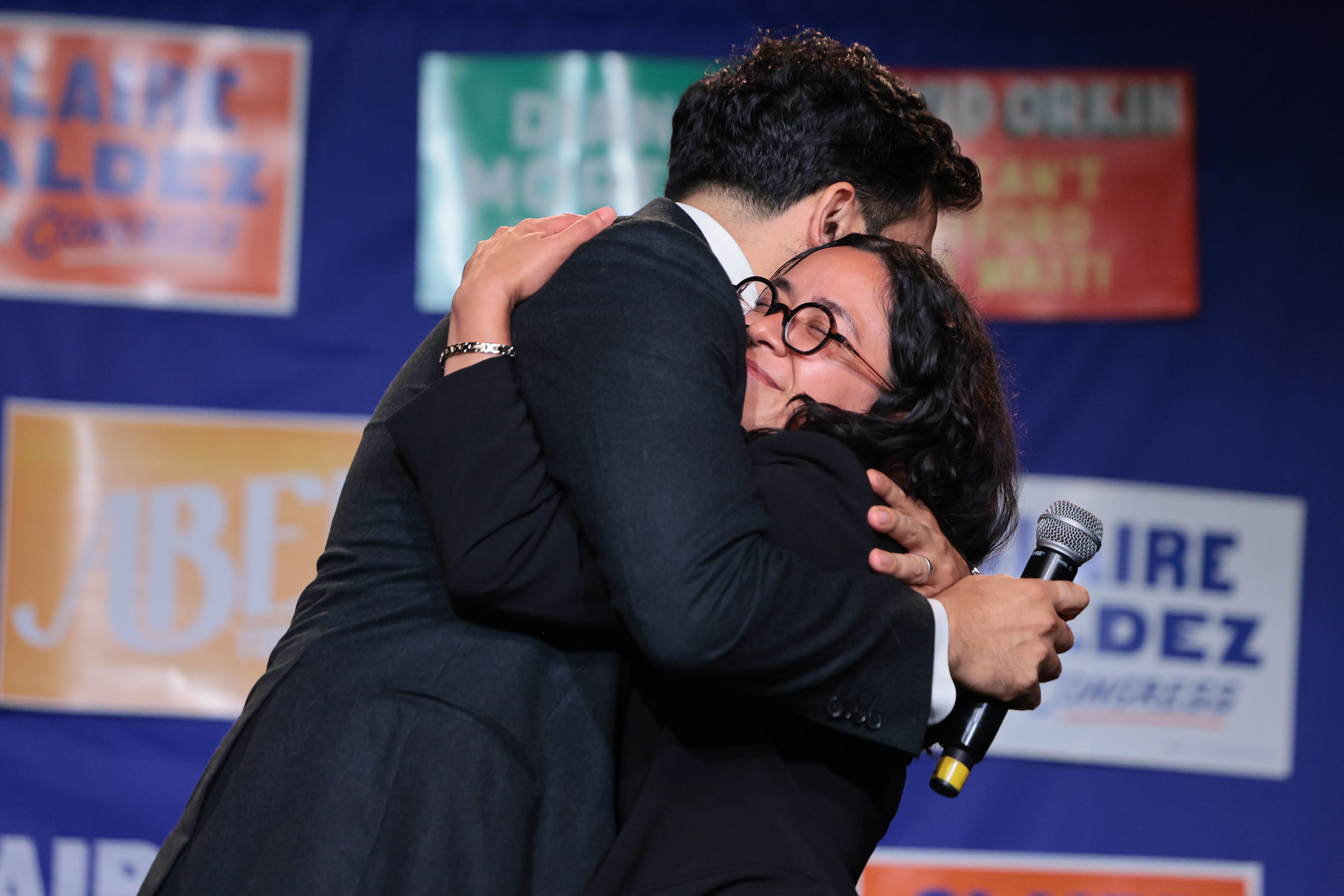
As soon as Mamdani clinched the mayoral election on Nov. 4, he and his team began working with NYC-DSA to figure out potential candidates to run in the upcoming midterm elections. He reached out to DSA members like Aber Kawas and David Orkin and encouraged them to consider running for state legislative seats.
As an early intervention to the 2026 elections, Mamdani made clear he’d be supporting his erstwhile mayoral rival Brad Lander’s primary challenge against Rep. Dan Goldman in the 10th Congressional District, which spans lower Manhattan and brownstone Brooklyn.
It would be a bold move to endorse against an incumbent member of Congress, but it wasn’t a huge gamble. A Data for Progress poll released months before Lander even entered the race showed him with a 19-point lead over Goldman, and Mamdani knew that Lander was beloved in the district, having represented Park Slope and surrounding neighborhoods for years in the City Council. Supporting Lander’s congressional bid would also provide a soft landing for the former mayoral contender, who had originally hoped to receive a top position in Mamdani’s City Hall, but was later informed that was not on offer. Lander had effectively converted his own mayoral campaign in the final days to help Mamdani, and the mayor found another way to reward him for his loyalty.
But there was one complication: NYC-DSA had already endorsed City Council Member Alexa Avilés, who was signaling her plans to run for Goldman’s seat. The mayor would need to maneuver her out of the race to clear the field for Lander, even if it meant crossing his political home. On Dec. 10, Lander launched his campaign, complete with a day one endorsement from Mamdani and a launch video produced by Katz. Socialists grumbled about Mamdani betraying DSA, but Avilés dropped out of the race the same day. Mission accomplished.
Avilés wasn’t the only socialist City Council member Mamdani had to keep from running for Congress. Council Member Chi Ossé, an ally who had recently rejoined NYC-DSA, was looking for the socialist group’s support to challenge House Minority Leader Hakeem Jeffries. Mamdani saw this as a fool’s errand. Ossé was an ambitious and supremely talented politician, but he couldn’t beat the future Democratic speaker of the House in a district filled with more moderate Democrats. And if DSA launched an all-out war against Jeffries, it could imperil Mamdani’s affordability agenda.
After failing to dissuade Ossé in private conversations, Mamdani took a bolder step. The mayor-elect, who’d become an international political celebrity, walked into NYC-DSA’s Electoral Working Group forum at a church in Greenwich Village and made his case on the microphone, personally discouraging members from endorsing Ossé. It worked. DSA narrowly voted not to endorse Ossé, who decided not to challenge Jeffries after all.
It was possible to look at these first couple moves and think Mamdani was moving away from his longtime political home of DSA. It soon became clear that was not the case.
*****
On Nov. 20, while DSA was still deciding whether to endorse Ossé, Velázquez shocked the New York City political world by announcing she would not run for reelection. The 17-term Congress member, affectionately known as “La Luchadora,” represented a swathe of western Queens and North Brooklyn that made up the core of Mamdani’s base. She had endorsed Mamdani before the mayoral primary and went to bat for him when many other established leaders were reluctant, or working against him. Velázquez did not immediately choose a successor, but it was widely expected that she would be replaced by one of her “godchildren” – a group of younger Latino elected officials she had mentored.
But Mamdani had his own idea about who should run for the district: his close friend and comrade Valdez. The two had worked together for years within the Queens branch of NYC-DSA, and Valdez had won election in 2024 to represent an Assembly district neighboring Mamdani’s.
But Valdez was not one of Velázquez’s mentees. Over the court of a half-dozen or so meetings between Mamdani and the retiring leader, Velázquez suggested a number of potential candidates to succeed her that she thought might be acceptable to Mamdani – DSA members whom she knew personally and trusted, like state Sen. Julia Salazar and City Council Member Tiffany Cabán, or even Avilés, who lived far outside the district boundaries. But Mamdani made it clear that he wanted Valdez.
This was not simply a personal preference. Mamdani knew that Valdez – who had served as NYC-DSA’s volunteer membership coordinator from 2020 to 2022, helping onboard new members – was beloved within the socialist organization, while there was less consensus around Salazar and Cabán.
In the days following Velázquez’s sudden announcement, Mamdani suggested Valdez should run for Congress, but she declined. “I had already told multiple people that I was not interested, and that I was really excited to throw my weight behind a different candidate, Julia Salazar,” Valdez told City & State. “So I said no in that initial call.”
Salazar had been the first DSA member to win election to the state Legislature back in 2018, but that had been a grueling race where she’d been forced to respond to opposition research about her personal life and background – which the media glare of a high-professional congressional race would like dredge up. As for Cabán, she had alienated the mayor and many in DSA by initially opposing Mamdani’s mayoral campaign and refusing to endorse him until late in the mayoral primary – and only after NYC-DSA’s Citywide Leadership Committee passed a resolution calling on all of the group’s elected officials to endorse Mamdani. She hadn’t shown loyalty to Mamdani, while Valdez had been with him on day one.
Valdez also had the full-throated support of her union, the United Auto Workers. Aaron Eisenberg, the union’s political director, told City & State that he texted Valdez within minutes of hearing about Velázquez’s decision to retire to ask whether she would run for the seat. Under UAW president Shawn Fain, the union has focused on recruiting its own members to run for office – and Valdez was a model candidate for that effort.
After Salazar publicly took herself out of the running, Brooklyn Borough President Antonio Reynoso – one of Velázquez’s “godchildren” – quickly launched his own campaign for the seat, and Valdez began to take the prospect of running for Congress more seriously. At the meeting with Mamdani and his inner circle at Union Square Café, she said she was at least open to the idea. “I said I would seriously consider it,” she said. “The asks at that time were just like, ‘leave the door open for this if you can.’”
While Mamdani tried to convince Valdez to run, he continued having conversations with Velázquez, in which he made clear he planned to back Valdez. Velázquez indicated she would back Reynoso if that were the case. Valdez finally made the decision to run in early December, while sitting next to her fellow socialist Assembly Member Emily Gallagher on an Amtrak train headed from the city to The Sagamore, a luxury Adirondacks resort, for the annual state legislative retreat. Mamdani’s political team swung into action. Epstein was dispatched to help set up her campaign, initially as interim communications director. He later took on the role permanently, acting as a liaison between Valdez’s campaign and Mamdani. Meanwhile, Katz produced a launch video for Valdez.
On Jan. 8, Valdez formally launched her campaign, and Mamdani appeared alongside Fain with Valdez in Brooklyn the next day to endorse her. But he had not given Velázquez a heads-up as to the timing of his endorsement of Valdez. The veteran pol felt disrespected and betrayed by the mayor she had once championed, and jokingly called “my boyfriend.”. A week later, she formally endorsed Reynoso and went on the record with The New York Times to criticize Mamdani’s involvement in local politics, warning him that “honeymoons are short.”
As the two coalitions took shape, with NYC-DSA and UAW endorsing Valdez while many other unions and nonprofit advocacy groups lined up behind Reynoso, Mamdani’s team made an aggressive and ultimately failed attempt to keep the Working Families Party from endorsing the BP. Reynoso had strong support from some of the most influential WFP affiliates – including New York Communities for Change, Make the Road Action, Churches United for Fair Housing Action and Citizen Action of New York – and the progressive third party’s New York City Regional Advisory Council ultimately voted to endorse him.
The race to succeed Velázquez soon turned into a proxy war between the socialist left embodied by Mamdani and DSA and the older, institutional progressive left embodied by the WFP – fracturing the coalition that had helped elect Mamdani a year earlier.
*****
Although Mamdani failed to kill the WFP’s endorsement of Reynoso, he did succeed in killing an even more consequential potential endorsement – that of Lt. Gov. Antonio Delgado. A former swing district Congress member, Delgado reinvented himself as a progressive insurgent after a falling out with Gov. Kathy Hochul and tried to primary her from the left. Many progressive groups welcomed the challenge, seeing it as a way to pressure Hochul on key issues like raising taxes on the rich.
The socialist mayor did not see it that way. He feared that challenging Hochul with a weak candidate – polls consistently showed her more than 40 points up on Delgado – would backfire, making the left look weak and dimming the chances of his agenda passing his agenda. Instead, Mamdani formed a strategic partnership with the governor – agreeing to endorse her reelection in exchange for, most notably, significant state funding for his landmark free childcare plans. Besides, Delgado was weak, and Mamdani didn’t owe him any loyalty. The lieutenant governor didn’t endorse Mamdani in the primary, but tried to claim his progressive energy the day after he won.
As part of Mamdani’s support for the governor, his team worked to block the WFP from endorsing Delgado. This was not easy, as major WFP affiliates had already endorsed Delgado’s primary challenge. But the mayor’s people were ultimately able to lobby enough members of the WFP’s state committee to prevent Delgado from winning an endorsement. He dropped his bid to challenge Hochul soon after, on Feb. 10
Mamdani’s support for Hochul also rankled his DSA allies. Two DSA state lawmakers – state Sen. Jabari Brisport, the mayor’s close friend and former roommate, and Assembly Member Emily Gallagher – had already endorsed Delgado, to put pressure on the governor to approve tax increases on wealthy New Yorkers and businesses. After Mamdani endorsed the governor, NYC-DSA released a rare statement distancing itself from the mayor’s decision.
*****
After Mamdani won the Democratic mayoral primary, he began to attract support from much of the Democratic establishment that had backed former Gov. Andrew Cuomo in the primary. That included Rep. Adriano Espaillat, the Upper Manhattan power broker and chair of the Congressional Hispanic Caucus who is widely seen as the leader of the city’s Dominican communities. The Hotel and Gaming Trades Council, along with other unions close to Espaillat that had initially backed Cuomo but threw its support behind Mamdani after the primary, helped broker a meeting between the veteran politician and the mayoral nominee.
After meeting with the young democratic socialist, Espaillat agreed to endorse him, but only after extracting a promise that Mamdani would back him when he faced reelection in 2026. Mamdani had little reason not to take the deal; at the time, he had no reason to think that Espaillat would face a serious primary challenge from a fellow democratic socialist – let alone one who worked on his own campaign.
By the time Mamdani won the mayoral election in November, though, the situation had changed. The mayor-elect soon heard from Katz that there was a “rock star” candidate exciting people uptown named Darializa Avila Chevalier, and that the Justice Democrats – the progressive group that had helped recruit her to run against Espaillat – was planning to go all-out to support her. In January, DSA also endorsed Avila Chevalier.
As Avila Chevalier’s campaign gained momentum, Mamdani repeatedly delayed following through on his promise to endorse Espaillat. The situation was untenable. The mayor had little love for Espaillat, who campaigned aggressively for Cuomo in the primary, but he understood there would be significant backlash if he reneged on his private deal with the member of Congress. At the same time, his base was increasingly excited about Avila Chevalier and he faced pressure from NYC-DSA to endorse the group’s full slate of candidates, including Avila Chevalier. The group’s leaders even met with him privately to make the case for him endorsing her.
“We talked about how DSA had grown so much in the Bronx and Upper Manhattan, that it's our fastest-growing area,” NYC-DSA co-Chair Gustavo Gordillo told City & State. “He cares about retaining the support and the trust of our members and leaders, because he knows how important that was to his election, and I think he knows that these endorsements are really big morale boosts internally in the organization. So I think that he wanted to keep that relationship in a good place.”
Ultimately, the mayor decided to take the risk and back Avila Chevalier. Some of the most powerful politicians in the state tried to dissuade him. Both Hochul and state Attorney General Letitia James called him in an attempt to get him to change his mind, to no avail. On May 28, Mamdani appeared on MS NOW with Avila Chevalier to announce his endorsement. Predictably, people close to Espaillat – including Velázquez, who already felt burned by Mamdani’s endorsement of Valdez – leaked the details of the mayor’s betrayal. Within DSA, the mayor’s endorsement was taken as a sign of his commitment to the movement; many in the group had doubted the mayor’s willingness to endorse against Espaillat, whose allies in the City Council and Albany could make life difficult for him.
But the mayor did not endorse the full NYC-DSA slate. Two days after announcing his endorsement of Avila Chevalier, the mayor unveiled his own slate of state legislative candidates. The mayor’s slate included DSA candidates running for open seats but not those challenging incumbent state lawmakers. It also included two progressive Assembly candidates that DSA was not supporting, Brian Romero and Eli Northrup
The mayor was unwilling to cross Assembly Speaker Carl Heastie by endorsing challengers to his incumbents. That led to an awkward situation where Mamdani declined to endorse Eon Huntley’s primary challenge to Assembly Member Stefani Zinerman, despite having backed Huntley’s previous challenge to Zinerman in 2024. He also refused to formally endorse David Orkin, a DSA candidate Mamdani had actually helped recruit months earlier to challenge Assembly Member Jenifer Rajkumar.
Mamdani did not leave those candidates entirely out to dry, though. He strategically appeared with Huntley and Orkin at events, and Orkin even put a photo of himself with Mamdani on his campaign mailers. When DSA’s army of volunteer canvassers knocked on doors, they would note that their candidates were part of the same political movement as the mayor – whether or not the mayor had technically endorsed them.
*****
In the end, all of the mayor’s political maneuvering paid off on June 23. All eight of the candidates he endorsed won their elections, as did all but one of the candidates endorsed by NYC-DSA. The mayor was instantly hailed as a kingmaker.
But unlike classic political bosses, Mamdani does not seem to be trying to build his own singular political machine. Instead, he’s maintaining a strategic alliance with NYC-DSA, his political home – and the very machine that helped elect him last year.
“He doesn't really have, like, a huge independent organizing apparatus,” Gordillo said of the mayor. “He has some staffers and some consultants that are maybe not DSA, but most of them are. So I don't think he's aspiring to set up parallel resources, really.”
Katz, the mayor’s adviser, is treating DSA as an allied army, praising the organization on a post-election panel with Citizens Union as “probably the most powerful political organization in New York right now by a pretty wide margin” with a “field apparatus that I think is unparalleled in terms of what it can actually do to mobilize voters.”
The mayor’s relationship with NYC-DSA is complex. The socialist group counts Mamdani as one of its own, and its leaders are in regular contact with him. He remains enormously influential within the organization, and most members are content to follow his lead, as they did when they voted not to endorse Ossé’s congressional run. But DSA doesn’t directly answer to the mayor. As a democratic and member-led organization, it charts its own path, even when that is at odds with Mamdani’s strategy. And the mayor does not always adhere to DSA’s line, either.
“The mayor is not DSA,” Valdez said. “He's a member of our organization, he's an incredibly important part of our organization, but we also have the right to criticize him, to hold him accountable in various ways.”
Usually, though, Mamdani and DSA are on the same side – united by a common goal of building socialist power. But in history, there’s a warning. An all-too-late endorsement from La Guardia in 1936 wasn’t enough for Marcantonio to win reelection. The mayor’s favored candidate had lost in a presidential year.
With reporting by Holly Pretsky and Jeff Coltin
NEXT STORY: Rafael Rubio, City Council staffer detained by ICE, is freed after 5 months behind bars