

Politics
Legal threats mount as law limiting ICE takes effect
As Gov. Kathy Hochul looks to crack down on 287(g) agreements, GOP leaders aren’t flinching.
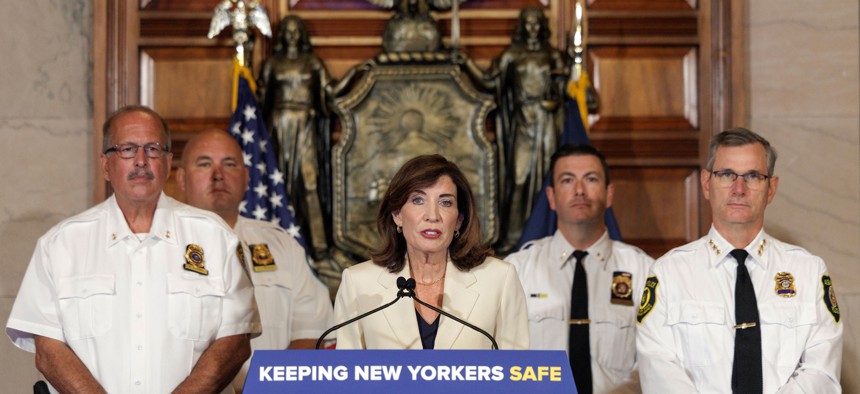
Gov. Kathy Hochul touted the implementation of a law banning local cooperation with U.S. Immigration and Customs Enforcement. Mike Groll/Office of Governor Kathy Hochul


A new state law officially took effect Tuesday prohibiting federal immigration officials from working with local- and state-funded law enforcement agencies for civil immigration enforcement matters. Now, it’s up to the state Attorney General’s Office to force the recalcitrant few municipalities that didn’t willingly wind down their agreements to follow the law. But if the responses from the Republican leaders of those defiant counties are any indication, the threat of getting sued by Letitia James doesn’t scare them much.
The new law prohibits local governments and police in the state from having formal partnerships – known as 287(g) agreements – with U.S. Immigration and Customs Enforcement and Customs and Border Patrol. Gov. Kathy Hochul argued on Tuesday the freshly effective statute will keep law enforcement’s attention on fighting local crime instead of advancing President Donald Trump’s deportation agenda.
“Local police will assist ICE only if a real crime has been committed,” Hochul said at a press conference about the law in the state Capitol. “New York state will never become a sanctuary for criminals. But at the same time … we will not sit idly by when ICE commits atrocities on our streets.”
Currently, only two counties have failed to give any response to the state indicating they wouldn’t dissolve their 287(g) agreements, with a third providing what James’ office called “an inadequate response.” The state Attorney General’s Office of Immigrant Trust issued subpoenas Tuesday to the Nassau County Police Department and Sheriff’s office, and the Rensselaer County Sheriff’s office for failing to confirm their plans to unwind their 287(g) agreements with ICE.
James also sent a subpoena to the Steuben and Broome County Sheriff’s offices, which gave an unsatisfactory response. Steuben County sent James’ office additional correspondence Tuesday afternoon and is in compliance, according to the Attorney General’s Office, but the subpoena is under review and remains valid.
Issuing subpoenas is a civil investigative demand for information and is the first enforcement step, but they don't seem to have phased GOP county leaders. Nassau County Executive Bruce Blakeman, the Republican running against Hochul in November, has indicated he’s not backing down. He recounted a recent crime where an undocumented person in his Long Island county was charged in connection with the alleged arson of 10 cars.
“If we didn’t have an agreement with ICE, that individual would have been sent back into the community and probably committed more arsons,” Blakeman said at an event in Delaware County. “What did they have to do, burn down a house with children in it to make Hochul realize these laws make us less safe?”
Likewise, Rensselaer County Executive Steve McLaughlin isn’t budging either, and said he’s ignoring the subpoena. McLaughlin said the county’s participation in the program since 2018 means officials screen noncitizens brought into the local jail to ensure they’re not wanted for crimes elsewhere, and it’s a practice he will not stop.
Though state leaders have spoken frequently about the importance of local officials following the law, Hochul and James haven’t spoken much about the specifics of actually ensuring compliance. The Attorney General’s Office will investigate agencies that do not unwind their agreement, which can lead to a civil action or a period where the office monitors the municipal entity, according to the law. Hochul deferred to James’ office while speaking to reporters Tuesday, but still offered little in the way of details.
“If they do thwart the laws that are duly enacted by this Legislature and the governor, the attorney general will be fully responsible for enforcement,” the governor said, adding it would involve litigation, and possible emergency court orders that would be instated quickly.
McLaughlin is leading a lawsuit filed by 15 sheriffs Tuesday in the Northern District of New York amid other concurring federal suits against the law. Madison County Sheriff Todd Hood, Blakeman’s running mate, is a plaintiff in the suit, but Blakeman is not. Hood agreed to terminate his agency’s agreement with ICE earlier this month. Blakeman has also been adamant his county’s 287(g) agreement isn’t changing, but has remained tight-lipped about his legal plans. His spokesperson declined to comment about either on Tuesday. Other sheriffs across the state are discussing filing a separate lawsuit to challenge the policy.
The law was partially upheld earlier this month, but a federal judge blocked a provision that bans police and ICE agents from wearing face masks. Even so, Hochul was unfazed by the legal threat. “Our law has been already upheld by courts, but if you try it again, I say bring it on,” the governor said. “The courts have already spoken, but I'm confident we'll win again.”
Nine of 12 police agencies that had formal 287(g) agreements have terminated their contracts, according to the state Attorney General's Office. But even without those specific contracts with ICE and Customs and Border Patrol, it remains up to a police agency’s discretion to contact ICE after an undocumented person charged with a crime is in their custody.
Albany Police Chief Brendan Cox and Kingston Police Chief Egidio Tinti, who both attended the governor’s press conference in Albany, said they would not contact ICE if their agencies charged a noncitizen with a crime, though other local law enforcement officials still could.
Complicating matters is the fact the law also bans informal agreements between federal immigration officials and local law enforcement. The state Attorney General’s Office has the authority to crack down on patterns of cooperation that amount to an informal agreement, and James has referred to an upstate county that used ICE for translation services as an example of what would now be an illegal informal agreement. But a spokesperson for James declined to comment on “hypotheticals” when asked when a pattern of police calling ICE about arrested immigrants may fall into illegal territory, and if or when it would intervene the office would intervene.
Hochul denies claims that the policy will erode public safety, arguing that 53 of 62 counties in the state never had formal 287(g) agreement to work with ICE.