

sponsor content What's this?
Sponsored Content
Climate Law Rollbacks Would Delay Pollution Protections & Cheap Energy Options New Yorkers Need Now
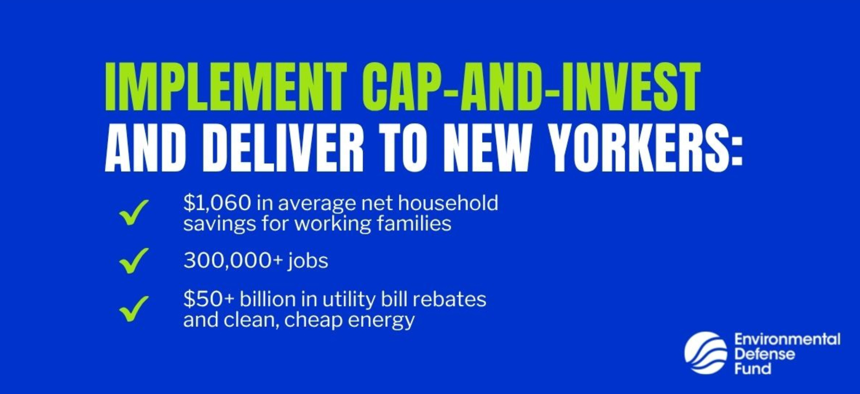
Consumer benefits of cap-and-invest over the program’s first decade, modeled by Greenline Insights. Environmental Defense Fund



New Yorkers are facing rising utility bills and unmanageable prices at the pump as fossil fuel prices continue to spike. There’s no question that addressing energy affordability must be a top priority for New York State leadership. As legislators debate proposed changes to the state’s landmark climate law (https://www.cityandstateny.com/policy/2026/04/what-happened-new-yorks-climate-goals/412959/), they must remember that slowing down the clean energy transition will only increase costs for New Yorkers and keep residents exposed to global price shocks.
Volatile fossil fuel prices have driven more than $1 billion (https://iranwarcost.watson.brown.edu/) in additional gasoline and diesel costs for New Yorkers since late February. Beyond costing us at the pump and in utility bills, we pay for fossil fuel dependence with our health. Cardiovascular and respiratory illnesses are directly linked to fossil fuel pollution, and those preventable diseases manifest in larger hospital bills, higher insurance premiums and unnecessary illness – especially for the communities living near polluting plants.
Gov. Kathy Hochul and legislators are right to prioritize affordability for their constituents. But that’s an issue the climate law can help solve. Policies like cap-and-invest – a centerpiece of implementing the law – aim to reduce dependence on price-volatile fuels and expand stable, clean energy options and efficiency upgrades that lower bills, all while curbing pollution in the process.
Well-designed cap-and-invest programs can deliver significant household savings, hundreds of thousands of well-paying jobs, billions in community investment and utility rebates, and major pollution reductions. Now two years overdue, New York’s cap-and-invest program would deliver $1,000 in net savings (https://www.greenlineinsights.com/new-york-clean-air-initiative) to 85% of New York households over the next decade, generate $13 billion in health benefits (https://capandinvest.ny.gov/Resources) and prevent 1,800 asthma-related emergency room visits annually by 2035.
Delaying cap-and-invest has a price tag: In the time since this program was slated to have launched, New Yorkers have missed out on $3 billion (https://www.edf.org/media/governor-hochul-delays-cap-and-invest-program-withholding-billions-benefits-climate-targets) in clean energy investments that would have lowered utility bills and decreased reliance on expensive and unhealthy fossil fuels.
As reported, these sweeping changes would make New York the first state to roll back a climate target by law and could remove any certainty about the pace of pollution reduction until 2050. These changes, if enacted, would leave communities vulnerable to the unchecked impacts of climate and air pollution, prolong fossil fuel reliance and cede New York’s role as a national climate and clean energy leader when that leadership couldn’t be more important.
As budget negotiations continue, the Legislature must prevent these sweeping rollbacks, and ensure New York has a plan to finally implement the climate law and scale investments in clean, affordable energy, starting with advancing the overdue cap-and-invest regulations as soon as possible.
And, the core of the state’s climate law must remain intact: mandatory interim benchmarks that drive down pollution. The most recently proposed changes threaten this, reportedly replacing a mandatory 2030 target with a more flexible 2040 target. Policymakers should not be debating whether a life-saving pollution reduction target 14 years from now is optional. Lawmakers must push for a mandatory 2040 target, ensuring near- to medium-term cuts in pollution that improve public health and mitigate the worst impacts of climate change.
This is what their voters want, too. Recent polling (https://library.edf.org/AssetLink/a116h6c1247l2017026a54852xv0o6c1.pdf) of competitive districts from Long Island to Buffalo found that voters would be more likely to support a state legislator who voted to continue implementing the state’s clean energy laws.
As state leaders deliberate changes to the climate law, they must maintain the core tools and investments needed to future-proof an affordable and healthy New York and implement proven and effective policies to cut costs and pollution right away. We can’t afford to wait.
Kate Courtin is Senior Manager, State Climate Policy & Strategy with the Environmental Defense Fund.
NEXT STORY: Choosing the Right Technology Partner Is a Mission-Critical Decision for Government Agencies