

Opinion
Opinion: Jewish CUNY students still need support
The next mayor should keep that in mind as he appoints members of the CUNY Board of Trustees.
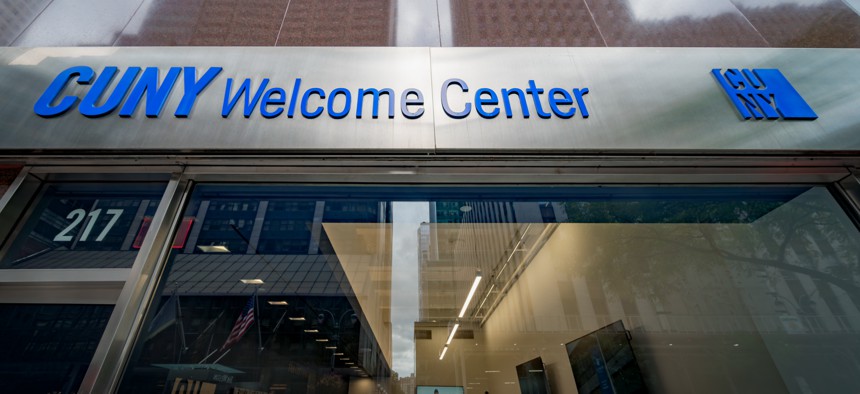
Council Member Eric Dinowitz says CUNY still needs to improve its support for Jewish students. Erik McGregor/LightRocket via Getty Images


CUNY students should be worrying about finals, internships and research projects. They should not be wondering whether they will be welcomed and safe when they walk onto campus.
For too many Jewish students, the basic question of safety has become a daily concern. This is unacceptable at any university, and especially at CUNY, which has long been the greatest engine of economic and social mobility in New York City. The situation demands urgency, and that urgency needs to be felt at all levels of governance.
Last year, CUNY received a level of independent scrutiny that was long overdue. The Lippman Report, commissioned by Gov. Kathy Hochul and led by former Chief Judge Jonathan Lippman, presented a clear analysis of campus climate and offered a comprehensive set of recommendations. Hochul responded with the urgency the moment required and directed CUNY to swiftly implement every recommendation, and reinforced that every student deserves a safe and respectful environment. The governor and Judge Lippman should be commended for bringing seriousness and accountability to this work.
CUNY has also entered into a Title VI agreement with the United States Department of Education, taking multiple steps to ensure better coordination and training across its campuses, which reflects the advocacy of students, faculty, community organizations and civil rights groups. Title VI protections are critical, as they protect our students against antisemitism, Islamophobia, xenophobia, racism and all forms of hatred that have been exacerbated in this climate. But thinking about change and achieving real change come at very different paces. As time has passed, there has been some progress, but some progress is not enough.
At a City Council hearing I convened last year after the release of the Lippman Report and after CUNY acknowledged the need for reforms, Jewish students revealed that the existing system continued to fail. They still felt targeted and isolated while complaints they filed disappeared without explanation. And a number of reforms called for in the report have yet to be completed, such as developing and auditing uniformity in training on antisemitism, finalizing a system-wide free speech policy and updating digital policy. I also believe that a clear and consistent definition of antisemitism would support these goals and ensure that all similar conduct be treated equally.
This is where the mayor must play a decisive role, as he has an essential voice in ensuring that the Lippman recommendations are implemented with urgency and that the Title VI agreement is met. The mayor has the opportunity and authority to ensure a safer CUNY environment for students.
The mayor appoints five members of the CUNY Board of Trustees. Under state law, trustees serve seven-year terms, and may remain in their seats after their terms expire until a successor is appointed and confirmed. Three of the mayor’s five appointees are serving on expired terms. This means the mayor can reappoint them or replace them. The responsibility is his, and the moment calls for action.
The future of CUNY depends on trustees who share a clear and uncompromising mission. It needs trustees who will ensure that students can focus on academics, extracurricular activities and career preparation rather than on whether they will face harassment. It needs trustees who will ensure CUNY remains the greatest engine of economic and social mobility. It needs trustees who will commit themselves to completing all 13 recommendations of the Lippman report and ensure that all Title VI requirements are met in full, with transparent timelines and a reporting system that students can trust. It needs trustees who will protect student safety and uphold free speech and academic freedom at the same time, not trustees who are placeholders or waiting on reappointment.
A mayor has the clear opportunity to determine the future of CUNY and shape the way CUNY is perceived as a welcoming institution of learning where debate is encouraged and discrimination and hatred are shunned, or leave the system with temporary leadership that has so far not acted with the urgency needed by the Jewish community. He can renew the terms of trustees who have demonstrated a firm commitment to this work, or he can replace them with new members who will treat the implementation of the Lippman recommendations as an urgent and nonnegotiable priority.
CUNY remains a powerful pathway to opportunity. Students deserve a university where they can devote themselves to their studies, their clubs, their research and their future careers without worrying about whether they will be targeted or marginalized. The mayor can ensure that happens by choosing trustees who will finish this work with urgency and conviction until it’s done.
Council Member Eric Dinowitz represents Council District 11 in the Bronx and chairs the New York City Council Committee on Higher Education.