

Opinion
Opinion: It’s time for abundance in specialized high schools
Almost 29,000 middle-school students take the SHSAT entrance exam each year, but only 5,000 of them gain admission to the city’s specialized high schools. Why not create more schools?
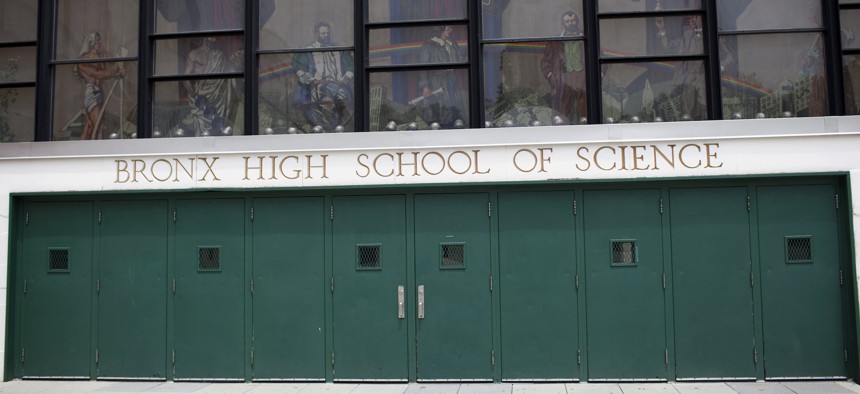
Mayor Zohran Mamdani is a 2010 graduate of the Bronx High School of Science, one of the city’s eight specialized high schools that admit students based solely on the results of a standardized test. Robert Nickelsberg/Getty Images


Mayor Zohran Mamdani represents a lot of firsts, but one thing about his background is generally overlooked: he is the product of the New York City school system – both private and public – and is less than two decades removed from his senior year at the Bronx High School of Science, one of New York’s crown jewels of public education.
He’s not the only one with a connection to the city’s specialized high schools. At last week’s inauguration, Mamdani (Bronx Science) was sworn in alongside Public Advocate Jumaane Williams (Brooklyn Tech graduate); sitting in one of the prime seats behind the mayor was former Mayor Bill de Blasio (father of a Brooklyn Tech alumnus); right behind him was outgoing Rep. Jerrold Nadler (a graduate of Stuyvesant High School), whose likely successor is Assembly Member Micah Lasher (a fellow Stuvesant graduate), and next to Nadler was Sen. Chuck Schumer (proud father of a Stuyvesant alumnus).
Beyond prominent politicians and their children, these high schools have produced numerous Nobel Prize winners (in 2023, Bronx Science grad Claudia Goldin won a Nobel in economics for her groundbreaking research in gender pay inequities) and titans of business (Bally’s owner and recent casino license winner Soo Kim is a Stuyvesant graduate). Two of the top physicists in the world – Harvard’s Lisa Randall and Columbia’s Brian Greene– were classmates of mine at Stuyvesant in the late 1970s.
As Mamdani takes the reins of government and installs his handpicked Schools Chancellor, Kamar Samuels, their new initiatives in 2026 will be closely watched by tens of thousands of parents around the five boroughs.
Mamdani’s campaign promise to eliminate Gifted & Talented testing for kindergarteners and Samuels’ record of replacing those programs in northern Manhattan will likely upset the large legion of New York parents who are eager for their children to be enrolled in schools with accelerated learning.
The perennial knock on the three top specialized high schools – Stuyvesant, Bronx Science and Brooklyn Tech – is the dearth of students of color each year who pass the sole criteria for admission: the Specialized High School Admissions Test (SHSAT). There’s a lot of sociological reasons for this disparity, not the least of which is the intense and long-term test prep for these exams in many Asian neighborhoods in New York.
I know this phenomenon first hand because I was inadvertently one of its pioneers: in 1986, while I was doing a two-year stint as a Stuyvesant English teacher, I was hired by an academy for young Korean students in Flushing to tutor their 3rd and 4th graders each Saturday for three hours in the English portion of the SHSAT. It was one of the first “cram schools” in the city, which helped young Asian students get a big head start in test prep. (Two of my children took test prep for six months before their own SHSAT exams. Both gained entrance to a specialized high school but chose to enroll elsewhere).
Five years after I started teaching that class in Flushing on Saturdays, 25 of my 26 students gained entrance into Stuyvesant or Bronx Science, an amazing outcome. Today, three decades after my first class at the Elite Academy, Stuyvesant’s enrollment is 72% Asian. Last year, unfortunately, the enrollment of Black or African American students was less than 2%. (Enrollment of Black students peaked in 1975 at 12%.)
Every year in the spring, the demographic results of these exams are announced and inevitably The New York Times will write a story about the meager amount of African American and Latino students admitted. There will be outraged criticism from some elected leaders about this “segregation,” and there will be calls to change the nearly century-old admissions system which relies solely on one’s SHSAT score. Within days, everyone will realize the test is too entrenched, will move on and nothing really changes.
But there is a relatively easy fix for this issue: just create more specialized high schools, and let the mayor and the chancellor set new criteria for admission to these specialized high schools.
For example, the Department of Education could create a Stuyvesant 2 in Harlem and use both the SHSAT test and middle-school grades as criteria for admission. They could say that the top 5% of students in each district middle school are guaranteed admission as long as they meet some minimum criteria on the exam. This will ensure racial diversity and would not pit one racial or ethnic group against each other in a zero-sum game.
Similarly, the DOE could create a Bronx Science 2 in the South Bronx and a Brooklyn Tech 2 in East New York. These new programs would be much better integrated and allow the top middle-school students in those neighborhoods to get a top-notch education and be on an accelerated track to the best colleges in the nation.
Just like Zohran Mamdani did in 2010 and Jumaane Williams did in 1994.
I’ve been ringing the bell on this vexing problem since 2011, when I wrote a column in the Daily News highlighting the shameful dwindling number of students of color being admitted to these specialized high schools, particularly Stuyvesant and Bronx Science. It became a key issue I spoke about in my unsuccessful run for mayor two years later.
In 2018, I co-wrote a column in City & State with then-Council Member Rafael Espinal advocating the creation of more specialized high schools. Then-Council Speaker Corey Johnson was interviewed on WNYC’s Brian Lehrer show about this idea, and he enthusiastically supported it.
But the de Blasio administration and then the Adams administration did nothing to correct this educational missed opportunity. When I first called out this inequity, Mamdani was a freshman at Bowdoin College. Now, 15 years later, we are no closer to a solution.
That’s why I’m hoping that the new mayor, a Bronx Science alumnus, will instruct his chancellor and his DOE to embrace the “abundance model” and create new specialized high schools in each borough.
Don’t those 24,000 middle schoolers who take the exam each year and fail to gain admission, and their disappointed parents, deserve a better chance at getting the type of accelerated education they crave? If “abundance” can work to solve affordable housing, it’ll surely help solve some of our public education woes.
Tom Allon is the founder and publisher of City & State. He is a 1980 graduate of Stuyvesant High School, where he taught English and Journalism in 1986-1987.
NEXT STORY: Opinion: The 40-year debate over school governance