

Opinion
Opinion: A Black History Month call to reform New York’s mental health courts
The Treatment Court Expansion Act will help dismantle the racist systems that historically criminalized behavioral health diagnoses in Black communities.
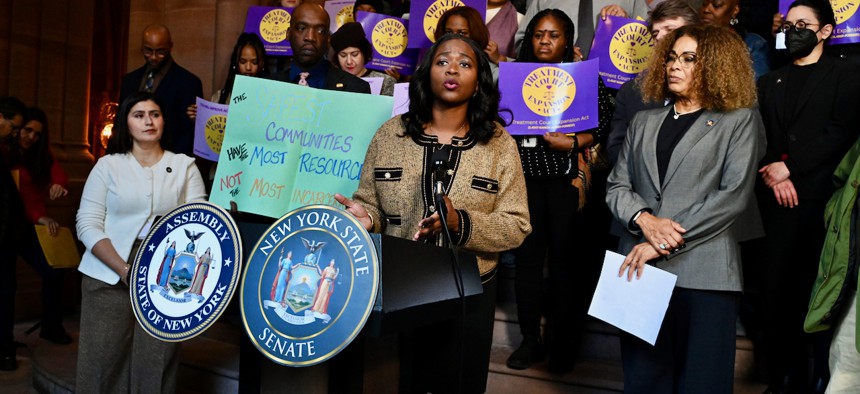
Assembly Member Phara Souffrant Forrest speaks at a rally in support of the Treatment Court Expansion Act. Eliza Colón / Bronx Defenders


Black History Month is a time to honor Black resistance, survival and the long struggle for liberation. As this month comes to a close, I call on our community to remember one of the greatest – yet oft forgotten – tools of oppressing Black activists throughout American history: the weaponization of mental illness.
Indeed, the legacy of this systematic pathologization of Black activism against white supremacy continues to have implications today and is directly connected to the overcriminalization of Black men and women who suffer from mental illness. This hideous dynamic weighs heavily on me as a nurse, Assembly member and Black New Yorker, and it is a key reason I am sponsoring the Treatment Court Expansion Act (TCEA), a state bill that would connect those who are arrested due to underlying mental health conditions to the treatment and services they need, rather than sending them to jail and prison.
In the 1800s, bigoted quackery produced pseudoscientific psychoses like “drapetomania,” the purported mental illness of a person trying to escape slavery. Racist clinicians posited that slavery quelled the minds of, and was the natural state for, Black people. Abhorrent fictions of inferior brain functioning and biological deficiencies rationalized a dual system of care for nearly 200 years, forcing psychiatrically-committed Black individuals into manual labor in traumatizing, wretched conditions, rather than the healing institutions of their white counterparts.
Many practices resisted civil rights reform. Schizophrenia was medically redefined during the Civil Rights Era to include “aggression” and “hostility,” reflecting efforts to psychiatrize Black activism. It was even described as “protest psychosis.” Asinine assertions of “aggressive feelings” and “delusional anti-whiteness” were attributed to Black people involved with the very advocacy groups like Black Power and the Black Panthers we celebrate this month.
Reaction to substance use in Black communities is similarly subjugating: Nixon’s racist war on drugs and the 1986 Anti-Drug Abuse Act yielded Black men’s imprisonment on drug charges at 13 times the rate of white men’s, with harsher and longer sentences.
This legacy of racism in mental health casts a shadow over today’s mental health care treatment for Black people. Too many of the genuinely sick are sent to the latest iteration of social control – the carceral system. White suffering is viewed differently.
Our state has explored diversion opportunities, treatment courts connecting people to services aimed at treating the root causes driving “criminal” behavior. They have had impressive success.
But the tale of treatment courts is one of racial inequity. Opioid Courts, for example, embrace a remarkably empathetic, healing-focused courtroom ethos. They allow enrollment without requiring an unwell person to first plead guilty or forfeit any of their constitutional protections; immediately connect participants to services; and are guided by proven best practices, including the tenets of harm reduction. For their overwhelmingly white participants, they are life-changing. Notably, this public health response is in stark contrast to how the crack epidemic, affecting mostly Black people, was handled: as a public “safety” issue, with major crime legislation being passed, ushering in an era of mass incarceration.
Black History Month calls on us not only to remember this history, but to change its trajectory. We must stop the cycle of racist subjugation. Learning from these opioid courts, let’s adopt the same public health-based approach for substance use, mental health and cognitive and intellectual concerns alike, ensuring all people in need receive the same connection to treatment.
The Treatment Court Expansion Act would accomplish this, establishing such access in every county of New York, providing clinically appropriate, non-institutionalized treatment. TCEA addresses the concerns that drive individuals to become involved in the criminal justice system in the first place, substantially reducing recidivism and lessening carceral populations. TCEA will prioritize healing over punishment, save money and improve the lives of greater numbers of people in need. TCEA is also a vital step in dismantling deeply ingrained, racist systems that historically criminalized behavioral health diagnoses in Black communities.
As we honor Black history, we must support this legislation, committing to a future where mental illness and substance use are no longer pipelines to prison for some, shaped by centuries of racism and control, but rather pathways to healing and dignity for all.
Phara Souffrant Forrest is an Assembly member representing Assembly District 57 in Brooklyn. Before being elected to the Assembly in 2020, she worked as a maternal child field nurse, caring for new mothers after they gave birth.
NEXT STORY: Opinion: How career pathways in health care help all generations of New Yorkers