

New York City
Eric Adams’ last-minute charter revision commission is hell bent on meeting ‘imminently’ – and self-funding if necessary
The previous mayor convened the group as a final gesture of defiance toward his predecessor. Members want to change New York City’s primary system, and they’re working on strategies to go around Mayor Zohran Mamdani’s likely opposition.
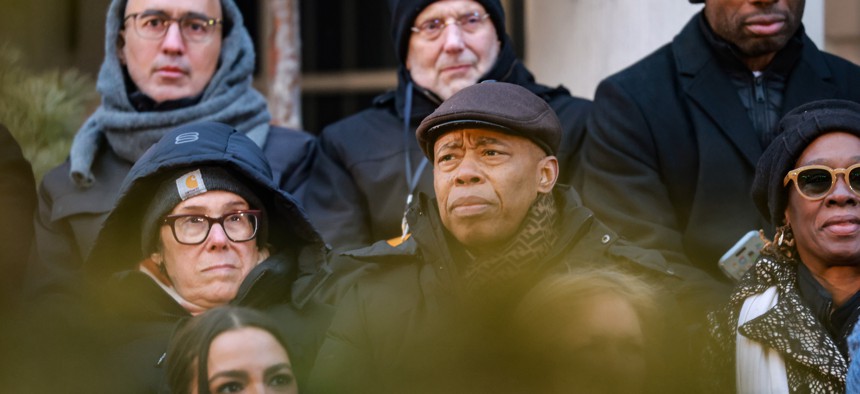
Former New York City Mayor Eric Adams convened a charter revision commission on his way out the door. Spencer Platt/Getty Images



The commission convened by former Mayor Eric Adams on his final day in office isn’t throwing in the towel – even with Mayor Zohran Mamdani unwilling to support its efforts to advance a ballot question about open primaries.
A former high-ranking official in the Adams administration with knowledge of the situation said the charter revision commission is exploring the possibility of accepting private contributions to fund its operations – and whether to retain pro bono legal representation should the Mamdani administration try to block its efforts. Much remains in flux in terms of logistics and what path the commission will ultimately take, but the group’s first meeting is likely “imminent,” they said. The vast majority, if not all, of the 15 members initially appointed by Adams on Dec. 31 filed an oath of office with the city before the deadline, securing their status on the legally protected body, according to four people with knowledge of the situation.
“I’m sworn in and ready,” said Menashe Shapiro, a commission member who previously served as senior adviser to Adams.
Martin Connor, the chair of the commission, did not respond to a request for comment prior to publication.
Charter revision commissions have the ability to review the city’s governing document known as the City Charter, then propose changes in the form of ballot questions after soliciting input from the public. While the latest commission could technically explore amending other aspects of city law, it was formed specifically to look into opening up the city’s closed primary election system. That remains the focus, according to three commission members. The last charter revision commission convened by Adams ended up withdrawing a proposal to open up city primaries late in the process, choosing to focus on several ultimately successful land use and affordable housing-related measures instead.
If this charter revision commission’s proposed changes came to fruition, New York City voters of any party would be permitted to vote in the first round of elections. Democratic socialists like Mamdani generally oppose such measures, which are thought to benefit candidates who are closer to the political center.
“This is not a commission appointed out of the blue,” the former Adams administration official said. “This is a commission that continues the work of the prior commission to finalize its work.”
But the group’s plans to blaze forward could devolve into a complex legal battle between the commission and the Mamdani administration. Many questions loom. There is little if any precedent of a charter commission established by a former mayor operating without approval from the new administration. And once assembled, a charter revision commission can’t be dissolved until its members propose ballot proposals, vote to cease its operations, or its term expires. (State Sen. John Liu recently introduced legislation that would allow Mamdani and other mayors to kill commissions created by outgoing mayors, but it’s unclear whether it’ll muster up enough support to move forward.)
As the current mayor, Mamdani wields a great deal of power over the commission’s fate. Legal experts said his administration could “starve” the commission of government resources and support by refusing to allocate funding, space and legal advice. Historically, charter commissions are heavily reliant on counsel from the city law department. Mamdani’s preliminary budget proposal makes no mention of funding the commission.
A spokesperson for the mayor declined to comment on how the administration intends to respond.
If Mamdani continues to refuse to provide funding, the commission is seeking additional ways to proceed – like accepting private donations and other resources to fund its operations. Some supporters of open primaries have approached the commission on their own, expressing interest in how they might help. Maria Danzilo, a lawyer and executive director of One City Rising, said the organization is willing to help fundraise donations from the public to support the commission’s work should Mamdani not offer any help. “When people want change, and they want good government, I believe they’ll step up and do that,” she said, adding that while she’s reached out to commission members, she hasn’t heard back yet.
State law says the commission “may accept any services, facilities or funds and use or expend the same for its purposes,” but it’s unclear how this would logistically apply to private contributions – especially without the approval of Mamdani.
City agencies have long accepted private contributions to support their programs and operations, like the New York City Police Foundation and the Mayor’s Fund to Advance New York City, according to a Q&A recently published by good government groups Citizens Union and Reinvent Albany. City agencies are technically also able to accept direct donations, but the Office of Management of Budget typically has control over those bank accounts.
“It is lawful for private donors to support a government entity in some way,” said Grace Rauh, executive director of Citizens Union. “The question is if they don’t have the cooperation of City Hall, what would be the vehicle in which they would be allowed to lawfully accept those donations.” Mamdani refusing to set up an apparatus to do this could be a “back door way of starving the commission,” she added.
Rachel Fauss, senior policy adviser at Reinvent Albany, noted that city-affiliated nonprofits like the New York City Police Foundation are subject to all sorts of disclosure requirements and must report to the Conflicts of Interest Board. It’s unclear how this would work for the commission – and soliciting private donations from nonprofits raises all sorts of thorny questions about conflicts of interest. “How would a nonprofit affiliated with this commission even be established? Would the law department have to sign off on it?” Fauss said. “This is uncharted territory, and the bottom line is this is a terrible way of funding what should be public government activity because of the conflicts of interests that can run rampant.
Legal experts also said that Mamdani could potentially issue an executive order barring the acceptance of direct donations to the commission. If there are any openings on the commission, he would also have the power to fill them with his own appointees.
The commission isn’t a monolith. While the group is composed of many allies to the former mayor, members technically have the freedom to operate as they wish. Housing advocate Shams DaBaron, who served on the last commission, emphasized that he and some of the other panel members don’t want to work in opposition to the City Council and mayor.
“This is an opportunity for us to do it like we did with the ballot proposals, which Mamdani supported,” DaBaron said. “This is a perfect opportunity to do for him and the administration as well as the City Council and get everybody on the same page to say, ‘Well this is what we’re going to do with this charter.’”