

Working Families Party
Here’s how the WFP’s endorsement vote works
A detailed look under the hood of the New York Working Families Party.
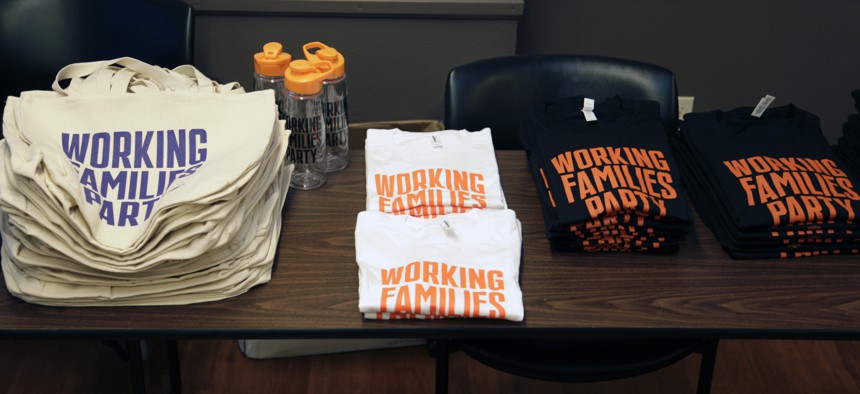
The WFP is a political party, technically, but it's more of a coalition of progressive advocacy groups and unions. Jason Wise/Getty Images for Green New Deal Network



The New York Working Families Party’s Monday endorsement of Brooklyn Borough President Antonio Reynoso in the Democratic primary for the 7th Congressional District was a blow to both Mayor Zohran Mamdani and the New York City Democratic Socialists of America, who are backing Assembly Member Claire Valdez for the open House seat.
“These are unprecedented times and Antonio is the best candidate to fight for working families in Washington D.C. and build a movement strong enough to defeat the forces of authoritarianism,” WFP State Director Jasmine Gripper said in a statement. “Importantly, Antonio is deeply trusted by our movement; he got his start organizing by knocking on doors in his community with New York ACORN” – referring to the organization that was a founding affiliate of the WFP.
Some Valdez supporters suggested the WFP’s decision was illegitimate, since the members of WFP’s Brooklyn and Queens chapters had voted to recommend endorsing Valdez, only for the WFP to vote to endorse Reynoso instead. Mamdani himself, when asked about the WFP’s endorsement decision, highlighted how the individual members in WFP’s local chapters had voted to endorse Valdez instead.
But those individual members make up only a small portion of the WFP’s constituency; the party is primarily a coalition of affiliated grassroots advocacy groups and unions, which (indirectly) represent their own members’ interests. The WFP has approximately 3,000 individual dues-paying members in New York City, compared to roughly 175,000 affiliate members and 23,000 WFP-enrolled voters. Its endorsement process uses a weighted vote system that seeks to balance the preferences of all its various constituent groups.
“Our affiliate community organizations, labor unions, and members all engage and influence our rigorous endorsement process,” Olivia Leirer, executive director of New York Communities for Change and an officer of WFP, said in a statement. “Throughout, there are multiple opportunities for members to make their voices heard.”
Inside the RAC
Here’s how the process works, according to internal WFP documentation and three people with direct knowledge. When asked for comment, the WFP did not dispute the accuracy of the following details.
According to the WFP’s New York City Advisory Council bylaws, the chapters who have jurisdiction over a certain race – in the case of NY-7, that would be the Brooklyn and Queens chapters – must advance recommendations to WFP’s New York City Regional Advisory Council, or RAC. The RAC can then vote to either approve or override that recommendation. In practice, the RAC routinely disregards local chapter recommendations, making them all but irrelevant. Last month, for instance, the Queens WFP chapter voted to endorse Rana Abdelhamid in the special election for Assembly District 36, but the RAC overrode that recommendation and instead voted to endorse Diana Moreno, who was endorsed by both Mamdani and DSA.
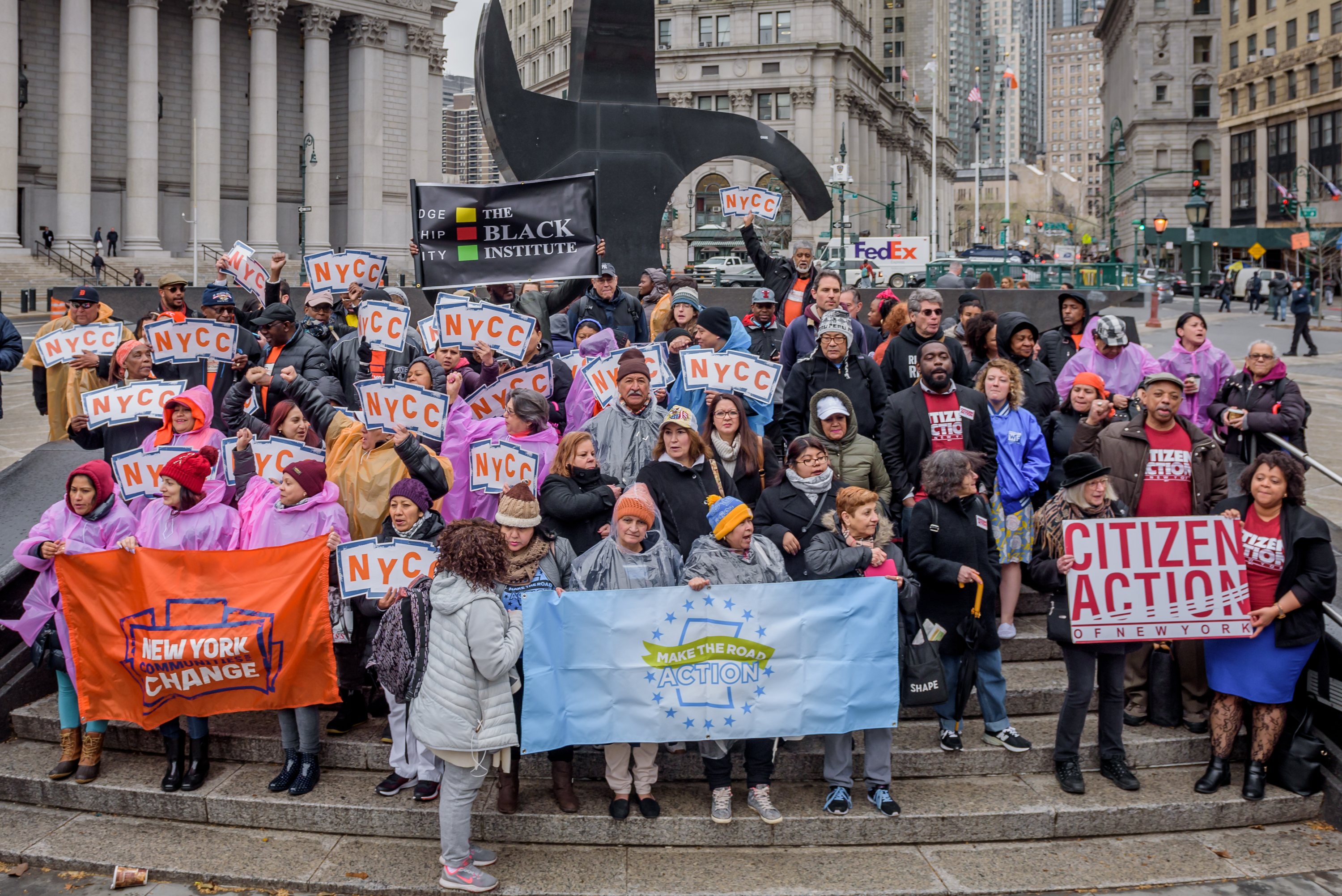
The RAC currently consists of 16 affiliated groups, four local chapters, one political club and seven state committee delegates. There are a total of 95 votes on the committee, which are allotted to the various members of the RAC.
The voting members of the RAC (with the number of votes they have in parentheses) are: New York Communities for Change (8 votes), Make the Road Action Fund (8), Citizen Action of New York (8), New York State United Teachers (8), New York State Nurses Association (8), Churches United for Fair Housing Action (6), PSC-CUNY (6), WFP Brooklyn chapter (4), WFP Queens chapter (4), WFP Manhattan chapter (4), WFP Bronx chapter (3), VOCAL-NY Action Fund (3), Community Voices Heard Power (3), The Jewish Vote (3), Committee of Interns & Residents SEIU (3), New York Progressive Action Network (2), United Auto Workers Region 9A (2), Teamsters Local 808 (2), Metropolitan Council on Housing (1), Laundry, Distribution and Food Service Joint Board (1) and Central Brooklyn Club (1). In addition, there are seven state committee delegates with one vote each.
The WFP, which was formed in 1998, used to count more labor unions as affiliates – including 32BJ SEIU, Communications Workers of America District 1, the United Federation of Teachers and the Retail, Wholesale and Department Store Union – but those unions left the party in 2018, after the party endorsed Cynthia Nixon’s gubernatorial campaign instead of supporting then-Gov. Andrew Cuomo’s reelection. Since then, the party has been dominated by grassroots community organizations like New York Communities for Change, the successor organization to New York ACORN.
The RAC vote allotments aren’t random. They’re based on members and money. According to the Working Families Advisory Council’s bylaws, organizations receive different numbers of votes based on the number of affiliated members they have. Organizations with 500 to 1,000 affiliated members statewide receive a single vote, those with 1,000 to 4,000 affiliated members receive two votes, those with 4,000 to 7,000 affiliated members receive three votes, and so on, all the way up to organizations with at least 25,000 affiliated members, which receive eight votes.
But it’s not enough for an affiliated organization to have lots of members; they also need to pay annual dues to WFP on behalf of those members. If an organization with 50,000 members chooses to only pay dues for 1,500 of them, then it will only be counted as having 1,500 affiliated members and only allotted two votes on the RAC. This is more or less the situation that UAW Region 9A is in; it has well over 25,000 members, but it has chosen to pay dues for only a small number of them, which means it just gets two votes on the RAC. NYSNA, on the other hand, has 42,000 and is willing to pay dues for at least 25,000 of them, giving it eight RAC votes.
These annual dues are not cheap, especially for unions. According to the Working Families Advisory Council bylaws, unions must pay dues of $2 per member. Community groups like New York Communities for Change have it a bit better. They only need to pay $2 per member for the first 500 members, with subsequent members only costing $0.30 per member. The upshot is that unions with at least 25,000 affiliated members, and therefore eight RAC votes, must pay $50,000 in per-member dues, while community groups with 25,000 affiliated members, and therefore eight RAC votes, must pay $8,350 in per-member dues. In addition to the per-member dues, affiliates must pay an additional fee based on their annual revenue, which ranges from $0 for organizations with an annual budget under $500,000 to a maximum annual fee of $10,000 for organizations with an annual budget of $5 million or more.
As for the local chapters, they qualify for four votes each as long as they have at least 200 dues-paying members. The Manhattan, Queens and Brooklyn chapters all clear that threshold, while the Bronx chapter only gets three RAC votes because it has more than 100 but fewer than 200 members. Each of these individual members must pay monthly dues of $10 (or $5 if they apply for a hardship waiver). The small number of direct party members in the chapters pales in comparison to the large numbers of members who belong to affiliate groups, but their votes are actually weighted more heavily than those of affiliated members. A local chapter with just 200 individual members has the same number of RAC votes (four) as an affiliate group with 7,000 affiliated members.
In effect, there are three distinct forms of WFP membership: you can sign up to pay $10 a month and become a direct member of a local chapter, you can belong to a WFP-affiliated community group or union and be counted as an affiliate member or you can enroll with the WFP as a registered voter. But that last one is rare – there are fewer than 60,000 enrolled WFP voters statewide, while 277,841 New Yorkers voted for Kamala Harris on the WFP line in 2024.
These forms of membership are not mutually exclusive; if they want, an affiliate member can sign up to pay $5 monthly dues (a 50% discount off the usual rate) to become an individual member of a chapter, and they can also switch their party registration to WFP. All three types of members are represented to some degree on the RAC: the affiliates represent affiliated members, the chapters represent individual WFP members and the state committee delegates represent WFP-registered voters.
A contentious vote
By the time the WFP’s New York City RAC voted to endorse a candidate to replace the retiring Rep Nydia Velázquez in the 7th Congressional District, four affiliates had already publicly endorsed Reynoso: New York Communities for Change, Make the Road Action Fund, Churches United for Fair Housing and the New York Progressive Action Network. That gave the borough president a floor of 24 votes. Valdez had only been publicly endorsed by UAW Region 9A, giving her two votes. Winning the support of all four local WFP chapters gained her another 15 votes, for a total of 17.
In order to win the WFP’s endorsement, a candidate needs to win a majority of all votes cast. (For example, if no groups abstain from the vote, you would need at least 48 of the 95 RAC votes to win an endorsement, but if groups that control a total of 25 votes vote to abstain, then you would only need 36 of the remaining 70 RAC votes to win an endorsement.) On Monday night, some groups that had not yet gone through their own formal endorsement processes, including the unions NYSUT and NYSNA, chose to abstain from the RAC endorsement votes. The practical result was to lower the threshold that Reynoso needed to win an endorsement.
Ahead of the RAC meeting, both Mamdani and Velázquez, who had endorsed Reynoso to succeed her, reportedly whipped votes behind the scenes for Valdez and Reynoso, respectively. During the meeting, according to one person present and two others briefed on what occurred, Valdez won the support of local WFP chapters, along with UAW Region 9A, PSC-CUNY and Teamsters Local 808, which was nowhere near enough to win a majority. UAW Region 9A Director Brandon Mancilla, a strong supporter of Valdez, advocated for undecided affiliates to at least support a placeholder candidate instead of Reynoso – similar to what the WFP did in the gubernatorial primary. But this gambit failed. After Valdez’s endorsement was voted down, a RAC member nominated Reynoso for endorsement and he won a majority of the cast votes, as grassroots community groups like Citizen Action of New York broke for him and the remaining unions voted to abstain. (The WFP confirmed that a motion to endorse Valdez failed by a majority vote and a motion to endorse Reynoso succeeded by a majority vote but otherwise claimed this account of the RAC vote was not accurate.)
Since its very beginnings, the WFP has been structured as a coalition of affiliates – more akin to the state AFL-CIO federation than a mass membership organization like DSA. The WFP has always sought to unite organized labor with the activist left, though the influence of the former in the party declined over time as several unions renounced their affiliation. The WFP’s RAC is now dominated by grassroots community organizations, and those groups’ staff and members simply prefer Reynoso, who has a much longer record of working in solidarity with them.
Valdez’s supporters in DSA may see this as unfair, but it’s simply how the party is meant to function – and supporters of WFP’s model say it does a better job of representing the interests of the low-income communities of color where its affiliates operate. “Affiliate community organizations like NYCC are rooted in working class communities in Brooklyn and Queens,” Leirer said. “They represent their members in WFP spaces. We are proud of the work each of our affiliates have done to fight to transform New York and win tangible change to improve the lives of working families.”
“Regardless of specific endorsements,” she added, “building power for working families is always the ultimate and shared goal.”