

Opinion
Opinion: New York homeowners shut out again as World Cup nears
With a $120 billion budget and no real relief for outer-borough families, the city is ignoring a simple solution to let New Yorkers stay in their homes.
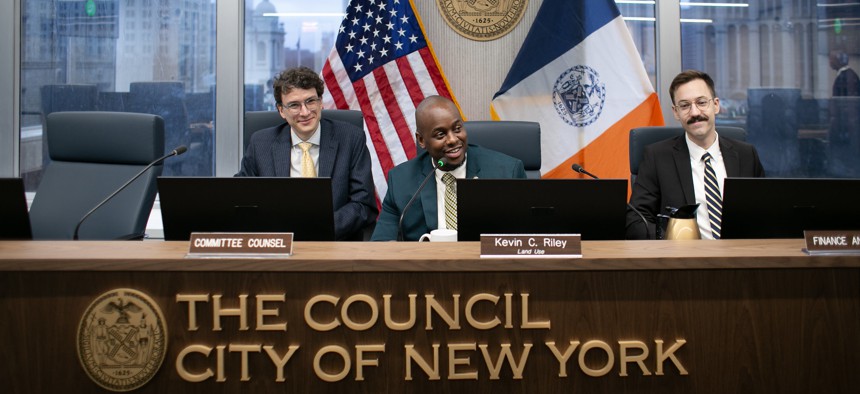
New York City Council Member Kevin Riley presides over a meeting of the Land Use Committee on March 23, 2026. Will Alatriste/NYC Council Media Unit


A looming property tax increase is yet another sign that the pressure felt by outer-borough homeowners is too often dismissed, if not ignored altogether. With a city budget exceeding $120 billion, too few solutions are on the table to address a chronically overlooked crisis: the affordability squeeze hitting outer-borough homeowners especially hard, where rising property taxes, insurance and utility costs are pushing families to the brink.
In neighborhoods across Queens, Brooklyn and the Bronx, homeowners who have spent decades building stability are now struggling to keep up with mounting bills. The subprime mortgage crisis of a generation ago devastated many of these families and yet we are watching it rear its head once again. Last year, the foreclosure rate in some of the most vulnerable neighborhoods was near 10%. This is a full-blown emergency not just for those who have a lease, but also our neighbors with mortgages. Yet, through overly restrictive policies on temporary home rentals, New York City has said to its homeowners that there is no financial lifeline for them. We say the time for reform is now.
As Black City Council members, we understand that protecting homeownership is directly tied to protecting the strength, culture and economic future of the communities we are honored to represent. No, we cannot find an answer in a single solution or lone piece of legislation. We can, however, deliver that answer they have clamored for in a measured way that addresses the immediate crisis as we carry out the arduous work of long-term solutions.
The stakes are indeed that high for those we represent. The alarm bells we have raised for years – based on stories from clergy, community leaders, small business owners and many others – became reality when New York City hit nearly 1,600 first-time foreclosures in 2025, an 8% increase from the previous year that hit the Bronx, Brooklyn and Queens the hardest. We would prefer to focus on the fact that collectively our counties are the lifeblood of the city – home to more than 6 million New Yorkers, many of whom do thankless jobs – but instead we are forced to lament 587 foreclosures in Queens, 460 in Brooklyn and 191 in the Bronx in just a single year.
Those filings represent 1,238 households, families fighting to hold onto the generational wealth they worked for decades to build.
Our warnings of a collapse on the brink of ruin were validated by PropertyShark, which found that one- and two-family homes accounted for more than 1,000 foreclosure filings, with a single zip code in Downtown Jamaica, long a bastion of Black homeownership, emerging as the city’s foreclosure hot spot. Generations of wealth-building for Black New Yorkers, in some cases built on the blood and sweat of their parents or grandparents, is being decimated before our eyes.
To sit back and hope another Black family will buy them is a threat to the makeup of this city. New York’s high cost of living has already driven out 200,000 Black residents in the last two decades, with more following them each year. That alone will threaten how these communities are represented in the years to come. Allowing these properties to sit vacant will only widen our $12 billion budget gap, considering real estate accounts for an overwhelming share of our tax base. Any effort to drive tourism will have been in vain as the formula for community blight kicks in. First, more vacant homes means fewer taxes collected. Then mass transit, sanitation and other services are cut back or diverted elsewhere. Finally, the diminishing foot traffic converts into vacant storefronts once home to thriving small businesses. At the same time, small businesses are struggling to stay open, and even parts of the hotel sector are feeling the strain of rising costs and limited supply, reshaping where visitors can stay.
Is this really the New York City we want to present to the estimated 1.2 million tourists expected for the World Cup? The World Cup presents a clear opportunity to deliver meaningful relief to homeowners. Visitors can stay in the outer boroughs, where a tourist from Colombia can enjoy arepas in Jackson Heights, visitors from Jamaica can have beef patties on Flatbush or Liberty Avenues, or a guest from Ghana can have daggai on Davidson Avenue – supporting a homeowner in the process. New York City draws its strength from the rich cultural fabric of our Caribbean communities in Central Brooklyn, Southeast Queens and the Northeast Bronx, alongside vibrant Latino communities from Upper Manhattan to neighborhoods across the Bronx. This is what we should showcase to the world.
Thankfully, there is an immediate opportunity before us even as we confront the deeper systemic challenges driving this crisis. While reforms to property taxes and utility costs are critical, many homeowners cannot afford to wait. We must advance a thoughtful and measured approach that provides responsible flexibility for homeowners to generate additional income, including allowing them greater discretion in how they host within their homes, while maintaining safeguards that protect neighborhood stability. Current policies that restrict homeowners to hosting no more than two guests at a time impose unnecessary barriers on families already navigating rising costs. A more balanced approach can support homeowners while safeguarding the character and stability of our neighborhoods. At a time when higher property taxes and household costs are not off the table, it is a necessary form of homeowner relief.
We can have the New York City many of us envision if we take these kinds of actions. This is a city powered by its Black residents. Many of whom are one setback away from sliding off of an economic downhill. And as costs rise it’s becoming nearly impossible to climb back up. We must act now to ensure they can share in the economic opportunities ahead. More importantly, we must do more to keep these families we are blessed to represent in New York City.
Kevin Riley is a New York City Council member representing Council District 12 in the Bronx and the chair of the Committee on Land Use. Mercedes Narcisse is a Council member representing Council District 46 in Brooklyn. Selvena Brooks-Powers is a Council member representing Council District 31 in Queens.
NEXT STORY: Opinion: New York needs graphic warnings at gun stores