

Opinion
Opinion: What cannabis legalization looks like in New York today
Five years after legalization, the Office of Cannabis Management has made real progress toward building the world’s most equitable and sustainable cannabis market.
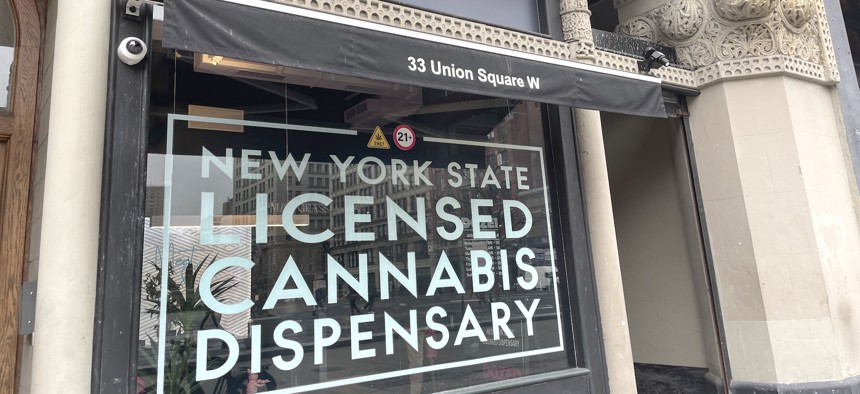
Dazed is a legal retail cannabis dispensary near Union Square in Manhattan. Deb Cohn-Orbach/UCG/Universal Images Group via Getty Images

Five years after the passage of the Marihuana Regulation and Taxation Act, New York’s legal cannabis market is no longer theoretical – it is real, operational and growing. But progress should not be mistaken for completion. Building a market of this scale rooted in equity, public health and long-term sustainability requires time, discipline and a willingness to adapt.
The work continues and getting it right still matters.
Having served as policy director and now as acting executive director of the Office of Cannabis Management, I have had a front-row seat to the birth of New York’s legal market. My experience affirms that building a market like this requires more than policy.
It requires persistence, flexibility and a clear sense of purpose. Under the leadership of Gov. Kathy Hochul and with the support of stakeholders and staff, what began as a startup effort has become a functioning regulatory system overseeing one of the world’s most closely watched cannabis markets.
From the beginning, New York set out to do more than legalize cannabis. The MRTA was designed with an ambitious goal in mind: to address the harms of prohibition while creating economic opportunity. Through automatic expungement provisions, more than 400,000 cannabis-related convictions were eligible to be cleared, removing barriers to employment, housing and opportunity for New Yorkers across the state. Equity was not an afterthought. It was an anchoring principle.
Putting that commitment into practice has required building the systems to support it – standing up licensing frameworks, developing compliance and enforcement operations, building systems and programs to support the nascent industry and adapting to the market’s evolution. That work has unfolded alongside legal challenges, resource constraints and an entrenched illicit market. It is work that demands coordination, adaptability, and sustained focus.
And yet, the market is taking shape.
New York now has more than 2,100 licensed cannabis businesses across the supply chain, with over 600 licensed dispensaries operating statewide. Legal cannabis sales reached approximately $1.6 billion in 2025 alone, with total sales surpassing $3 billion to date.
Just as importantly, that growth has been accompanied by measurable progress on equity. Today, over 55% of licenses are held by social and economic equity applicants, a reflection of the deliberate effort to ensure that the communities most impacted by prohibition have a real opportunity to participate in and benefit from this market. New York is showing that a cannabis market can be both economically viable and intentionally inclusive, and that those goals are not in conflict. That outcome is not accidental. It is the result of deliberate policy choices and sustained focus. The state’s two-tier market structure, which separates supply from retail, was designed to prevent early consolidation and create space for small and mid-sized businesses. At the same time, our technical assistance, financial support, and business development resources have helped licensees navigate the increasingly dynamic and competitive industry.
Reinvestment is also central to this framework. Through the Community Reinvestment Program, $5 million has been awarded to 50 nonprofit organizations supporting mental health, workforce development and housing, with an additional $5 million announced for a second round. The governor has also proposed an additional $25 million in this year’s Executive Budget to further expand these efforts. These investments ensure that the benefits of legalization extend beyond the marketplace itself.
Public health remains a core consideration. New York has taken a measured approach to legalization, investing in education, safe consumption and youth prevention. To advance this work, Hochul has launched a first-in-the-nation Cannabis Center of Excellence for Medical Cannabis and Health Equity, developed in partnership with medical schools to train clinicians in evidence-based cannabis care and expand access to clinical guidance – particularly in communities that have historically had limited access to medical cannabis services. Continued monitoring will remain essential as the market grows, particularly in understanding long-term impacts.
Meanwhile, there are real challenges that remain.
Enforcement continues to be one of the most complex aspects of implementation. With 579 illicit stores shut down and padlocked, the state has taken significant action to shut down these unlicensed operators and remove illegal products from the marketplace. We have also equipped localities with the authority and tools to conduct their own enforcement, resulting in hundreds of additional actions across the state. However, these efforts are impacted by legal injunctions, resource limitations and the scale of the illicit market. There is no simple solution – but standing still is not an option. Addressing this will require deeper coordination and a sustained focus on protecting the integrity of the legal market.
We also have to be honest about where we have fallen short. Communication with licensees and stakeholders has not always been as clear or consistent as it needs to be. In a market evolving as quickly as this one, uncertainty around timelines and expectations has created real challenges for businesses making critical decisions. Improving that communication is not just a priority; it is essential to the success of this market.
The next phase of New York’s cannabis market will focus on strengthening what has already been built: finalizing regulations, bringing additional license types online, expanding reinvestment and improving coordination across the system. At the same time, federal cannabis policy is beginning to shift in ways that could materially impact our state market. That presents both opportunity and responsibility. We must prepare our market for the coming changes and be prepared to lead the industry under a national framework.
Five years in, New York has moved from promise to progress. The foundation is in place. The work now is to build on it – thoughtfully, responsibly, and with a clear focus on delivering a market that is both strong and fair.
Because the success of this market will ultimately be measured not just by how much it grows, but by who it serves, who benefits from its opportunity and whether we met the ambitious goal of building the world’s most equitable, sustainable and opportunity rich market.