

Opinion
Opinion: Can Mamdani confront the NYPD’s ‘Blue Power’?
Since the 1960s, the police department and police unions have constituted a powerful, at times implacable, force in city and state politics.
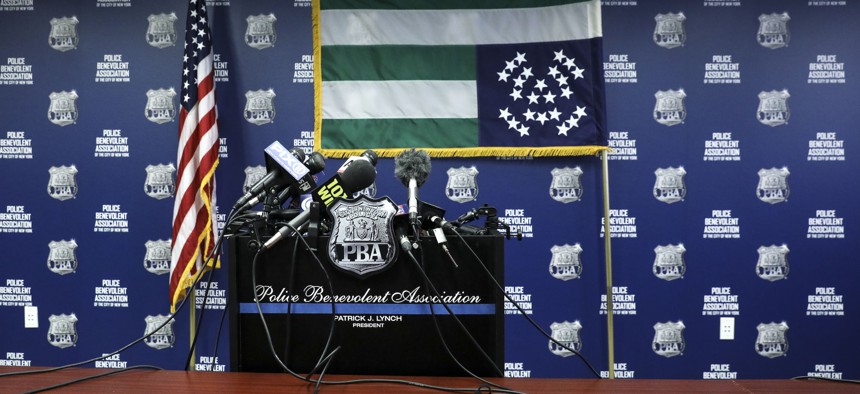
The Police Benevolent Association displays the NYPD flag upside down in protest of the termination of Officer Daniel Pantaleo, who choked Eric Garner to death, on Aug. 19, 2019. Drew Angerer/Getty Images


When federal agents ferried an injured Nigerian detainee to Wyckoff Heights Medical Center in Bushwick earlier this month, an impromptu protest broke out, as rapid-response chats and social media calls for aid exploded. Officers from the NYPD rapidly arrived on the scene. When ICE officers exited the hospital with the detainee, Chidozie Wilson Okeke, city police officers contained the crowd and assisted in getting Okeke into a Department of Homeland Security vehicle while a few protesters tossed garbage cans to block the street. Officers arrested eight protesters amid the chaotic scene, charging them with reckless endangerment, resisting arrest, obstructing governmental administration, and criminal mischief.
Local City Council Member Sandy Nurse was disturbed by the apparent “coordination” or even “collusion” between NYPD and ICE, contradicting the city’s sanctuary laws. Mayor Zohran Mamdani, moreover, has pledged to eliminate any collaboration between federal immigration enforcement operations and city police under his authority. Mamdani’s supporters, including in the so-called Commie Corridor where the hospital is located, are growing impatient with Mamdani’s apparent inability to eliminate the NYPD’s reflexive assistance of ICE, particularly when it comes to crowd control, as immigrant-defense networks are able to rapidly rally large numbers of protesters when ICE engages in any visible operations on city streets.
Yet a widely circulated video of one NYPD captain’s remarks during this episode illuminates why any mayor – not just a democratic socialist – faces difficulties reining in the police department. Captain James G. Wilson, wearing a white shirt and a smirk, bantered with some protesters about the situation. He was asked why the police department was aiding ICE, when Mamdani opposes such assistance.
Wilson was derisive. “Who’s Mamdani?” he quipped.
He called the mayor “temporary” and “expendable.” He referred to Mamdani as “total nonsense” and “an embarrassment.” Mamdani, he declared, is “not my boss” and “not my mayor.”
The police department’s response was swift. Wilson violated a policy that bans officers from commenting on politics while in uniform. Wilson was transferred from his supervisory position in Greenpoint’s 94th Precinct (again, smack in the middle of the Commie Corridor) to a desk job in the Bronx at the 911 command center. A disciplinary process is now underway.
From the perspective of what my new book calls “Blue Power,” however, Wilson was not wrong when he called Mamdani temporary and signaled that police power is more durable. Despite the specific rules of the NYPD Patrol Guide restricting what officers may say while on duty, one of Mamdani’s greatest challenges is the simple fact that the police department, and especially its unions, constitute a powerful, at times implacable, force in city and state politics.
The political power of police hasn’t always existed in its current form; it emerged only amid the tumult of the 1960s, as a rejoinder to civil rights and police reformism alike. But it has defined our politics ever since, especially in New York City, outlasting any mayor. Since the 1960s, Blue Power has been a conscious project by police to assert their social importance, win handsome compensation, insulate themselves from oversight, reject meaningful reform and defang critics. At the municipal, state and federal levels, through associations, fraternities and unions, police have wielded this Blue Power – as both a means and an end – with remarkable success.
To Mamdani’s supporters, his decision to retain Jessica Tisch as police commissioner was controversial. But the real locus of political power in the department remains its five unions, including the Police Benevolent Association, the largest municipal police union in the country. (The relatively small Captains Endowment Association, to which Wilson belongs, has so far remained mum during this brouhaha.) The police rank and file can be antagonistic toward the brass. Veteran cops like Wilson might also acknowledge that even a well-connected commissioner is also expendable, serving at the pleasure of the mayor. But the unions endure.
The police unions are accustomed to getting their way. They have a long history of obtaining strong contracts, with pensions and benefits that would incite jealousy among the millions of New Yorkers who are just getting by. And, perhaps more importantly, they fiercely protect their members from significant punishment, and even democratic oversight. When police unions don’t get their way, unlawful strikes and slowdowns have ensued.
Predictably, the unions go on the offensive when it comes time to negotiate a new contract. For the PBA, that time may come soon. Mamdani’s predecessor, Eric Adams, signed a landmark contract with the union, negotiated under the watchful eye of Patrick J. Lynch, as a final act in the lengthiest tenure of any NYPD union president. Once labeled by a confederate the “most powerful police union chief in the world,” Lynch demanded loyalty. The PBA helped put Rudy Giuliani into the mayor’s office in the 1990s, but when his contract offers proved lackluster, the union turned on him, too. He was expendable.
Mamdani’s surprise win, and the shift in the state legislature away from police-backing Republicans, may be changing the balance. The police unions have been trying to pick a winnable fight against Mamdani, hoping to restore a status quo of mayors who cower before them. It hasn’t yet worked. Think about the PBA’s denunciation of Mamdani as “disgraceful” after he downplayed the February snowball fight in Washington Square Park that injured two cops. Or consider the petition issued by the Sergeants Benevolent Association and signed by 11,000 officers around the country after a Bronx sergeant was convicted of manslaughter. It was meant as a show of strength. With friends like the New York Post and Fox News, police unions know that screeching about perceived slights will earn airtime.
But Mamdani has also been careful not to pick his own unwinnable fights, proceeding cautiously as he confronts long-entrenched Blue Power. Vocal supporters wonder if he will ever get around to abolishing the Strategic Response Group or the department’s gang database – as he pledged to do on the campaign trail. What about his promise to end certain types of quality-of-life enforcement or to empower the Civilian Complaint Review Board (which the PBA sued recently, another shot across the bow)? His proposal to create a Department of Community Safety might alleviate some of the challenging aspects of police patrol, but the unions are unlikely to cede ground or resources. If the new outfit implies diminished centrality of police in city life, it will be anathema to the unions.
Inside One Police Plaza, the brass may have been displeased to hear Wilson’s caustic words about the “nonsense” mayor, but New Yorkers can be certain similar ideas are widely held within the department. Mamdani was elected on a promise to change civic life in a city increasingly defined by its vertiginous inequality. The stranglehold on our politics that the police unions have held, using crime fears to get their way, may be weakening, particularly as crime remains low. A defining question of Mamdani’s mayoralty may not be whether he is expendable; it will be whether Blue Power can last forever.
Stuart Schrader is an associate professor of history at Johns Hopkins University and the director of the university’s Chloe Center for the Critical Study of Racism, Immigration, and Colonialism.
NEXT STORY: Opinion: Big Pharma is lying about 340B, and New Yorkers are the ones who will pay