

Opinion
Opinion: You can’t solve a mental health crisis without a workforce
Federal student loan policies are creating new barriers to entry for students who want to become social workers, jeopardizing New York’s mental health programs.
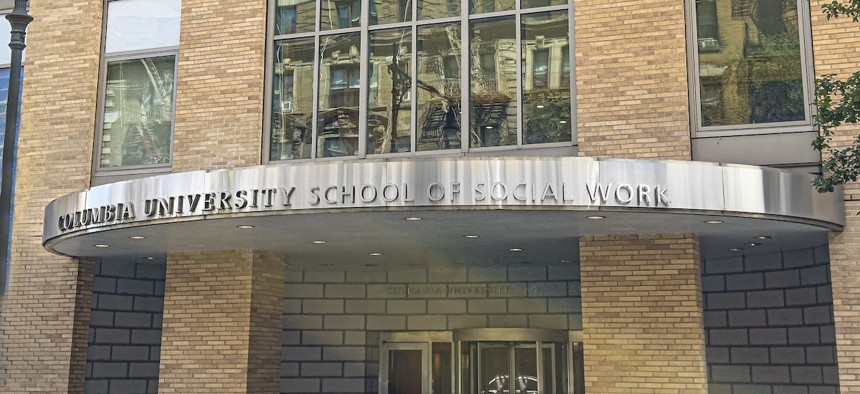
Tuition at the Columbia University School of Social Work is over $60,000 per year. Plexi Images/GHI/UCG/Universal Images Group via Getty Images


New York is facing a growing mental health and human services crisis. And at the exact moment we need social workers, Washington. is choosing to put the profession further out of reach. In New York City, schools fall short of the recommended ratio of one social worker per 250 students. In some districts, ratios are as high as 1:1,000.
Across the state, the gaps widen. Rural counties average one mental health provider for every 590 residents, compared to 1:384 in urban areas as of 2021.
The need is clear. The pipeline is not.
Social workers stand on the front lines of nearly every crisis our communities face. Yet a dangerous disconnect is emerging between the demands we place on this workforce and the policies shaping how they are trained.
Recent federal changes to student loan policy are fundamentally altering access to graduate education. The elimination of Grad PLUS loans and new borrowing limits will leave thousands of students without a viable path to finance advanced degrees. At the same time, federal policymakers have even proposed excluding social work from being defined as a professional degree.
For a field that requires a Master of Social Work degree to practice, this is not a technical change. It is a direct barrier to entry.
We are already seeing signs of strain. Social service organizations report persistent vacancies. Caseloads remain high. Demand for mental health services continues to grow, particularly among young people and underserved communities. This is not just a higher education issue – it is a workforce and public health issue.
New York has made clear its commitment to expanding mental health services, strengthening child welfare systems and supporting communities in need. But those priorities depend on a strong and stable pipeline of trained professionals. That pipeline begins with access to education.
Social work has never been a profession driven by the lure of high salaries. It has always relied on people willing to serve, people who step into difficult, under-resourced environments because they believe in the work. But when policymakers strip away fair and flexible student loan financing, they send a clear message: this profession is only for those who can afford it.
This is not just inequitable; it is unsustainable.
Social workers support children in foster care, counsel families in crisis, guide individuals in navigating substance use recovery and provide essential mental health services in schools, hospitals and community-based organizations. Their work is not optional. It’s what holds our communities together.
New York will see the impact quickly. Fewer students will enroll in MSW programs, leading to more workforce shortages in mental health, child welfare and community services. Nonprofits and public agencies, already struggling to hire, will fall further behind.
And New Yorkers will pay the price.
Waitlists for care will grow. Fewer providers will be available. Families in crisis will struggle to find support. Communities already facing barriers to care will see those barriers harden.
Federal policy is shutting that door to education, and the state must respond and open another.
Federal policymakers should revisit loan caps and restore essential pathways to graduate education that represent the on ramp to essential fields like social work. At the state level, New York has an opportunity – and a responsibility – to act by developing solutions that ensure students can continue to pursue these careers.
That includes exploring state-supported financing options, expanding grant aid and investing in targeted programs that support students entering high-need professions. It also means aligning workforce goals with the policies that make those goals achievable.
We cannot say we value mental health, community well-being and support for vulnerable populations while simultaneously making it harder for the very professionals who provide that care to enter the field.
Social workers show up every day for New Yorkers – often under challenging conditions, with limited resources and driven by a commitment to serve others. They are essential to our communities, our economy, and our future.
New York has an opportunity to spearhead policy to show up for them. It must do so now.
Maritza Davila is an Assembly member representing District 53 in Brooklyn. She is the chair of the Assembly Social Services Committee. Harry Bronson is an Assembly member representing District 138 in Rochester. He is the chair of the Assembly Labor Committee.
NEXT STORY: Opinion: Require all New York employers to offer paid family leave