

Budget
Opinion: Why I voted no on the $126 billion budget
New York City Council Member Althea Stevens was the only Democrat to vote against the budget Tuesday.
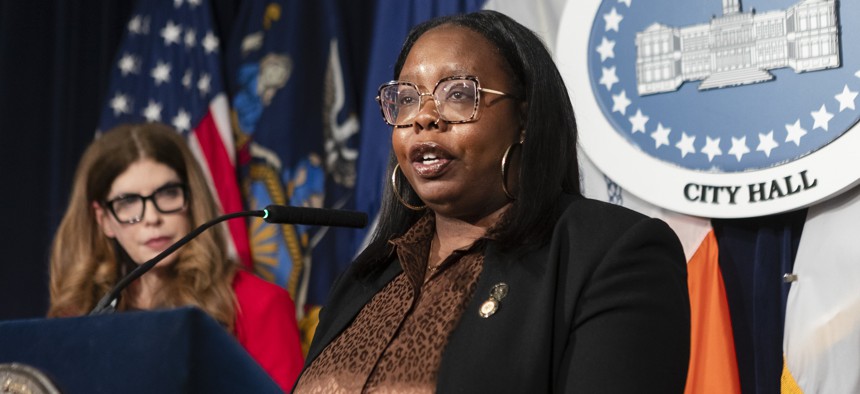
“My no vote was, in many ways, symbolic but symbols matter,” Council Member Althea Stevens writes. Emil Cohen/NYC Council Media Unit


Dr. Martin Luther King Jr. once reminded us that the government has a moral obligation to serve the people, especially those who have the least. That belief has always guided my work as an elected official, and it guided my vote on New York City's $126 billion budget.
Let me be clear: this budget contains meaningful investments that will improve the lives of many New Yorkers. I applaud the funding for CityFHEPS, Fair Fares, NYCHA, Crisis to Care, our parks and other initiatives that help working families, seniors and young people thrive. These are real accomplishments, and I commend everyone who worked tirelessly to secure them.
But voting on a budget is about more than recognizing what is good. It is also about asking whether it is fair.
For me, the answer was no.
I represent District 16 in the Bronx, one of the poorest communities in New York City. Our residents face some of the city's highest rates of poverty, unemployment, housing instability and gun violence. They deserve a budget that reflects both the urgency of those challenges and the promise of their potential.
Instead, the investments allocated to our district were deeply disappointing.
I understood that my vote would not determine whether the budget passed. There were already enough votes to approve it. My “no” vote was, in many ways, symbolic – but symbols matter. They send a message about what we are willing to accept and what we are not.
I could not, in good conscience, tell the families of District 16 that this budget fully reflects their needs when it does not.
What made this even more difficult was seeing districts with higher incomes and greater access to resources receive significantly larger investments while neighborhoods like mine continue to fight for the basics. That is not what equity looks like.
Equity cannot simply be a word we use in speeches or campaign slogans. Equity means directing resources where the needs are greatest. It means recognizing that communities carrying the heaviest burdens require greater investment, not equal investment, but equitable investment.
When we fail to do that, we reinforce the very disparities we claim we are trying to eliminate.
When I ran for office, I did not do so for a title or recognition. I ran to be a voice for the families who too often feel invisible in City Hall, for the young people searching for opportunity, the seniors trying to age with dignity and the working families doing everything they can to make ends meet.
Those are the people I answer to. It is because of them that I voted no.
My vote was not a rejection of progress. It was a call for greater fairness. It was a statement that the residents of District 16 deserve the same level of commitment and investment as every other community in this city.
I respect the difficult negotiations that produced this budget, and I appreciate the colleagues who fought to include important priorities. But respect also requires honesty. And the honest truth is that District 16 deserved more.
My vote was about accountability.
It was about equity.
It was about ensuring that the communities with the greatest needs are no longer expected to settle for the least.
I voted no because I believe our residents deserve better, and I will continue fighting until they receive the investment, opportunity and respect they have long been denied.
New York City Council Member Althea Stevens represents District 16 in the west Bronx.
NEXT STORY: Editor’s Note: DAC déjà vu