

New York State
Opinion: What was Hochul thinking?
Making sense of the governor’s decision to support Trump’s education tax credit
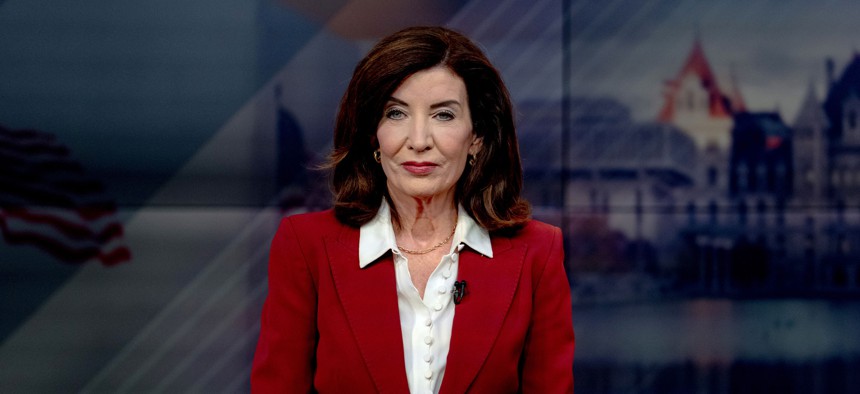
Gov. Kathy Hochul is one of just two Democratic governors to opt in to President Donald Trump’s education tax credit. Anna Connors - Pool/Getty Images

Last month, Gov. Kathy Hochul defied establishment Democrats when she opted to participate in President Donald Trump’s school choice program, which could bring millions of dollars to families who send their children to private and religious schools. United Federation of Teachers president Michael Mulgrew accused the governor of “giving up local control of public education to the federal government.” State Senate Majority Leader Andrea Stewart -Cousins and Assembly Speaker Carl Heastie, both Democrats, have also denounced her decision, as have civil rights organizations such as the NAACP and the ACLU.
The Education Freedom Tax Credit Program (EFTC) was passed last year by Republicans in Congress over Democratic opposition as part of President Trump’s “Big Beautiful Bill.” It provides a tax credit of up to $1,700 to individuals for donations to private “scholarship granting organizations” that make tuition scholarships available to students at nonpublic schools and a variety of other grants to students attending both nonpublic and public schools. Any family whose income does not exceed 300% of the median income in their area can qualify for the assistance. So far, 31 states have signed on to the program, which is a matter of state discretion. Colorado Gov. Jared Polis is the only other Democratic governor to do so, and he is about to leave office. What could Hochul have been thinking?
It is highly unusual for a mainstream Democrat to defy teachers unions, and Hochul is up for reelection. That said, polls indicate that she appears to have a safe lead over her Republican opponent Bruce Blakeman, who himself has endorsed the Trump program, leaving its opponents nowhere else to go so far as the gubernatorial race is concerned. Notwithstanding the shouts and murmurs coming from the governor’s fellow Democrats in the legislature, they don’t seem ready to challenge her decision through legislative action in an election year when party unity is the name of the game.
The school choice program has strong support among the Catholic and Jewish day school lobbies. School choice is generally popular among Black, Brown and working class families looking for alternatives to failing segregated public schools. Jorge Elorza, the CEO of Democrats for Education Reform, spoke for many on both the left and the right in his party when he publicly urged state officials to get behind an initiative from which needy families have much to gain.
Teacher union advocates insist that public schools will lose funding when students transfer out to private and religious schools. In response, school choice lobbyists question why public schools should receive funding for students they don’t educate. And, they ask, why shouldn’t parents who choose to opt out of underperforming institutions get support if they believe their children would benefit? The program will allow better off parents in New York to demand financial support when the funds could be used more efficiently to help needier children; yet, Catholic and Jewish schools that make up most of the nonpublic school market here have a long history of educating students of modest means.
There are legitimate legal concerns about the program that cannot be ignored. Private and parochial schools do not provide the same protections for teachers and students that public schools do. Will those in place at the state level provide sufficient protections to those who might be discriminated against on the basis of race, religion or gender? Will they hold up in a legal climate where the U.S. Supreme Court has whittled away such protections? The high court is about to hear a claim from a Catholic preschool in Colorado claiming that it has the right under the First Amendment’s Free Exercise Clause to bar the children of gay parents from a publicly supported state program with provisions clearly designed to protect such rights.
Beyond these legal questions, the federal government has set minimal requirements for monitoring or enforcing standards for schools and other service providers participating in the program. Local officials will need to ask themselves whether provisions already adopted in state law for nonpublic schools and other related programs are sufficient to ensure the quality of the services offered.
The big question remaining is just how public school students might receive support from the program and indirectly subsidize state and local budgets. That might be what Hochul is betting on, and it is there where public officials will need to be creative. Might public schools be able to charge students for such services as transportation, tutoring, afterschool program, and extracurricular activities for amounts up to what they might receive from the federal government? Do the city and state have the capacity to help public school parents navigate such a process? New York City currently spends $1.35 billion annually to send children with disabilities to private institutions that public schools are unable to serve. If all or some of that cost could be picked up by the federal government under EFTC, it could be a huge bonus for Mayor Zohran Mamdani, who has remained conspicuously silent on the governor’s decision.
None of the benefits reaped by the program will undo the threats to civil rights present at nonpublic institutions in such a precarious legal setting overseen by the Roberts court. Those who subscribe to the school choice playbook would counsel parents to exercise their options and take their scholarship money to places where they are welcome. For a mother or father desperate to give their child a better life, that may be enough.
Joseph P. Viteritti is the Thomas Hunter Professor of Public Policy at Hunter College and author of “Radical Dreamers: Race, Choice, and the Failure of American Education” (Oxford).
NEXT STORY: Opinion: Privately owned public spaces should actually benefit the public