

Interviews & Profiles
Everyone’s against Rana Abdelhamid. She’s running anyway.
A Q&A with the Assembly candidate running in a special election against the new “establishment.”
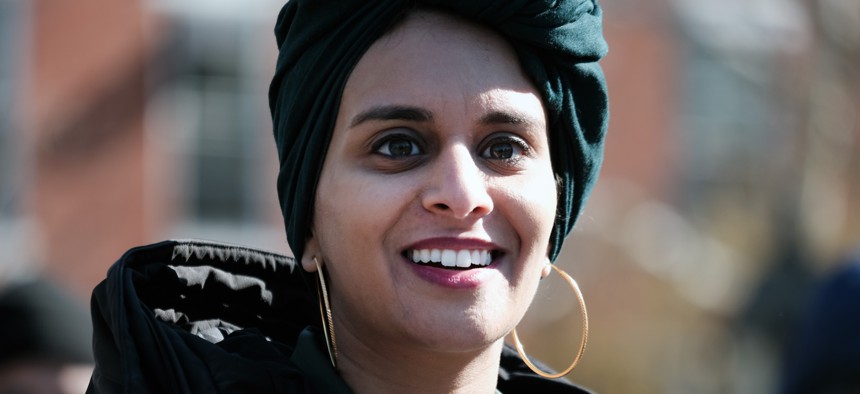
Rana Abdelhamid, seen here campaigning for a 2022 congressional run she aborted after redistricting, is now running in an Assembly special election. Spencer Platt/Getty Images


Special elections in New York City tend to be predictable. The Democratic Party nominates someone to appear on their line in the partisan race in solidly blue districts, and it’s all but an anointment. Republican opponents are token opposition if the party puts anyone up at all, and independent runs are uncommon. Competitive independent campaigns even more so.
That’s not the case in Assembly District 36 in Western Queens, where Rana Abdelhamid is taking on Diana Moreno – the pick of the Queens Democratic Party and Working Families Party – and fellow independent Mary Jobaida for the seat previously held by Mayor Zohran Mamdani. In addition to the party support, Moreno has the backing of both Mamdani and the NYC-DSA, as well as the lion’s share of key progressive endorsements. But that hasn’t stopped Abdelhamid.
A DSA member and self-described socialist, Abdelhamid still sees a pathway to victory on the independent “Queens for All” line despite the headwinds against her. She cites her long history organizing in the district as setting her apart, and believes she has tapped into the growing Muslim, North African and South Asian population in Astoria. And in a recent surprise endorsement, Abdelhamid picked up the support of Rep. Nydia Velázquez as part of a series of pointed disagreements with the mayor over electoral politics.
Early voting starts Saturday and election day is Feb. 3. As the first contest that Mamdani has chosen to weigh in on as mayor, all eyes are watching to see how his candidate fares. And while Abdelhamid recognizes the uphill battle, she expressed confidence she can not just beat Moreno, but also beat back what she considers a new machine politics.
This interview has been edited for length and clarity.
What can you tell me about the state of your race? It’s not often you have a competitive special election for a solidly Democratic seat.
Our race feels like it is picking up a lot of momentum and steam. We had a really good turning point last week when we were able to submit our petitions and get on the ballot. And we have a very activated volunteer base, very activated community base. We just picked up a couple of endorsements as well. We were endorsed by Congresswoman Nydia Velázquez and (New York City) Council Member Julie Won. We are door knocking, speaking to our neighbors and doing all the things that you need to do to win a race.
What was the race like before the Queens Democratic Party made its pick? Did you think it was really up in the air and you were lobbying for the line, or did Diana Moreno seem like a foregone conclusion?
Oh, my God, absolutely opposite. I had been having conversations with our district leaders, with Congress Member (Greg) Meeks and a coalition of other people who are deeply rooted in Democratic county politics in Queens. I actually felt really confident. I think there was a really stark difference at the forum in terms of who has a deep, nuanced understanding of the district and the issues in the district. So I was actually pretty shocked that it didn't go to us. It was a difficult moment, but I think we were able to just keep going and continue to build that momentum. And I think people will see our name on the ballot, and they'll recognize it.
Why do you think that happened with that endorsement?
I don't know the exact details of what happened there. The congressmember (Meeks) did call me to let me know. And he did let me know that he felt that he was needing to go with the mayor's pick because the mayor was in the seat previously.
What is your approach to really compete with the person on the Democratic line in such a Democratic district?
We have been really positively surprised and excited by the fact that we have pretty high name recognition at the doors from early on. When we're door knocking, over 50% of people already know my name, even outside of the realm of the electoral process. And I think that's given the work that I've been doing in the district since I was a teenager. People in this district are also really highly engaged voters. They're highly informed voters, as opposed to maybe other places, which also is why I think we have such a leftist politics here. And people read, they are very well-informed. People are excited to have those conversations, and are excited to see nuance. I think people are aware there are three candidates in the race as you're speaking to them, so I think that's part of it too. Not everybody's gonna go out there and automatically vote Democrat.
Certainly special elections tend to have lower turnout, but higher-information voters.
Exactly. I think we're uniquely positioned here as well because we're building on momentum that exists specifically within the North African, Muslim, South Asian, working class community of voters, which are very enthusiastic and very engaged in this race. I've never seen this many aunties at forums. And I think that those are voters who are obviously activated by candidates, and aren't voting based on a party line.
The district and Western Queens is a hotbed of leftist and DSA politics, as you alluded to. You’re a NYC-DSA member like Moreno, why didn’t you seek that endorsement in the end?
I had conversations with the democratic socialist leadership very early on in the process. It was very open and transparent. And had multiple conversations with their leadership, with their electoral working group, with members who are in the district. There was, I think, a level of engagement. As soon as I started the endorsement questionnaire, (I was) told that there's already a favorite. There was consensus around one person who was recruited to run for this race, and that was Diana. And I was told by multiple leaders, multiple high profile leaders of the DSA, elected officials who are part of the DSA, that they had picked Diana. So that is why it didn't feel like it made a lot of sense for me to go through the process if they already had a chosen candidate, and there was consensus around that candidate, and it was a recruited candidate.
What was it like to get Nydia Velázquez’s endorsement? It was a little surprising.
Just very validating. I really respect her, her history in the district. She's a long term leader who has an incredible organizing record and policy record. She advocates for immigrant people. She advocates for so many issues that I people care about. And I think it is an indicator of the fact that she's seen the history of the work that I've done here for a really long time. She knows the importance of community ties for representation. And her endorsement is validation.
Yours is really the first big race of the year since Mayor Mamdani’s election and the first test of both his and DSA’s influence. It’s not an apples-to-apples comparison to future races as a special, but what do you think a victory from you may indicate at a broader level?
I think we've seen so much in the history of New York City politics over the past couple of years, starting with (Rep. Alexandria Ocasio-Cortez) to even Zohran’s race, that sometimes the grass top doesn't meet the grassroots fast enough. I think my race, Inshallah when we are successful, will indicate that establishment politics doesn't always get it right. I'm seeing the momentum on the ground. I'm seeing the energy on the ground. I know my neighbors. They know me. They've seen the work that I've been doing here for years and years and years. And I think people want someone that they have organized with before, that they have a relationship with before, that they have seen do the work. And I think that's what this is going to indicate. A win will indicate that community ties really matter, that being rooted and being connected to community really matters. And that establishment politics misses the mark once again.