

Interviews & Profiles
Mark Levine says the NYC budget gap really is that bad
It’s also politically convenient for a mayor looking to tax the rich.
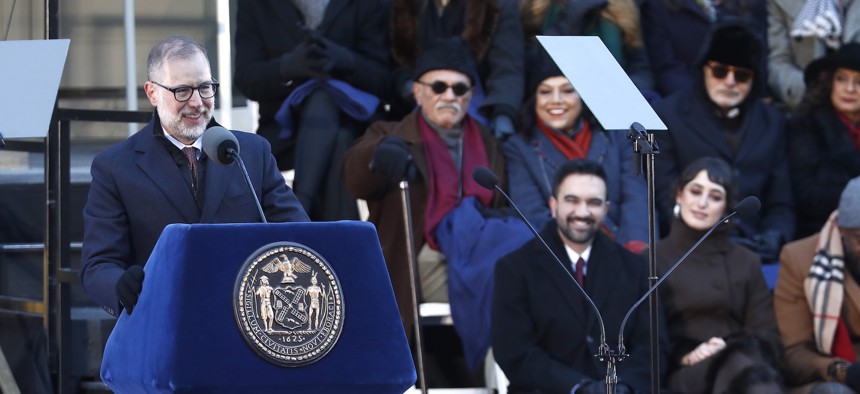
Comptroller Mark Levine was sworn in on the same stage as Mayor Zohran Mamdani. John Lamparski/Getty Images



What is the scale of the budget gap facing New York City? The number getting thrown around this month is (a staggering) $12.6 billion. That figure comes from the newly minted New York City Comptroller Mark Levine, and it combines the midyear budget gap of $2.2 billion he’s identified for this fiscal year and the budget gap he predicts for next fiscal year of $10.4 billion.
Levine is sounding the alarm, saying this gap is much more serious than past ones. But other budget watchdogs don’t see a situation so dire. The Citizens Budget Commission, a fiscal policy think tank that often advocates budgetary restraint, this week projected a gap of “up to $8 billion” next fiscal year. The city’s Independent Budget Office in December projected a budget deficit this year of $380 million and a gap next year of $6.5 billion. In November, the New York City Council Finance Chair Justin Brannan was even more optimistic: “gaps are manageable: ~$3.1B in FY27 & ~$5B after,” Brannan wrote on X. “We’re heading into this next year strong,” he told Fox 5.
Mayor Zohran Mamdani has embraced Levine’s projection, saying it essentially matches what his office has found. On Wednesday, Mamdani gave a gloomy budget address in which he blamed former Mayor Eric Adams for the “crisis,” calling Adams its “chief architect.” Of course, the higher the deficit figure, the more Mamdani can make a case that Gov. Kathy Hochul needs to raise taxes on the wealthy – a key campaign promise undergirded by his socialist ideology. It also helps Mamdani explain to voters why they won’t get all the free stuff in the first year.
We talked to Levine after Mamdani’s budget address, to kick the tires a bit on this $12.6 billion figure. This interview has been edited for length and clarity.
What did you think of Mamdani’s budget address?
We have a budget gap that is beyond anything we've seen in recent memory, a gap mid-year and next year. And I think the right thing to do for the mayor is to acknowledge that so that we can work seriously to fill the gap, and so I'm pleased that he's been very upfront about it.
There's some speculation that he, like previous mayors before him, is inflating this gap, or that you all are making it seem like a bigger deal because it gives you a better negotiating position with the state to get more resources. Is this actually as big as everyone's saying? Is it really that big of a deal compared to previous years?
Unfortunately, it is a big deal. And we looked at this. The state comptroller looked at this, the Independent Budget Office looked at this, and we all came to similar conclusions that because the previous administration used a number of one-shot accounting measures that pushed expenses to future years, and because they under-budgeted for a number of expenses that are large and growing, this gap is real.
And in fact, it doesn't account for the possibility of a recession or the AI bubble popping. It doesn't account for the expansion of CityFHEPS (rental assistance program) which is caught up in court, actually being implemented. It doesn't account for our need to renegotiate labor contracts. I think this is actually a truly defensible and reasonable assessment of just how big of a hole we're in.
Does your calculation assume that tax revenues are going to continue to grow as they have in recent years?
Yes, it does, and that's been a bright spot for us. And it's possible that, in fact, there's some signs that we'll have further improvement in the tax outlook for this year, but that those generally are on the order of hundreds of millions of dollars, not billions of dollars. So while that could be good news, it's unlikely to be the solution that gets us out of this hole.
In response to Mamdani’s address Wednesday, Gov. Kathy Hochul said she expects the budget gap to narrow with an updated revenue forecast.
Yes, we agree that there's likely to be an improvement in the revenue forecast, but my team is projecting numbers that are not going to dramatically change the picture.
Eric Adams did try to reduce spending at least the first three years of his administration. My suspicion is that he didn't the fourth year because it's an election year –
Correct, correct.
– so you want to not have cuts because they're so unpopular. But so many of the critics, including Zohran Mamdani, were really hard on Eric Adams when he was doing those Programs to Eliminate the Gap, and he was trying to rein in spending to avoid having these deficits. And now the former mayor is saying on Twitter, like, “This is crazy. I left you with an $8 billion surplus. We have a really good bond rating. I left you in a really good position.” So I'm just curious if you have thoughts, first on the fact that he did try to rein in spending, and got so much criticism for it for his first three years. And then secondly, on this pushback from him that he left the city with a surplus.
Look, I think that they became a lot looser on the spending in 2025. A very common tactic is to prepay expenses at the beginning of every year, and roll that over, and that sort of functions as a reserve. And when we went from June to July last year, the amount of prepaid expenses dropped by $600 million, which is to say last year, we spent $600 million more than we took in – just one example of the kinds of one-shot maneuvers they did that just pushed the gap out into this year and the next.
And it's true that past mayors have also under-budgeted for expenses that we knew we were going to incur. But just to give you one example, they budgeted, I think originally, $600 million for CityFHEPS, and it's going to be over $2 billion in the current fiscal year. And they budgeted, I think $750 million next year, and it's going to be, according to our projections, $3.2 billion. And there's a similar under-budgeting story and several other lines. So he's not the first mayor to under-budget, but it's at a scale that we haven't seen before.
On the rainy day fund or the reserve: Look, we shouldn't be tapping the reserve now. We're not in an economic crisis. We're not in a pandemic. And so that's that that shouldn't be the solution. And then on the bond rating, this reflects longer-term factors that are beyond the current year deficit. I don't think that negates the budget gap that's in front of us.
How is the new job? It seems like you're just taking to it like a fish to water already.
It's been an intense and exciting first month. I think the comptroller’s office is important at any time, but in times of fiscal and economic challenges, even more so. I have an awesome team here, and we're at full speed, and I'm planning to be quite activist throughout the budget process.
Mamdani talked a lot about Andrew Cuomo today, who hasn't been governor in five years. It seems like you really agree with Mamdani about the culpability of Eric Adams. Do you also agree with him on the culpability of Andrew Cuomo in this situation?
I don't think I'm going to personalize it at the state level, but I'm just going to say that he is correct: We are the economic engine for New York state, and we send billions more to Albany every year than we get back in tax dollars. And that despite what I think the popular perception is, I think people might actually think we are or we're absorbing much more than we produce, but it's the opposite. Same for the federal government, and that often comes in the form of unfunded mandates, and we should be getting our fair share, and I'm going to be making that case, when I go up for Tin Cup Day as well.
Do you think that Mamdani’s agenda of expanding child care, having free buses, freezing the rent, which I guess, doesn't really go into the city budget. But do you think his agenda is doable this year?
This is a major challenge. I think this is surmountable, and I think we can still do bold things. All of these programs require multi-year phase-ins. Even in the best of times, just for operational reasons, you couldn't build out the entire free child care system on day one, anyhow, because of all the logistical and staffing and space challenges. So I think we can make progress towards those goals while tackling our budget challenges, if we're smart about our fiscal policy, and if we're willing to make tough decisions, and I'm optimistic that we will be.
So what should be cut? Like, Where are areas that the city can start to tighten the belt?
Yeah, look, we are. We're deep in reviewing the options here, and hope to have more to say about that in the days ahead. But I think everything has to be on the table at this point.
Are you and the mayor coordinating on your messaging about what should be cut, or are you separately evaluating and going to have different suggestions?
We're totally independent. And certainly our budget teams talk regularly, as they should. But I don't know yet where they're headed on potential cuts, or if they're contemplating potential cuts, and it's possible that we ultimately have different priorities.
NEXT STORY: How to talk like a socialist