

Interviews & Profiles
Stanley Richards wants Rikers closed. In the meantime, he works there.
The new correction commissioner is committed to borough-based jails, ending solitary confinement and collaborating with federal supervisors.
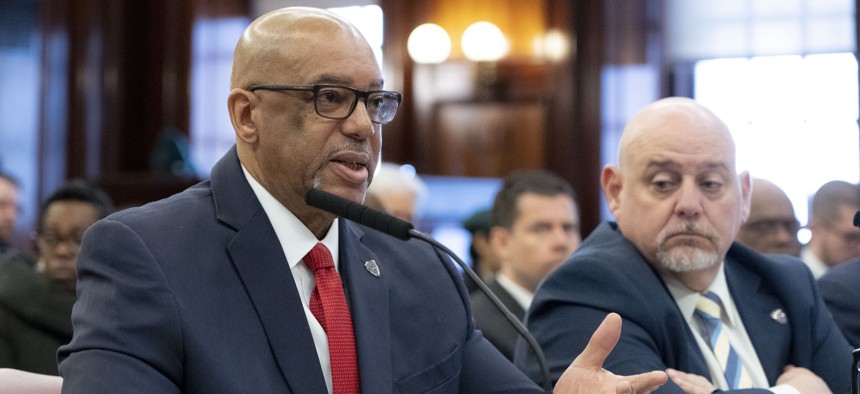
Corrections Commissioner Stanley Richards was previously incarcerated on Rikers Island. Gerardo Romo/NYC Council Media Unit



Stanley Richards is taking over the New York City Department of Correction at a crucial time.
As the newly appointed commissioner, he’s tasked with stabilizing the city’s embattled jail system – all while working to close Rikers Island and replace it with four smaller borough-based jails as the summer 2027 deadline looms. Both are massive undertakings with little to no precedent. City officials have already voiced defeat on the latter, acknowledging that the jail’s population is currently too high and that progress to build the new facilities is too slow to meet the current legally mandated deadline. Richards won’t be alone though. His appointment came mere days after a federal judge announced that former CIA officer Nicholas Deml would oversee city jails as “remediation manager” – a court-ordered arrangement that comes after years of city leaders failing to reform conditions. The two men are expected to work together closely.
Richards’ leadership under Mayor Zohran Mamdani marks a new era at the department in the wake of the Adams administration’s tumultuous oversight of city jails. As a youth, he was in and out of Rikers Island throughout the mid-1980s. He joined The Fortune Society as a reentry counselor in 1991 where he helped other formerly incarcerated people integrate into life outside, working his way up through nonprofit’s ranks to president and CEO in 2023. Richards also served in a high-ranking role at the Department of Correction during the final months of the de Blasio administration.
City & State spoke with Richards about his vision to fix the city’s jails, what he expects from working with Deml, the Mamdani administration’s efforts to implement a law banning solitary confinement and his relationship with the correction officers unions. This interview has been edited for length and clarity.
You have seen the system from multiple sides, having been incarcerated in your youth, helped people reenter society after they were released from custody and you served as the department’s deputy commissioner. How have these experiences shaped your vision for the system going forward?
When I look at the cumulative learnings of my experiences, this work needs to be centered on the humanity of everybody. I’m not interested in winners and losers. I believe firmly that a rising tide lifts all boats. In this moment, we need to do the things that allow staff to know that they are valued. We need to create and support the safety of our jails. We need to create opportunity and give a sense of hope that things could be different – for the people in our care, that life could be different for them. And for our staff, that when they come to work, their commissioner and their leaders of the agency are going to value them and make sure that they are safe. That’s what I’m going to do.
How has working with Nicholas Deml, the new remediation manager, gone so far?
Nick and I have met a couple of times so far. His official first day is March 30, but we’ve been in constant contact. We are describing our work as a partnership. We understand that this moment calls for true partnership and collaboration. Nick is charged to address the 18 contempt orders – basically our safety. My job is to create conditions that allow people in our care to be safe and allow staff to be safe. Our North Star is the same thing.
We have different experiences that we’re going to bring to the table. Both of us think about this as not relying solely on our knowledge and our expertise, but to tap the expertise that’s out there. We want to learn from others, bring that information in and assess what we are doing. At the end of the day, I want family members to know that when their loved one comes to work, that they’re going to come home and not go to an emergency room. I also want the family members of the people who are in our care to know that while they’re with us and getting their cases adjudicated, that they are going to be safe. That’s what Nick and I are going to focus on. I look forward to working with him. We’ve had really good conversations, and I’m looking forward to this work ahead.
Is the idea that eventually you’ll be working side by side from the same location?
Yes, my office is in the old chapel on Rikers. Nick has an office on Rikers in one of the trailers. We both understand that you can’t do this work from a corporate office. You have to be out here. You have to be taught. You have to be talking to officers and executive leaders. You have to be listening and observant. You have to be nimble, and most of all, you have to be consistent. I think what we’ve seen in this department over decades is inconsistency in the way that mayoral administrations have worked with the department, which has created skepticism and hopelessness and had a major impact on operations. What Nick and I want to bring is hope, consistency, fairness, accountability and transparency.
You were at Rikers recently with Mayor Zohran Mamdani for iftar. I believe that was the first time the mayor has visited city jails since he was elected. What was that like?
It was an amazing event. The mayor came out here and broke fast and prayed with the people in our care and officers, and it was pretty amazing. One of the things the mayor said was that when he looked around the room, he didn’t see blue uniforms and brown uniforms. He saw people praying, seeking the Lord, and it was just a powerful moment. He went around and shook everybody’s hand and was talking to people. He toured our veterans unit, our LGBTQ unit and really engaged with staff and people incarcerated. I think everybody left there feeling valued and appreciated.
Do you expect him to be fairly active on the ground and to visit regularly?
Absolutely, I don’t know how regularly he’s going to be coming, but he’ll be out here. The message I got from City Hall is that they want to support the department to be able to move forward. That means reducing population, making the jails safe and preparing for the borough-based jail system – putting that on track.
During your previous time at the Department of Correction, the New York City Correction Officers’ Benevolent Association had been critical of you and then-Commissioner Vincent Schiraldi. What is your relationship with COBA and the other unions like now?
I’ve got to tell you that in my experience with the union and members of services, I have felt welcomed. I have experienced a sense of hope in the department that really indicated to me that while we talk about the people in our care feeling hopeless and angry and frustrated and isolated, I think a similar experience was happening with our officers and members of service. I think that this moment, this administration, this mayor, is bringing a kind of energy and possibility to the department that is really bringing people to the table.
I’ve had good meetings. I’ve met with the captains union, I met with the (assistant deputy warden and) deputy warden union. I’ve met with COBA. What I said to them is that at the end of the day, our North Star is the same thing. We want to make sure our jails are safe and that there’s accountability. Our strategies from time to time might be different, but I think our North Star is the same. I’m very transparent with them. I’ve said I understand that previous administrations didn’t bring you to the table. That’s not going to be happening. I’m going to be operating transparently. I’m going to be bringing them to the table. I want their input. And I told them I can’t save jails without their partnership. I need their partnership, and they need my partnership.
Solitary confinement, as you know, has been a big point of contention with the union. Do you expect further delays in implementing Local Law 42, which was passed by the City Council in 2023 banning this practice?
We put together a plan as instructed by the mayor via executive order to bring city jails into compliance with the Board of Correction’s rules as well as how to come into compliance with Local Law 42. The team I’m assembling is working with members of service to implement that. We all agree that we need to have a system of accountability and we’re going to develop a system that allows us to do that.
But here’s what we’ve learned for both members of service and the people in our care: Punishment alone doesn’t reduce violence and isn’t safer. And so we need to develop strategies that allow us to hold people accountable, given the tools and legal resources we have, and also create conditions where people care more about holding on to something rather than losing it. Nick and I are talking about the kinds of things we could do to make the jail safer, while also holding people accountable in a different way.
We are now a little over a year away from the 2027 deadline to close Rikers. It’s clear that is going to have to be pushed back. The council will likely be working on that in earnest this year. How do these conversations impact the department heading into budget negotiations?
The mayor and this administration is committed to closing Rikers Island. The reality is it won’t be closed by next year, but this administration is going to do everything in our power to work with our partners to reduce population, build the borough-based jails, which are under construction and in various stages, and to do that as expeditiously and safely as possible.
Is there anything else you want to share?
I’m really defining this moment in this way, using this sort of framework: We are in a moment that is standing on a foundation of hope. Mayor Mamdani, through his multiple appointments, through the way that he’s been showing up as mayor, is clearly committed to making sure all of our work in government is centered on the humanity and value of New Yorkers, regardless of your circumstances.
That is a moment that gives people hope. But it is also a moment that requires us to manage this moment, not as a speedboat moment where we turn a corner and everything is addressed. It’s going to take partnership, nonprofit partners, our community partners, from all of government and it’s going to take time to turn the ship, but we will absolutely turn it.