

Interviews & Profiles
The man building up Gowanus
A Q&A with Sam Charney, the real estate developer who bet big on the canal.
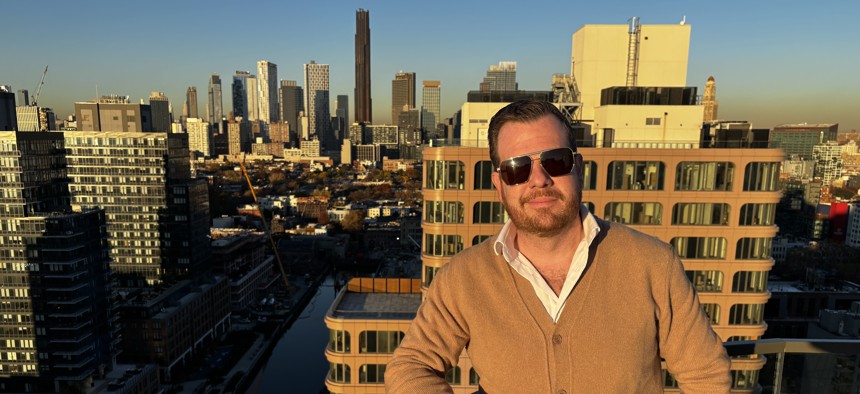
Charney Companies Principal Sam Charney on the roof of the newly opened Nevins Landing South. Jeff Coltin



The Gowanus Canal in Brooklyn used to draw comparisons to a “stinking, cancerous sore.” Now, it’s being likened to the finest cities in Europe.
“I had some friends in town from Greece and Italy over the weekend,” real estate developer Sam Charney recalled, “and they were like, ‘This neighborhood reminds me of any Scandinavian port city, like Copenhagen or Stockholm, Amsterdam.’ Canal, city, northern architecture, repurposed warehouses, new architecture on repurposed ports – really cool to draw that analogy.”
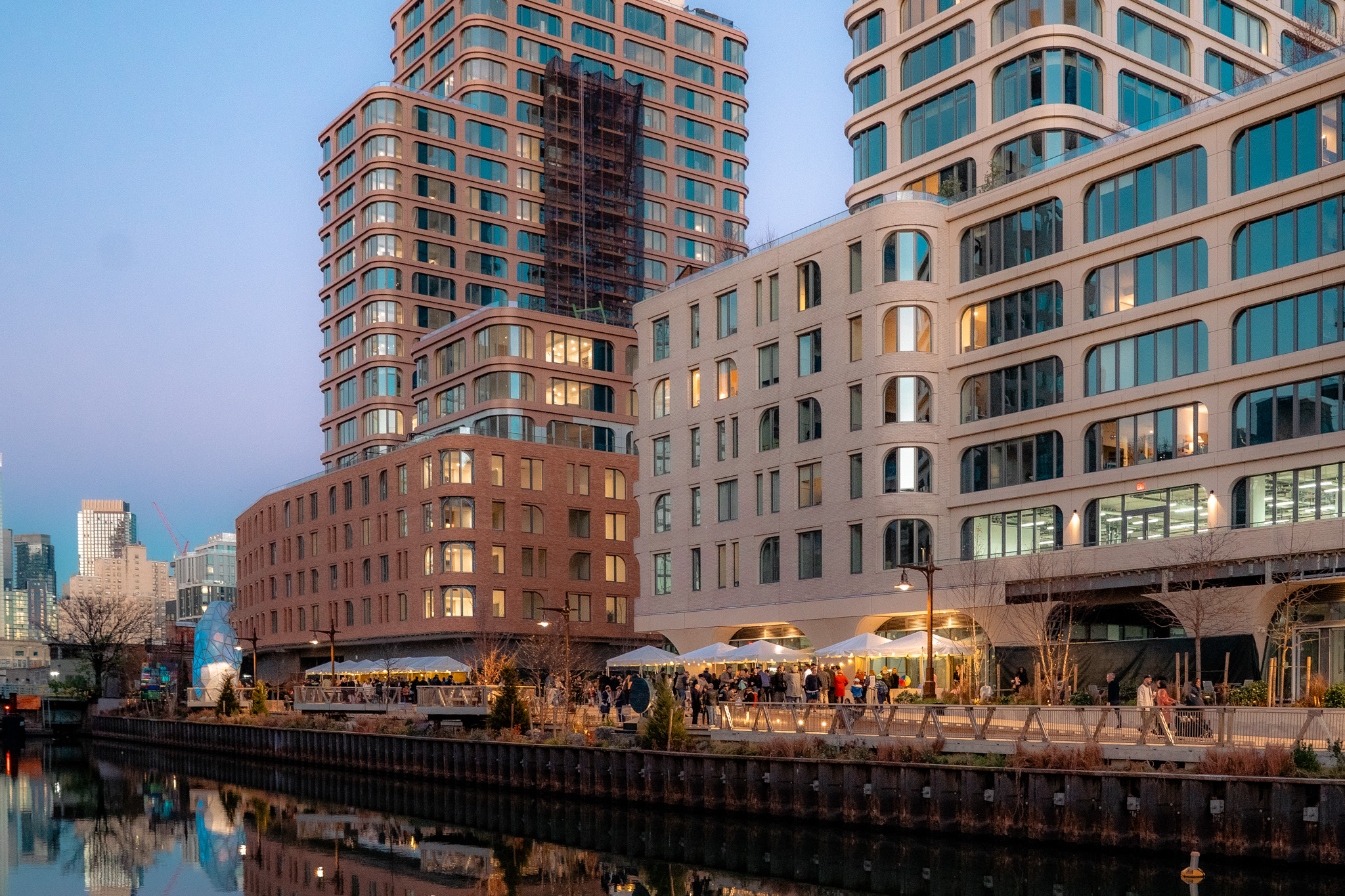
His firm, Charney Companies, has recently finished four buildings, totaling 1,200 apartments, right by the canal, and has started construction on a fifth that’ll have 1,100 units on its own (and is being designed by the starchitect Bjarke Ingels, who happens to be from Copenhagen). Charney is the biggest developer in a neighborhood that’s being entirely transformed.
While other developers were leaving after the COVID-19 pandemic to work in Florida, the New York City native decided to make a bet on Gowanus, which the city was rezoning to allow for housing – if they could ever finalize an agreement, after 12 years of planning and discussion.
“We’re either going to be idiots and bankrupt, or we’ll have really created something special for New York,” Charney said about buying the land to build on. “We put ourselves in a position to be lucky.”
City & State caught up with Charney in a residents lounge in one of his buildings, Nevins Landing South, just before he cut the ribbon on the canal-front park, dotted with public art. He talked about expediting ULURPs, why banning brokers’ fees wasn’t the end of the world, and why Albany needs to find a way to get developers building more than 99 units at a time. This interview has been edited for length and clarity.
Did you start planning here before the Gowanus rezoning was passed, in 2021?
We were very much early adapters to the rezoning in this neighborhood. Not many people were buying land here, taking the entitlement risk. We were speaking with former Mayor Eric Adams and (former City Council Member) Brad Lander and a bunch of other people who were involved in this rezoning, and got a good sense that it was going to happen. There was a small, kind of rogue group called FROGG which was Friends (and Residents) of (Greater) Gowanus, who were fighting this rezoning and actually appealed it after it got done – they did an Article 78 to sue against the rezoning.
It’s one of those things that just works so well. You’ve got the cleanup of a Superfund site in the canal. You’ve got individual private landowners to pay for (New York State Department of Environmental Conservation) standard remediation, really top notch remediation, all over the neighborhood. And then you’ve got mixed-income buildings with deeply, permanently affordable, units. So it’s a huge win. Ground floor retail and public parkland along the canal. Just a really, really smart partnership, public and private. It’s one of the few rezonings where the city really, really got it right.
It was a very slow one, famously. Lander was working on that his entire tenure in the council. You’re happy with the final result, but is there a fundamental problem with the land use system?
Very slow. Very slow. Definitely. I mean, thankfully now there are ELURPs (Expedited Land Use Review Procedure) and they’ve done things to take away what used to be an almost kiss-the-ring process with the local council member, where they had the final vote and everyone was beholden to their final vote.
So now at least it’s more of an advisory position than a definitive (judgment.) I think a lot of the reason it lasted so long and went on for so long is you just had so many different parties – and they always do in New York, right? – so many interested parties, invested parties that want different things. And people flip-flopped. People wanted more affordability. They wanted less affordability. They wanted prevailing wage. They wanted affordability. You had a lot of people that had their hands in the proverbial cookie jar looking for things, and that’s what happens when a rezoning goes down. So yeah, took a long time.
Now the ELURP process is in effect – do you have any potential developments bubbling in any of those “bottom 12” districts?
We’re involved in something right now – I can’t disclose what it is – but we’re hopeful it will be an ELURP and not a ULURP. We are learning more as the days go by.
And that’s a relief to you?
100%. Thank God, right? This (Mamdani) administration is very much pro-housing. We walked (Buildings) Commissioner (Ahmed) Tigani through our buildings two weeks ago. He was really excited to see what we’re doing here and what we’re building. He was super impressed with the quality and what we do. And the administration, if they truly want to solve for the affordability crisis – which, by the way, has always been here. All of a sudden it’s the buzzword, “affordability crisis.” New York has never really been particularly affordable. It’s always been a place that capitalism thrives. The best and brightest come here and they work the hardest, and generally they’re able to figure it out one way or another. And it’s a shame that we haven’t kept up with the amount of housing that we needed to build over the years to continue that level of affordability, which wasn’t affordable, but was, for the time, relatively speaking, affordable. Now we’re really in a bad situation.
I think the city realizes that, and they’re doing everything they can to allow for more units to get built. Expedited processes. We got a (Temporary Certificate of Occupancy) on this building in two weeks – from submitting our final package to DOB to TCO in two weeks is unbelievable. Generally that was a six- to eight-week process, so it was really nice to see.
You said the Mamdani administration is pro-housing. Are they pro-existing-housing, or only pro-future-housing?
I think the administration is more pro-new housing than existing housing stock. I hope they are pro-housing at all different levels. The reality is that New York needs all different types of housing. Everybody can scream at the top of their lungs that we need a more affordable city, and we do. But you also need the high taxpayers who are going to subsidize New York City. So we have to be building high-end, luxury condos. We have to be building luxury rentals. We have to be building mixed-income rentals. We have to be building all-affordable projects. We need everything. And the tool that the city has without a viable tax abatement – and I’m hopeful that things change with the budget early next year – is upzoning and rezoning. So I think that they are really paying attention there, and we’re going to start to see some serious upzonings – or at least, I hope.
The pied-à-terre tax caused an uproar among real estate players and “high net worth individuals.” What do you think of that reaction? Was it overplayed? And how did the Mamdani administration handle it?
I think it’s a fine tax to put into effect, I don’t think it’s super troublesome. It exists in lots of other major international cities all over the world. I’m generally a little confused by politicians picking and choosing things to tax. To me, simple is always better. I’m a big proponent of just raising the tax brackets. The wealthiest can certainly afford to pay an extra half a percent or percent, right? And that will reap way more tax dollars than little, nitpicky, picking-around-the-edges taxes like a pied-à-terre tax.
It’s been a year and a half since the FARE Act banning mandatory broker fees went into law. What effect has it had on the market?
I honestly have not seen an effect on the market. All I’ve seen is brokers losing jobs. And that’s unfortunate. There were a lot of brokers out there whose livelihood were these fees and their businesses are effectively done. But that’s literally the only effect that I’ve seen on the market. Just lots and lots of brokers who used to specialize in collecting fees to show units, effectively overnight losing their business. And I feel bad for them.
We're coming up on the 2027 legislative session. Reforming the Scaffold Law was the talk of Somos, and Gov. Kathy Hochul has said she’s interested. Is there a deal to be made?
Yeah. Insurance costs are rising everywhere. It’s not just scaffolding. We’re seeing it tenfold in building insurance, like operations insurance, not just construction insurance. And it’s really difficult to keep up with. I’m not sure what they can do to really regulate it. I’m hoping that they can do something because we’re seeing it on all ends. I think it’s ambitious, but we’ll see.
Cranes too. We had this conversation with Tigani when he was here. You look around the country, and you see tower cranes everywhere. For like, three-story buildings, they’ll put a little tower crane. It’s like an old-school Erector set they used to play with as a kid. But because we’ve had a couple of bad actors in New York City and a couple of tower crane accidents that have been tragic, tower crane insurance is wildly expensive, so most developers try to build without using a tower crane. And it’s a shame because it’s one of those things that would really expedite building if the tower crane didn’t add such a wild expense to your project.
There are other things like that that we brought up with the commissioner as well. Elevators count as floor area in your building, but they’re not a floor. There’s actually only one floor, right, it just travels up and down the building. So a lot of developers will look at a project and say “maybe I can get away with two instead of three elevators here.” And that’s probably doing a disservice to the building because you're going to have slower travel times for people. God forbid if there’s a fire, FDNY might not have as much elevator access as they need. But if you’re going to ask a developer, is he gonna put an elevator in, or is he gonna take 100 square feet on every floor for a 50-story building – that's 5000 square feet – especially if it’s worth $2,000, $3,000, $5,000 a foot in Manhattan, he's going to take the square footage every day of the week. Simple things like that need to be changed as well as building code things that we do in New York.
We use shielded wire in New York City, referred to as BX in the industry. Nowhere else in the country uses shielded wire. The wire is in a fire-rated wall anyway. It doesn’t need to be shielded. We do it here because it was part of electrical code a long time ago. The same thing with cast iron pipe and copper pipe; those are very labor-intensive assemblies in the field. Everywhere else, again uses PEX pipe, plastic. They use PVC for waste. Really, really simple to cut. Really simple to assemble and use. We’re still using arcane technology in some of our buildings in New York.
Is there any particular legislation that excites you in the upcoming session?
Top priority’s got to be 485-x, right? (Reforming the tax incentive meant to spur affordable housing production.) Got to be. Mayor Adams said this, and I think it was really brilliant: Real estate, to New York, is what oil is to Texas. And if we are not building here, we are not going to have the tax assessments and the revenue that we need to continue to operate New York City at a high level. So if developers are stuck building 99 units or less in tons of neighborhoods because we’re avoiding the prevailing wage cap, then we have a real, real problem, and we’re not going to get even close to the amount of units that we need to be building. So there’s a dance here that has to happen. We’re not saying that every project should be built non-union. We’re just saying that, to be building buildings that are above 99 units, and getting into prevailing wage, you have to understand the economics don’t work.
And we are more than happy to talk about those economics. I am thrilled when I get a politician who’s willing to sit down with me and actually go through the math and understand that this doesn’t work. And I think to most of the laymen out there, they look at it and they say, “So the developer is only making this and not making that? Who cares?” The reality is, it’s not the developer. Most developers are merchant developers, like I am. We’re using other people’s money. We’re not multigenerational. I come from a father who was a doctor and a mother who was a musician. Before them, my grandparents were teachers. No one was in real estate. A lot of developers are like that. We’re not multigenerational. We’re using what's called LP capital from private equity funds, or hedge funds, or large banks, and if they’re not getting the returns that they need to see in a project in New York City, there are 49 other states and hundreds of other cities that they can go to and build in.
Are we in a 99-unit building, by the way?
(Laughs) No, we’re not. Because it’s a 421-a project. It’s an old program project. Everything that we have built in Gowanus is a 421-a project, as is our new 1,100 unit site over at 175 Third, because a pile was put in the ground and vested before the program expired. Actually done by (the real estate company) RFR, who we bought the site from.

You’ve said you got opportunities in Gowanus because other firms were moving to Miami. Do you only work in New York?
Yeah, we only work in New York.
Do you have dreams of working anywhere else?
Not really. I love it here. I grew up in Manhattan. Our offices are in Long Island City. I spend most of my waking days in Brooklyn and Queens. To me, they’re the most interesting places to be. The Brooklyn and Queens of today remind me of the Manhattan of the 1980s that I grew up in. There’s still interesting mom and pop retail, neighborhood retail. There’s less density. Which look, as a developer, I shouldn’t be crying about density, right? We’re talking about solving the affordability crisis here, obviously, we need to build more. But I do like the feel of a neighborhood when it’s not immensely dense and you can walk around and still have a little bit of breathing room on the sidewalk.
You’re based in Long Island City, you've built in Long Island City. What do you think of Mamdani and Trump talking up Sunnyside Yards? Quite a moonshot.
I would love to see it happen. There was an RFP – God, this must have been 10 years ago – for the southern portion of Sunnyside Yards, in Long Island City. And we had looked at that RFP. Ultimately, (we) never ended up moving forward. And what we found – and I think this is common for all rail overbuild sites – the cost of shutting down the railways, putting footings into place, piles, etc., and building that platform over the land is so expensive that the land has to be free. Like you’ve got to literally just designate to developers and say, “Here you go, free land.” Because your platform cost is going to be more than what regular terra firma would cost. So you’re going to have to do that, you’re going to have to abate it with taxes. Everything comes down to economics. If it’s viable – and I think we might have to subsidize – but if it’s viable, we should 1,000% do it. Like, what a great place to be building. Any of the rail yard overbuilds that have happened up to this point have been great to create housing, whether Hudson Yards or Atlantic Yards. So, I’m all for it.
Have you had challenges marketing new homes in Gowanus, given that New Yorkers like yourself associate it with a polluted canal?
Interestingly, no. Like zero. There’s two reasons for that. One, again, there’s no housing available. So you have people that live in Park Slope, Carroll Gardens, or want to live in the surrounding Brownstone Brooklyn neighborhoods, but want a new product. You cannot find it in any of those neighborhoods because generally they’re low-scale, from a zoning perspective. A lot of them are landmarked. So if you want to be close to those neighborhoods, this is your option.
The second part of that, which I think is the most important part, is that these sites are actually the cleanest places to live in New York now! Everything in the boroughs is contaminated from high, high industrial use forever. But these sites have been thoroughly remediated to state and city standards. In fact, 251 Douglass, it was a site from National Grid, from Brooklyn Union Gas back in the day. So there was coal tar … there were lots of really ugly contaminants under this site. We created a monolithic block of concrete, 30 feet deep, on the entire site – it’s called intersoil stabilization – to make sure that all of those contaminants are locked into place under concrete. Traditionally you would just put a cap on top of everything. We actually froze everything in place so that it will never travel with groundwater and it will never seep out, vapor out, nothing. That’s like the cleanest it gets, right? Basically living on bedrock. I don’t know if everybody understands that or knows that. I do think that there’s probably still a stigma with the neighborhood, but I will tell you that the canal is clean now, cleaned up to EPA standards, federal standards. The pumping station is getting completed down at the tail of the canal.
Would you swim in it though?
Nooooo. I wouldn’t swim in any body of water near New York City! I mean, would you go in the Hudson or the East River? I’d like to avoid my hepatitis.