

Education
The education challenges the Mamdani administration faces
A wholesale end to mayoral control of schools will not be among them, despite what Mayor-elect Zohran Mamdani said on the campaign trail.
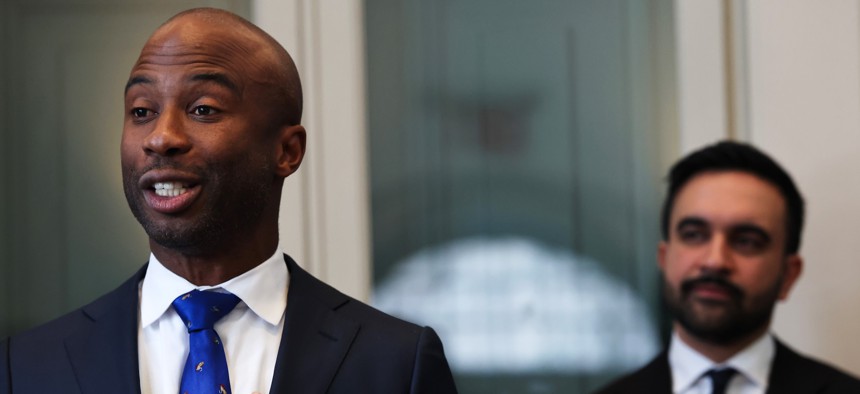
Kamar Samuels was named Zohran Mamdani’s schools chancellor. Spencer Platt/Getty Images


Mayor-elect Zohran Mamdani will soon assume control of the nation’s largest school system where he will confront a bevy of challenges ranging from teacher recruitment to enrollment declines to significant federal funding cuts.
Leading that effort in his administration will be Kamar Samuels, who Mamdani announced as his schools chancellor on Wednesday. City & State first reported on Tuesday that the Manhattan superintendent was Mamdani’s pick for the challenging job.
It’s a huge system with over 135,000 employees and more than 900,000 students. Though multiple candidates were in the running – including current Schools Chancellor Melissa Aviles-Ramos and former Schools Chancellor Meisha Ross Porter – Samuels won out, and has no shortage of fans who praise his work in Manhattan. He started his career at the Department of Education as an elementary school teacher in the Bronx.
“We will fully fund public schools. We will invest in recruiting and retaining educators, especially in special education,” Samuels said on Wednesday.
But Mamdani’s announcement also came with a surprising pivot on one of Mamdani’s few education policy stances. After saying on the campaign trail that he wants to end mayoral control of schools – stating the current system has too little input from families and educators – Mamdani said Wednesday that he will in fact ask the state Legislature for an extension of mayoral control. Rather than ending it, he now says he will improve upon the current system to create more input from those stakeholders.
To bring you up to speed, here’s a run down of the big education policies Mamdani has previously announced.
Early childhood education
Of the many affordability-centric policies Mamdani has trumpeted, implementing a truly universal child care system is perhaps the most ambitious. His promise to make child care free for every New Yorker between the ages of six weeks and five years old would come with a colossal $6 billion annual price tag – and that’s just a rough estimate – not to mention an avalanche of logistical and operational challenges. But it’s also one of his more popular ideas, subject to an unusual degree of political openness. More than half of New York City families with children under the age of four are unable to afford child care, and it’s one of the leading reasons families are leaving the city.
Mamdani also announced on Wednesday that Emmy Liss, a co-founder of New Yorkers United for Child Care, will be a leader in the administration’s work on the issue as the new executive director of his Office of Child Care.
Gov. Kathy Hochul has voiced support for universal child care, saying she wants to work with Mamdani to make it happen. (Though she has so far shut down the idea of a tax hike on the city’s wealthiest earners, which is the primary way Mamdani has proposed paying for the program.) Incoming City Council Speaker Julie Menin and a bevy of other state and city elected officials are also on board. As is the public. A recent poll from Siena University found that nearly two-thirds of New Yorkers support raising taxes on the wealthy to pay for universal child care.
Pre-K and 3-K, which respectively serve 4-year-olds and 3-year-olds, is basically universal in New York City right now, kickstarted by the de Blasio administration’s ambitious efforts several years ago. While it’s complicated – waitlists are staggeringly long in some neighborhoods and experts say there’s still some unmet demand for 3-K – about 101,000 of the city’s roughly 195,000 3 and 4 year olds were in a free program last year, according to Chalkbeat New York.
Mamdani’s plan would expand programming to include children 2 and under. To do so, the staffing needs would be immense as younger children require more teachers. Their needs also vary, meaning small, home-based child care providers would be in far greater demand. Mamdani has said he would open more child care centers, prioritizing existing public school buildings and city space. He’s also said he would push to ease regulatory challenges to make it easier to open new programs and to hire more providers. And perhaps most importantly, he’s promised to implement “pay parity” for early child care workers on par with public school teachers to help with recruitment. While Mamdani has yet to detail how exactly he’d roll out his vision, many education advocates like New Yorkers United for Child Care have encouraged him to start by implementing universal child care for 2-year-olds. According to the organization and estimates from Comptroller Brad Lander’s office, this would cost about $1.3 billion each year.
"Families are spending $20,000 to $30,000 a year or more on child care and it’s become unsustainable,” said Rebecca Bailin, executive director of New Yorkers United for Child Care. “This moment is ripe. I’m really hopeful … for this administration who will hopefully take the problem of child care affordability head on instead of running away from it.”
Mayoral control
Mamdani campaigned on ending the current system of mayoral control, setting up what would have been an enormous shift in school governance under his tenure. But at Wednesday’s announcement, he pivoted from that stance, saying that he will ask the state Legislature for an extension of mayoral control powers, but aims to improve upon it. “I will also be committed with my incoming schools chancellor to ensure that the mayoral control we preside over is not the same one that New Yorkers see today,” he said Wednesday. “It will be one that includes more involvement, more responsibility, more accessibility of the current processes that parents are told to engage in, but so often, either do not know about, do not know how to be a part of, or do not see the need to do so, given how limited the scope is.”
As it currently stands, the state has given the New York City mayor almost complete power over the public school system for more than 20 years. This allows the mayor to unilaterally appoint the schools chancellor and to select most of the members on the Panel for Educational Policy, which runs the city Department of Education. There are pros and cons to having power be centralized in this way. Debate has been robust and Mamdani’s desire to shake up the system will no doubt reignite it. On one hand, mayoral control makes it easier to implement much needed system-wide reforms and makes it clear who is responsible for schools’ collective performance. Critics meanwhile argue that mayoral control blunts parents, students and educators’ influence over how schools are run.
Mamdani had previously proposed replacing the current system with what he’s called a “co-governance” model, which would better incorporate feedback from other voices. Specifics on that original plan were scant, and Mamdani shared few specifics on Wednesday for what a new and improved version of mayoral control would look like.
Gifted and talented programs
Another way Mamdani has proposed shaking up the school system is by eliminating gifted and talented programming for kindergarteners. The most controversial of Mamdani’s education proposals, this is something he’s argued would encourage school integration – one of his campaign policies. This would impact only a slice of students. Less than 4% of kindergartners were enrolled in gifted and talented programs during last school year.
Mamdani also said Wednesday that enrollment for Gifted and Talented for Kindergarteners is currently open, and he would not take action to disrupt the current period. The range of students in the program diversified significantly under Mayor Eric Adams, Chalkbeat reported, owing to a change in the admissions process.
Teacher recruitment
Hoping to make it easier for the city to comply with the state law mandating smaller class sizes, Mamdani has proposed offering college students $12,000 a year in tuition assistance in exchange for their commitment to teach in the city’s school system for at least three years. The initial program incorporating 1,000 students would cost about $12 million each year – paid for by cutting extraneous contacts within the Department of Education.
A state law passed in 2022 mandates that all classrooms in the New York City school system must be capped between 20 and 25 students by 2028. While these requirements are being gradually phased in, teacher recruitment remains a massive hurdle. The Independent Budget Office for example estimated in 2023 that the city will need to hire roughly 18,000 additional teachers to meet the law’s demands.