

Budget
Business as usual: Lawmakers pass second one-week budget extender
Lawmakers popped back to Albany for a few hours to pass a bill to fund state government for another week as talks drag on.
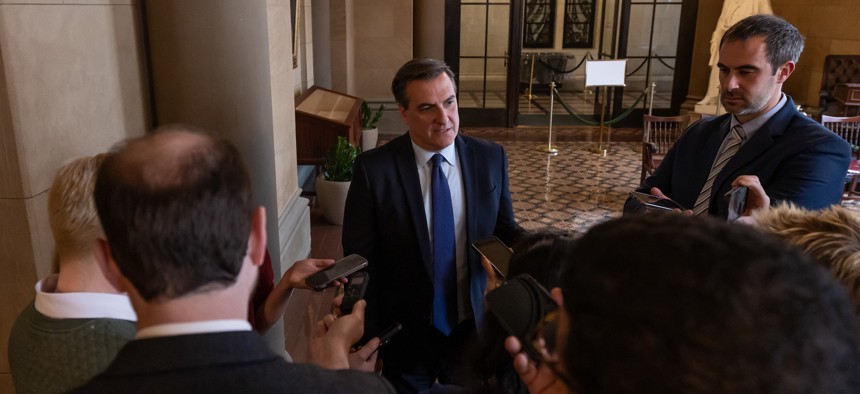
State Senate Deputy Majority Leader Michael Gianaris speaks to reporters after lawmakers pass a one-week budget extender on April 7, 2026 NYS Senate Media Services


With a second week-long extender in the books, this year’s budget process certainly looks different from those in years past. But several Albany lawmakers seem to welcome that.
The Legislature briefly returned to the Capitol on Tuesday to pass another budget stopgap bill that will keep state government running through April 14 as leaders plod through spending talks.
It marks the second one-week extender in a row for lawmakers — issued at the direction of Gov. Kathy Hochul, who’s knee-deep in serious negotiations with Senate and Assembly leaders. And it’s a change compared to past years, when Hochul would offer two- or three-day extenders that had legislators headed back and forth from Albany even as negotiations dragged on.
This year, state leaders have been at odds for weeks over changes to the state’s landmark 2019 Climate Leadership and Community Protection Act, as well as Hochul’s push to reform car insurance and update the state’s environmental review process. And they haven’t even had a chance to discuss other thorny issues, like potential tax increases on the wealthy.
“We have had many, many meetings with the leaders, literally, starting in the fall on a regular basis,” Hochul told reporters Monday. “There is certainly a lot of communication, a lot of give and take, a lot of conversations going on, which I think is really important to the process.”
Hochul has become known for budgets that go weeks past the April 1 deadline, and they’ve only gotten tardier. The budget was one week late in 2022, 32 days late in 2023, 20 days past the deadline in 2024 and a whopping 38 days late last year – pushing negotiations into May.
It’s a hallmark of Hochul’s strategy to wear down lawmakers until they concede to her spending priorities. But that hasn’t seemed to frustrate legislative leaders this session – or at least, not yet. State Senate Deputy Majority Leader Michael Gianaris said the longer negotiation timeline has become business as usual.
“I think it’s built into people’s expectations,” Gianaris told reporters on Tuesday. “It’s just seeing reality. We’re not imminently closing the budget, so why hold everyone here unnecessarily?”
None of the issues holding the minimum $263 billion spending plan up are closed down, Gianaris said, and leaders still haven’t talked table targets. On the floor, Assembly Ways and Means Committee Chair J. Gary Pretlow said some discussions have taken place about a costly push for Tier 6 public pension changes, but he declined to give more details to his inquiring Republican colleagues.
Gianaris expects the final budget will include a deal to counter President Donald Trump’s mass deportation agenda, a change from the original plan to pass standalone immigration measures.
“A late budget is not ideal, but as long as you’re moving the extenders and it’s not too long-lasting, it’s very manageable,” Gianaris said.
While late budgets and slower negotiations have become customary, week-long extenders have not. Typically, the legislation necessary to pay state employees on time only pushes the deadline to adopt a spending plan out a few days due to a series of staggered pay periods for different public workers. But the holidays of Passover, which ends Thursday, and Easter encouraged the governor to set the first two extenders on week-long timelines.
Assembly Member Jo Anne Simon said the longer delay allows members to properly observe the holidays. “I think it shows that the governor is sensitive to people’s religious observances,” she said, adding she had little information about how talks were progressing.
Assembly Member Al Stirpe said the one-week extender is kinder to lawmakers and gives leaders adequate time to have productive discussions.
“Maybe they’re trying to be nice to us,” he said. “We can leave and go back to our districts and actually do something. The worst part is having to just stand around and wait for somebody to say ‘Well, there’s an agreement.’ Us just spending money being here without any chance of accomplishing anything is really not very smart. So in that respect, it’s a good thing we’re doing it this way.”
The three people in a room haven’t reached an agreement on changes to the state’s climate law – a pivotal debate as Hochul and all members of the Legislature are up for election this fall. Stirpe said some members of his conference have expressed a willingness to find a compromise with the governor on the release of cap-and-invest rules or other mandatory regulations the state must issue to hit its climate goals. A judge ruled last year that Hochul needed to release the regulations by February after environmental advocates sued Hochul for blowing past the 2024 deadline. But her administration appealed the ruling, prolonging the legal battle.
According to Stirpe, some of his colleagues are open to accepting a new statutory deadline of 2027 – three years sooner than the 2030 deadline Hochul proposed. Either change would render the current lawsuit moot. But Assembly Environmental Committee Chair Deborah Glick said overall, little movement has taken place as the governor hasn't given ground for a compromise yet.
"At this juncture (there is) no agreement on anything," Glick said in a text message to City & State. "Movement requires a bit more flexibility on (the governor's) part." She also added that Hochul should simply settle the lawsuit.
On Hochul’s priority of car insurance reform, Stirpe said talks have been productive even as some reservations persist. Several lawmakers have criticized Hochul’s attempts to lower insurance premiums by limiting how much a driver responsible for an accident receives in damages. They doubt the changes would have the intended impact.
When it comes to the governor’s proposals, Stirpe said, “95% of it, we’re OK with, but I think she’s starting to realize there’s something to some of the comments people in the conference are making, and they’re looking at ways to accommodate us.”
The Assembly member said he hopes leaders will give lawmakers plenty to conference when they return to Albany next week – agreeing it’s possible to adopt a final budget this month.
But don’t get used to the week-long reprieves. Gianaris said he expects future extenders to only be for a few days at a time, keeping with Hochul’s previous patterns where the budget is late, but not too late.
“Hopefully we’ll be able to shut it down; next week, we expect to be a full week here,” Gianaris said. “I don’t think this is going to be an ongoing one-week at a time thing.”
Rebecca C. Lewis contributed reporting.
NEXT STORY: City Hall cut references to ‘DEI’ from NYC racial equity plan