

Budget
Immigration budget deal within reach as lawmakers pass fourth extender
Budget negotiations are in full swing with no end in sight as the Legislature circles a deal to bar local police from working with ICE.
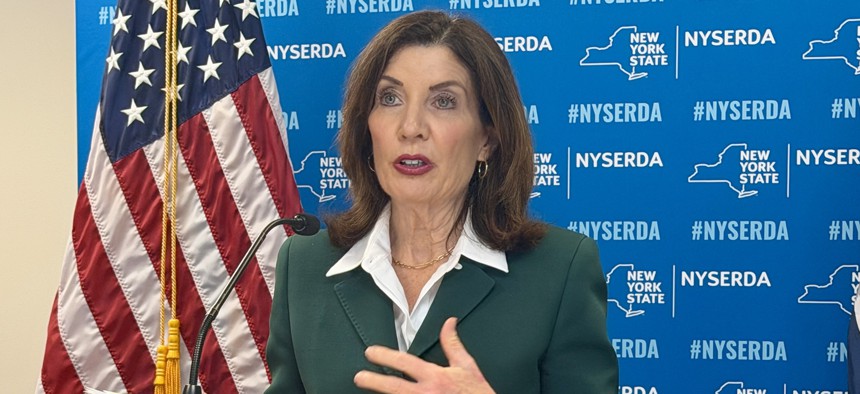
Gov. Kathy Hochul speaks to the press about her immigrant protection proposals on April 16, 2026. Kate Lisa


As state lawmakers met in Albany to pass the fourth budget extender, state Senate Deputy Majority Leader Michael Gianaris called a public dustup with Gov. Kathy Hochul over auto insurance earlier this week “the distant past.” Even if they’ve moved past those tensions, the latest quarrel revolves around immigrant protection measures as the Legislature and executive close in on a compromise they’ve been trying to iron out for months.
Shortly after lawmakers passed another stopgap measure on Thursday, which will keep the state government open through Monday, Hochul told reporters at an unrelated event in Albany that she and legislative leaders have made substantial progress on a package to strengthen protections against U.S. Immigration and Customs Enforcement misconduct. The governor unveiled several new measures including a prohibition on local police sharing information with federal agents in most cases. Police would still be permitted to coordinate with ICE to assist with criminal convictions, or if officers have probable cause that they committed a serious or violent offense. (It remains murky exactly which crimes would qualify.) Under the governor’s proposal, local police could transfer people convicted of a misdemeanor or felony crime to ICE, but not people convicted of an infraction or violation.
“Local cops should be focused on local crimes, keeping our streets safe, responding to emergencies, going after gun traffickers and violent offenders,” Hochul said. “This is something supported by many in law enforcement who want to make sure that they can focus on the communities where the taxpayers are paying their salaries to do their jobs and protect them – not doing ICE’s job.”
The law, expected to be inserted in the state budget that’s now 16 days late, would prevent ICE from making arrests in sensitive locations like schools and houses of worship, and would ban local law enforcement agencies from having 287(g) agreements to cooperate with federal immigration officers. It would also bar ICE from using local jails for civil enforcement. But Hochul stressed that local police will continue to help federal law enforcement track down and prosecute people accused of certain violent or serious crimes – not jaywalking or a traffic stop.
“If the only offense is the act of crossing the border, we’re not constituting that as a criminal act for purposes here in the state of New York,” she said.
The governor’s proposed additions would also prohibit members of any law enforcement agency from wearing face coverings and prohibit non-law enforcement agencies from sharing information with ICE. Both proposals have had support from lawmakers.
“I’m announcing where I am right now,” Hochul said. “I was very clear that the conversation will continue (and) I'm looking forward to the feedback from (legislators).”
But the deal isn’t buttoned up yet – nor are any of the other outstanding policy items holding up the adoption of the minimum $263 billion spending plan. Some lawmakers have expressed concern the proposal could undermine an existing executive order meant to protect immigrants and that the probable cause provision is a step in the wrong direction. “Letting police collude with ICE if they think there is probable cause a crime (occurred) will harm immigrants, and people who look like immigrants,” state Sen. Andrew Gounardes wrote on X. Gounardes is the sponsor of the New York for All Act, which includes even more comprehensive immigrant protections and has the support of many lawmakers.
Progressive advocacy groups are also fighting against Hochul’s proposal to include a carve-out for probable cause – arguing it would embolden police to turn New Yorkers over to the federal government based on personal biases.
“Black and brown New Yorkers – immigrants and citizens alike – are being targeted by immigration officials while going about their lives,” Make the Road New York co-executive director Natalia Aristizabal said in a statement. “To give police such wide discretion over something as consequential as pulling people away from their loved ones is simply unacceptable and could put a damper on future efforts to protect immigrants.”
Democrats in both chambers conferenced Hochul’s latest immigrant compromise package, a sign of movement that the issue may be approaching a conclusion. But the feedback so far has been mixed. “People are happier with the progress, but I still think our conference would – particularly in an instance where someone's committed a serious crime – they'd rather that person see justice, rather than just a quick exit out of the country,” Assembly Speaker Carl Heastie told reporters on Thursday.
Lawmakers are expected to pass a fifth budget extender by noon Monday as other significant sticking points remain unresolved, including the governor’s proposals to roll back the state’s 2019 climate law, reform car insurance liability policies and modernize the state environmental review process.
And the governor’s pushing a new “pied-à-terre” tax proposal for owners of luxury second homes in the city who primarily live outside the five boroughs. She suddenly thrust that proposal into budget talks this week to appease New York City Mayor Zohran Mamdani and his progressive supporters who have insisted on increase taxes on the richest New Yorkers. Gianaris said the tax, which is expected to generate about $500 million annually for the city and help offset a $5.4 billion municipal deficit, is important to help the city as Hochul continues to reject raising personal income taxes for millionaires and billionaires.
“She’s come up with another way, which I think is fine,” Gianaris told City & State. “If she finds the money, we’re game.”
Budget talks will continue over the weekend, and Gianaris he’s holding out hope that some of the nine remaining budget bills could be printed late next week.
“We’re getting there,” he added.