

Budget
Lawmakers pass fifth extender as budget talks lag
Leaders continue to slowly plod through policy items holding up the late spending plan.
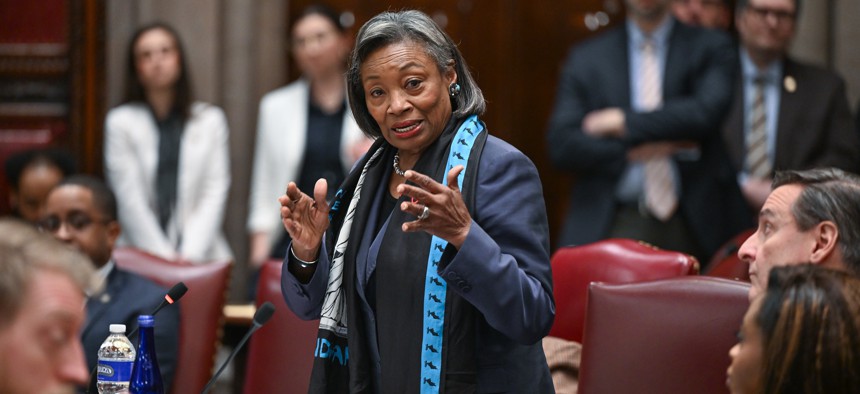
State Senate Majority Leader addresses the Senate on March 12, 2026. NYS Senate Media Services


If you haven’t been paying attention to the ongoing state budget negotiations happening in Albany, fear not. You haven’t missed much over the last three weeks since state leaders blew past the anticipated $263 billion spending plan’s April 1 deadline.
State lawmakers voted to pass a fifth, $5.1 billion budget extender Monday, with the next stopgap bill expected on Wednesday. But lawmakers don’t seem any closer to closing down controversial policy issues that – as always – have gummed up the process.
Although Assembly Speaker Carl Heastie told reporters that leaders were “on the same planet” when it came to talks – a slight improvement than his previous assessment of “the same galaxy” – progress has been slow going.
“As far as the discussions that are going on, unfortunately, we have not started the game yet – there’s a rain delay,” Assembly Ways & Means Committee chair J. Gary Pretlow said on the floor – continuing an analogy comparing ongoing talks to a baseball game. “We’re still doing batting practice, but the good thing about batting practice is it makes the game a lot more exciting.”
Pretlow on Monday told inquiring Republicans that lawmakers have not seen draft language of Gov. Kathy Hochul’s proposed pied-à-terre tax on luxury second homes, the immigration package, Tier 6 public pension reform, auto insurance liability changes, modernizing the state’s environmental review process or specifics to roll back the 2019 climate law. And Pretlow said it’s unclear how long the next extender will be.
State Senate Deputy Majority Leader Michael Gianaris nonetheless expressed optimism about negotiations. “We’re starting to feel that desire to start wrapping things up,” he told reporters Monday. “So hopefully that will result in agreements.” But he said he had “nothing to share publicly” in terms of language in the mix.
Legislative leaders still haven’t signed off on a push to create a secure area around houses of worship where protestors could not demonstrate. There’s disagreement over how large to make that buffer zone, with proposals for both 25 feet and 100 feet still on the table – and concern about costly litigation. Heastie, who has the bulk of the reservations about the proposal, privately met with Jewish members about the details in the Capitol on Monday.
At the annual Somos conference in Albany over the weekend, Heastie told reporters that some Assembly members feel it would be better to leave the buffer zone up to the discretion of local police departments.
“Some members in the conference support it and some don’t,” the speaker told reporters late Friday at a reception for state comptroller Tom DiNapoli. “The Orthodox community is a little more concerned about the 25 feet, they feel that they often get (a larger area of protection) when you leave it to the New York City Police Department. And if you put just the 25 feet into statute, then the NYPD is just going to follow the 25 feet. So we haven’t figured that out.”
And Hochul has offered very minor updates on her proposed rollbacks of the 2019 Climate Leadership and Community Protection Act, according to sources familiar with negotiations.
The governor has floated an implementation date of 2029 for necessary regulations, one year sooner than the 2030 deadline she originally proposed. That’s still two years later that the 2027 date legislators and some climate activists and legislators have indicated they would accept as a compromise. The rules were due in 2024, and Hochul has continued fighting a lawsuit over the missed deadline.
Sources also said it’s unclear how binding any new interim emission reduction targets will be from the governor. With state regulators already acknowledging New York won’t hit the 2030 benchmark of a 40% reduction in greenhouse gases compared to 1990 levels, the next statutory target doesn’t come until 2050. Hochul had proposed a new 2040 target in her original pitch on the CLCPA this year, but the strength of the language around new benchmarks is nebulous at best.
The governor proposed adding language to the statute specifying the kinds of rules and regulations the state must enact in order to meet its goals, which includes cap-and-invest. Current law only requires the state to enact regulations to meet its climate goals, which includes net-zero electricity by 2040 and an 85% emissions reduction compared to 1990 levels by 2050, but does not specify the actual regulations. An advisory committee tasked with helping to implement the CLCPA recommended the creation of a cap-and-invest program, but that is not directly mentioned in the climate law itself.
“It seems like the governor is sharing some new ideas off of her original proposal,” Gianaris told reporters Monday of climate law discussions. “So hopefully that gets us to a good place.” He did not offer or confirm any specifics.
As for auto insurance reform, a source familiar with those discussions said little movement has happened on the incredibly thorny topic, as Hochul digs in her heels on her proposals and deep-pocketed special interests continue their full-frontal assaults both for and against the governor’s proposal. “That’s probably the thorniest of the issues still pending,” Gianaris said.
As of Saturday, Heastie said there was nothing new in negotiations. Staff continue to work on language, but leaders aren’t meeting every day. And it’s too soon to say when they’ll achieve a handshake deal, or when the remaining nine budget bills will be printed.
NEXT STORY: What happened to New York’s climate goals?