

Housing
5 things to know about Mamdani’s big housing plan
The mayor is YIMBY.
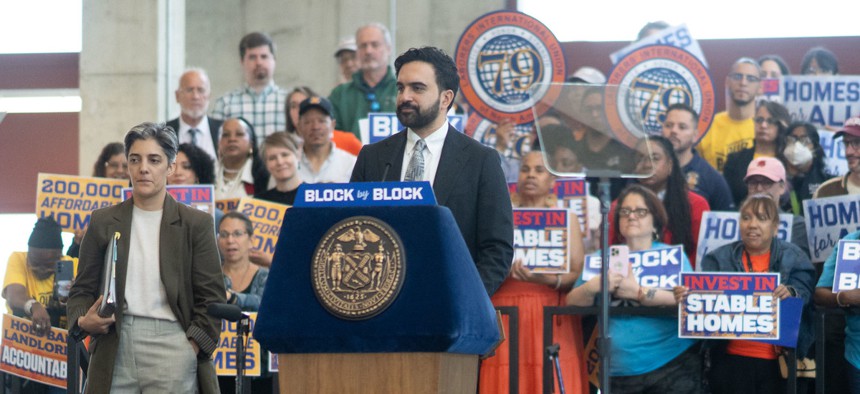
The mayor held a rally-style press conference to unveil his housing plan on Tuesday. Michael Appleton/Mayoral Photography Office



New York City Mayor Zohran Mamdani unveiled his highly-anticipated housing agenda on Tuesday, detailing a flurry of measures to improve the city’s public housing system and plans to build 200,000 new affordable homes.
The 100+ page plan, coined Block by Block, comes nearly six months into the mayor’s tenure. Rather than roll it out alongside his executive budget proposal earlier this month, the Mamdani administration released the ambitious agenda at a packed, rally-style event in Gowanus, Brooklyn – a neighborhood that’s seen a major housing boom in recent years due to a 2021 city rezoning. There’s been a lot of expectations around the plan’s release. The city faces a historic housing and affordability crisis, which has driven droves of residents from the city and created a mere 1.4% rental vacancy rate.
“If the absence of good government created the conditions we now face, the presence of good government can build the solutions we now need,” Mamdani said, adding that his plan “meets this crisis with the scale and urgency it demands.”
Here are five big takeaways from the mayor’s plan.
Build baby, build
Doubling down on the promise he made on the campaign trail, Mamdani said that his administration would create 200,000 new affordable, rent-stabilized homes and preserve another 200,000 existing homes over the next decade. This will be made possible through a $22 billion capital investment in housing over the next five years coupled with new financing tools and a sweeping land use agenda, according to the Mamdani administration. Prior mayoral administrations have set their own targets for building housing units with varied degrees of success. The de Blasio administration for example said it would build and preserve a combined 300,000 affordable units. The Adams administration set a “moonshot” goal to build 500,000 units over the next decade, but stopped short of specifying how many would be affordable versus market value.
Mamdani’s proposal focuses heavily on expanding affordable housing production. The administration plans to build 8,000 new affordable apartments in fiscal year 2027 and 2028 – a 35% increase from the previous two years. Of those 16,000 apartments, 30% will be catered to “extremely low-income” New Yorkers – meaning they earn less than 30% of the area median income – and 20% will be for “very low-income” New Yorkers – households earning between 31% and 50% of the area median income.
There’s been a sea change in how the left and elected officials in general feel about the role of development and the necessity of building more housing. As a democratic socialist, Mamdani’s proposal further underscores this.
“The mayor has put a strong and clear stake in the ground today by announcing this housing plan – arguably the most anticipated announcement of what his administration does to date – which says that the only way we can address housing affordability is through creating more supply,” said Amit Singh Bagga, Democratic strategist and campaign director of Yes on Affordable Housing, which helped spur the successful passage of several housing-related ballot proposals last year.
NYCHA improvements
The housing plan focuses heavily on addressing many of the problems that have impacted the New York City Housing Authority, or NYCHA, for years. To do so, Mamdani’s budget plan proposes $5.6 billion in capital funding for NYCHA – the largest investment in city history, according to the mayor’s office.
There are more than 170,000 apartments and 330 NYCHA developments spread across the city, many of which were built decades ago and are plagued by heating and power outages, pests, backlogged repairs and broken elevators. To help address these issues, the Mamdani administration is seeking to strengthen and utilize the Permanent Affordability Commitment Together, a program in which NYCHA partners with private developers to free up funding for building renovations, and the Public Housing Preservation Trust, a program in which NYCHA buildings are leased to a public benefit trust created by the state – again for the purpose of renovating housing units. NYCHA residents must vote to join either of these programs.
The housing plan also pledges to build more NYCHA housing on city-owned land, rebooting it as a “public developer,” to speed up completion of vacant units and to bolster local forums for NYCHA residents.
Reversing course
As a state Assembly member in 2022, Mamdani voted against the Public Housing Preservation Trust, which was something former Mayor Eric Adams had pushed the Legislature to create. Several of Adams' allies were quick to point out on social media that the idea had originated under the former mayor.
Asked about this on Tuesday, Mamdani said that his prior opposition had been rooted in concerns about NYCHA residents not having adequate say in the decision-making process. ”Now that I stand here as the mayor, I am incredibly excited about putting forward a plan where those residents' input is a critical part of how we move forward,” he added.
The housing ballot proposals appear to be doing their job
The ballot proposals approved by voters last fall aimed at overhauling the land use process and spurring housing production were featured prominently throughout the mayor’s plan. Capitalizing on some of those changes, the Mamdani administration plans to pursue housing projects in transit rich areas and in the neighborhoods that have produced the least amount of affordable housing.
Supporters of the proposals celebrated the mayor’s embrace of the changes. “There’s a lot of new tools that the city has with the ballot measures,” said Annemarie Gray, executive director of Open New York. “The fact that the mayor is fully embracing them, that’s a really, really big deal on a lot of the stuff that the city can internally do.”
Bad landlords beware
Building on the series of “rental ripoff” hearings held by the Mamdani administration over the last few months, the city will launch a new program called “Fix the City” aimed at going after “bad actor” landlords who’ve routinely neglected their buildings. (Incidentally, a super PAC supporting Andrew Cuomo’s mayoral campaign had the same name.) This effort will kick off this year starting with at least 10 of the worst landlord portfolios with the end goal of forcing them to give up their buildings by selling them to “responsible preservation purchasers” who’ve been approved by both the tenants and the Mamdani administration.