

Energy & Environment
Hochul got most of the climate rollbacks she wanted in this year’s budget
After months of secret debate, New Yorkers finally can see where things landed with the CLCPA.
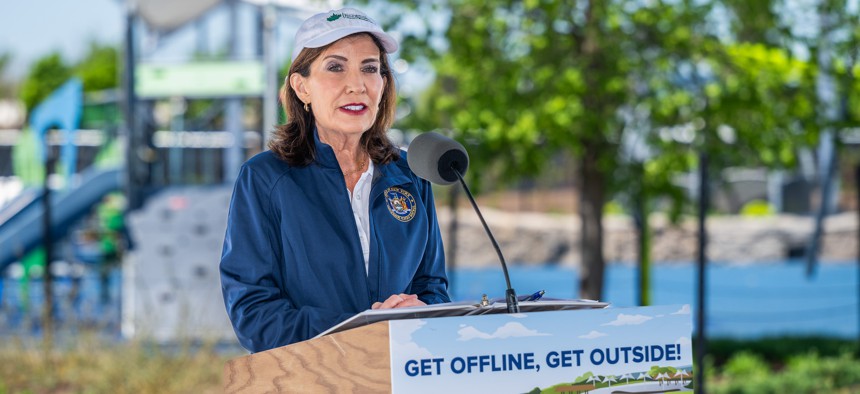
Gov. Kathy Hochul, seen speaking at an unrelated event in Buffalo last week, made a hard push to make changes to the state’s climate law in this year’s budget. Darren McGee/ Office of Governor Kathy Hochul



Gov. Kathy Hochul seems to have gotten just about everything she wanted when it comes to rolling back part of the state’s landmark climate law. It’s further evidence that her budget tactic of delaying and inserting controversial policy matters late is a winning strategy for her.
Under new budget language for the Transportation, Economic Development and Environmental Conservation bill introduced on Memorial Day, key deadlines and benchmarks included as part of the 2019 Climate Leadership and Community Protection Act would get pushed back. Firstly, the state will have until Dec. 31, 2028, to implement necessary regulations to meet emissions reduction goals. Per current state law – that a state judge has ruled Hochul is violating – the administration should have enacted those regulations by the start of 2024. The budget change makes the decision, which Hochul’s administration had appealed, moot and saves Hochul further legal headaches.
The 2028 deadline for the regulations, largely expected to be a cap-and-invest program, is slightly earlier than Hochul’s original pitch of 2030. And it’s even slightly earlier than the 2029 date she pitched during negotiations. But it still gives Hochul another two-and-a-half years to put off regulations her own administration has claimed would cost New Yorkers thousands in future years – an estimate refuted by climate activists, who have released their own analyses.
The budget will effectively eliminate the upcoming statutory 2030 goal of reducing greenhouse gas emissions by 40% from 1990 levels, which the state is nowhere close to meeting. Instead, it lays out a new, fungible 2040 goal of a 60% emissions reduction from 1990 levels. That goal includes the caveat that the state meet it “to the maximum extent feasible and cost effective,” which is far less binding than the ultimate, binding 85% reduction target by 2050, which remains in place.
Also delayed would be the deadline for the Climate Action Council to meet and update its scoping plan. Current law would necessitate the committee meeting next year, five years after the release of its original final scoping plan, in order to update that plan. The newest budget bill changes that to 2028, and establishes the council to meet every six years after, rather than every five years.
The other major change won by Hochul in the budget is on how the state will account for greenhouse gas emissions. The language, as expected, changes that accounting method from a 20-year timeframe to a more common 100-year timeframe. While more common, climate scientists have said the short timeframe better reflects the impacts of methane gas, which stays in the environment for a much shorter period of time than carbon dioxide. The change – along with two others – would immediately alter the level of greenhouse gas emission reduction the state has recorded without any other action, placing New York closer to hitting its goals.
Hochul has frequently defended the change, saying it aligns with the standard used by almost every other state and other countries, and places New York on a more even playing field, though climate activists said those other places passed their laws earlier with older recommendations. “New York, by 2019 … decided it was time to take a fresh look at our new and evolving understanding of the science,” Sasan Saadat, senior research and policy analyst at Earthjustice, told reporters Tuesday. “This is walking away from a more updated version of our scientific assessment.”
Many political observers expected Hochul to make changes to the CLCPA as part of her budget this year. Her administration has blown past statutory deadlines – resulting in a lawsuit it’s losing – and has struggled to keep pace with ambitious goals. The governor herself took to lamenting unforeseen circumstances hampering environmental efforts.
Ken Lovett, senior communication adviser on energy and the environment, pointed to federal roadblocks for renewable energy and supply line disruptions from the pandemic as forcing the governor’s hand. “Governor Hochul has made clear her top priority is keeping the lights on and costs down for all New Yorkers,” Lovett said in a statement to City & State. “While reckless policies coming out of Washington D.C. continue to bring unprecedented challenges, the commonsense reforms Governor Hochul fought for in this year's budget protect New York's status as a climate leader, while prioritizing affordability for New Yorkers.”
Yet the climate law did not receive a mention in her executive budget, nor did Hochul include her proposal as part of her 30-day amendments. “The means matter less than the ends,” Hochul budget director Blake Washington told City & State earlier this year when asked about the measure’s exclusion from the public documents the governor typically uses for her budget measures.
Washington’s comment came after a Citizens Budget Commission breakfast in which he effectively confirmed the governor would seek climate law rollbacks. One day later, City & State first reported on a memo from the New York State Energy Research and Development Authority that estimated an aggressive cap-and-invest program could raise utility rates by thousands for average New Yorkers.
Roughly a month later, Hochul finally released her pitch to amend the law – sort of. The governor published an op-ed in Empire Report offering the broad strokes of what she wanted, but actual language remained elusive until Memorial Day, when the budget bill containing the provisions finally got printed.
“The governor has manufactured an election year crisis about our climate law and shoved language to substantially weaken our law under secrecy in the budget process,” said Liz Moran, state policy advocate at Earthjustice. “Doing this, this process, is wholly undemocratic.”
This story has been updated with comment from the governor’s office.
NEXT STORY: Here’s how NYC plans to keep more information away from ICE