

Politics
Enacted state budget roughly $9 billion more than initially announced
With additional federal money, the newly released state budget financial plan has a $277 billion price tag.
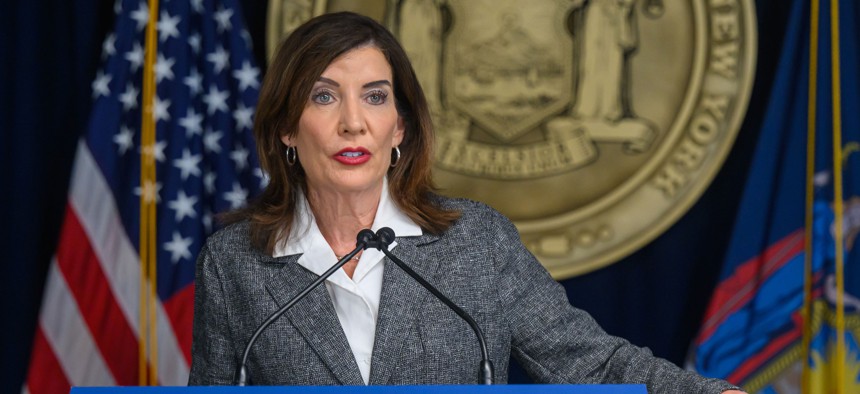
The enacted state budget is about $9 billion than Gov. Kathy Hochul had said previously, due in large part to more federal dollars. Susan Watts/Office of Governor Kathy Hochul



The state released the enacted budget financial plan that placed the total price tag at over $277 billion – about $9 billion higher than the $268 billion total Gov. Kathy Hochul announced in mid-May.
According to the financial plan, which the state put out Wednesday afternoon, the difference came “almost entirely due to a $10 billion upward adjustments to estimated Federal spending.” In other words, the total budget has grown, but that’s thanks to additional federal dollars – not more state spending. In fact, the document said officials made a revision to state operations and capital projects spending that reduced its total by about $1 billion compared to when the governor made her budget deal announcement. Hence, $9 billion higher since May.
Most of the additional federal money comes from the state tapping a trust fund to shoulder the costs of the Essential Plan, according to a Division of the Budget spokesperson. In March, the state received a waiver from the federal government to revert the Essential Plan back to a Basic Health Program in order to access that multibillion dollar trust fund and keep over 1 million New Yorkers from losing healthcare.
Smaller portions of the upward cost estimate come from past federal emergency relief dollars and distressed hospital funding owed to the state that must be reflected in this year’s enacted budget.
The financial plan also provides an update on the state’s outyear budget gaps, adjusting those estimates upwards by a cumulative $3.8 billion over the next three years compared to the governor’s executive budget proposal. Fiscal year 2028 will have an estimated $6.4 billion hole, up from $6.1 billion projected in the executive budget; fiscal year 2029’s gap increased from $9 billion to $10.5 billion; and fiscal year 2030 now has a predicted $14.7 billion budget deficit, up from $12.8 billion in January.
The plan places the blame for the increased budget hole projections on new recurring spending negotiated between the governor and the state Legislature that got added into the enacted budget. According to the financial plan, much of that is attributable to increases to school aid, enhanced pension benefits like the Tier VI reforms and additional support for SUNY and CUNY.
Fiscal watchdog group Citizens Budget Commission praised the more timely release of the enacted budget financial plan compared to past years, but still criticized the flat rainy day fund and increased outyear budget gaps. “The structural gap is now nearly $18.0 billion,” CBC President Andrew Rein said in a statement. “That’s a real fiscal risk to the State – and vulnerable New Yorkers who rely on its services – because it could drive serious service cuts in the future even without a recession.”