

Albany Agenda
It was a pretty good year for regulating AI in New York
State lawmakers passed a variety of artificial intelligence guidelines before the end of the legislative session.
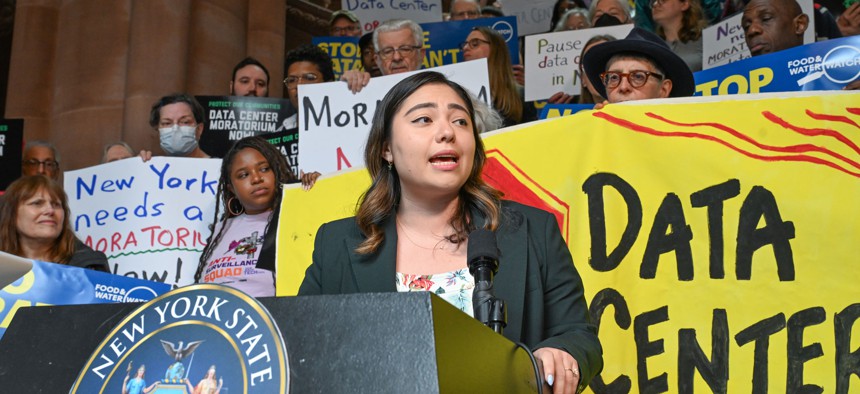
State Sen. Kristen Gonzalez’s bill would ban certain AI chatbot features used by kids that could be harmful. NYS Senate Media Services


State lawmakers didn’t slow down on their attempts to create artificial intelligence safeguards this year as they approved a series of new measures to reign in misuse in the fast-growing and frequently evolving industry. Although none were quite as high-profile as the RAISE Act approved last year, legislators passed a fairly wide range of AI-related bills at the end of the legislative session earlier this month.
Two notable bills that made it through both chambers directly relate to how minors interact with AI chatbots. One far-reaching piece of legislation from state Sen. Kristen Gonzalez and Assembly Member Alex Bores would enact new regulations on AI chatbot features used by kids that could be harmful or dangerous. If signed into law, the measure would, for example, prohibit chatbot interactions with minors from simulating emotion to establish false companionship, engage in unsupervised therapy and promote self harm, among other things.
“For too long, tech companies have been allowed to deploy increasingly powerful systems without meaningful protections, and we’ve seen it through dozens of tragic, chatbot-related cases around the country,” Gonzalez said in a statement, referring to instances of teen suicide that could be traced back to troubling conversations with AI.
Groups like Common Sense Media have been pushing for protections in AI technology in New York and across the nation. “This is a huge victory for kids and families and a model for other states to follow,” James Steyer, founder and CEO of Common Sense Media, said in a statement. “We encourage Gov. Kathy Hochul, one of the strongest governors in the nation for kids’ online safety, to sign this bill into law.”
The other bill, sponsored by state Sen. Andrew Gounardes and Assembly Member Rebecca Kasay, would place a five-year moratorium on the sale of children’s toys that incorporate chatbots, which Gournades likened to something out of The Twilight Zone. “It’s logical, it’s fair, and most importantly, it makes clear that our children’s safety is nothing for Big Tech to play around with,” Gounardes said in a statement about his bill’s passage.
Also from Gounardes and Bores, the Artificial Intelligence Training Data Transparency Act passed both chambers. The measure would enact transparency requirements for the data used to train large language and generative artificial intelligence models. The bill was one of several targeted by tech industry lobbying last year, along with the RAISE Act.
In a different vein, state Sen. Pat Fahy’s and Assembly Member Nily Rozic’s Fundamental Artificial Intelligence Requirements in News Act made it through the state Legislature. Dubbed the FAIR News Act, the nation-leading bill would require news organizations to disclose the use of generative AI in its reporting and writing. It would also enact protections for human newsroom staff against AI automation.
“Perhaps one of the industries at most risk from the use of artificial intelligence is journalism, and as a result, the public’s trust and confidence in accurate news reporting,” Fahy said in a statement. “AI is reshaping our economy at a pace faster than the Industrial Revolution.”
Still, plenty more was still left on the table for future years. Gonzalez, who held a hearing at the start of the year to gather feedback on AI regulation best practices, had hoped to get her New York AI Act passed, for one. It would have put into place certain ethical and transparency guidelines for companies developing artificial intelligence.
An executive budget proposal that would have required clear labeling for all AI-generated content and fully banned deceptive political AI content also didn't make the final cut. That’s good news for Republican gubernatorial candidate Bruce Blakeman, who has made heavy use of AI so far in his campaign messaging in a way that may already have violated existing state law.