

Zohran Mamdani
What Mamdani got – and didn’t get – from Albany this year
Some of the New York City mayor’s biggest wins and losses after his first session lobbying for City Hall.
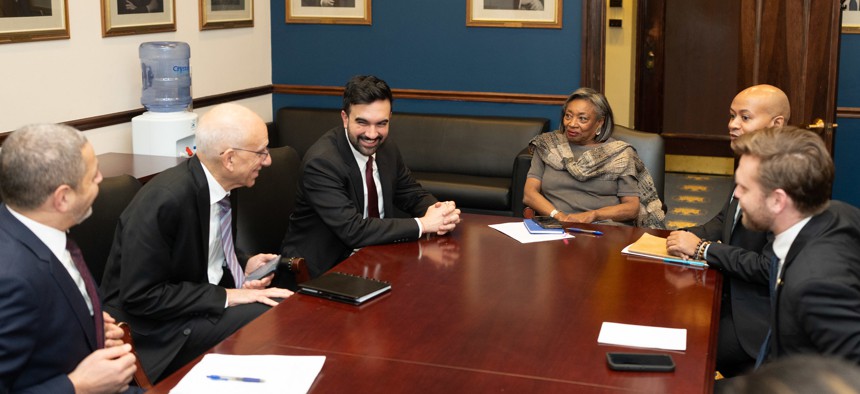
Zohran Mamdani got more done in Albany as mayor than he ever did as an Assembly member. Ed Reed/Mayoral Photography Office


Former Assembly Member Zohran Mamdani didn’t vote on the state budget this year, but the $268 billion spending plan impacts him now more than ever. As state lawmakers conclude their 2026 legislative session, Mamdani has extracted some major wins from his former colleagues – including a mechanism to kill his predecessor’s Charter Revision Commission and an infusion of cash for childcare and reducing the city budget gap. Mamdani was also granted a limited levy on the wealthy in the form of a pied-à-terre tax on second homes worth more than $1 million – a bone to throw to his billionaire-chomping base.
Mamdani’s first legislative session as New York City mayor has been challenging, to say the least. Soon after he came into office, he raised the alarm about a massive two-year city budget gap he estimated at $12 billion. That number shrunk significantly with tax revenue updates and an influx of cash from the governor, but Mamdani still caused panic and outrage when he floated the idea of raising property taxes in the city to close the remaining gap.
Mamdani dropped that idea in his executive budget, released May 12. Despite Hochul’s earlier contention that the state had already delivered plenty of assistance to New York City, she promised $4 billion in additional last-minute state actions to close a remaining budget gap over this fiscal year and next. The lion’s share of that comes from state-authorized restructuring of the city’s pension payments – a measure public employee unions aren’t thrilled about.
Mamdani is now newly empowered by an influx of state aid as his budget team and the City Council negotiate the city budget due June 30.
“The Mamdani administration is incredibly proud of the work we did to address the structural imbalance between the city and the state and balance a historic deficit without cutting essential services,” City Hall spokesperson Dora Pekec said in a statement. “The Mayor is grateful to Governor Hochul, Leader Stewart-Cousins, and Speaker Heastie for their partnership.”
Here are the mayor’s big wins and losses from the 2026 state legislative session.
WINS
Charter Revision Commission killer
For weeks, Mamdani said little about where he stood as the Charter Revision Commission convened by former Mayor Eric Adams on his last day in office barreled forward. While it was generally understood that Mamdani didn’t want the zombie-like panel to advance any questions onto the November ballot, there was only so much he could do beyond cutting off funding. That is until state lawmakers, at Mamdani’s request, granted him a new power to accept or reject the commission. Mamdani wasted no time killing his predecessor’s creation and forming his own Charter Revision Commission.
Pension restructuring
As far as methods to close a budget gap go, pension restructuring certainly isn’t the sexiest. But it’s expected to free up a good chunk of the money in the short run: an estimated $2.3 billion over two years. To do so, Hochul and state lawmakers agreed to grant the city permission to stretch out its annual public pension contributions so that it meets its long-term obligation by 2037 rather than 2032, the current deadline. Mamdani has insisted that the proposal won’t have any impact on retirees and their benefits – nor will it impact current employees and their future benefits, though that hasn’t stopped critics from raising concerns about shifting costs into future years. State approval was only step one. Next, the proposal will need to earn the approval of the boards that oversee the city’s five municipal pension funds. Unions, which hold considerable influence over said boards, have yet to sign off on the idea.
Child care funding
One of the earliest wins Mamdani secured from Albany this session was also one of the most politically significant. After campaigning on a three-prong promise of fast and free buses, rent freeze and universal childcare, Mamdani was able to say just a week into his term that he was making serious headway on the third. Hochul agreed to provide funding for a new, free childcare program for 2-year-olds, starting with 2,000 seats this fall and growing from there. While Hochul committed state funding for the first two years, the commitments are less clear in the following years. But it’s a mutually beneficial partnership for Mamdani and Hochul, who is running for reelection, and the two have appeared together often to celebrate it in the months since.
Pied-à-terre tax
Many of us learned who Ken Griffin was this spring, thanks to a megaviral video Mamdani recorded outside the hedge fund CEO’s $238 million penthouse to tout a new pied-à-terre tax, which Mamdani said will raise $500 million annually. (Skeptics, including city Comptroller Mark Levine, have questioned whether the new tax will actually pull in that much given how difficult it can be to implement.) The video caused a dust-up with the corporate honchos, but the tax is a testament to the power of Mamdani’s populist campaign. This tax will apply to second homes worth more than $1 million.
Class size relief
New York City schools will now have an additional two years to comply with a state law aimed at shrinking class sizes, giving the city some relief from the costly state measure first enacted in 2022. Those requirements have been gradually phased in over the past couple of years to the delight of educators who’ve long argued that smaller classes lead to better learning outcomes. Under the initial timeline, all classrooms were supposed to be in compliance with the cap of 20 to 25 students by the 2027-28 school year. Now with compliance pushed back another two years, the Mamdani administration is expected to save around $500 million next school year followed by an additional $730 million in the next year.
Mayoral control
Mamdani will get at least two more years of control over the New York City public school system. While that’s less than the four-year extension he and Hochul pushed for, two years isn’t far from the ordinary – especially given the mayor’s prior position on the policy. As a candidate, he’d openly campaigned on overhauling mayoral control, only to backtrack shortly before taking office.
SEQRA reform
While Mamdani himself has made a few high profile trips to Albany since he took office, his intergovernmental team and even some commissioners have been doing a lot of the heavy lifting. Newly installed Department and Housing Preservation and Development Commissioner Dina Levy trekked to Albany to lobby for reforms to the State Environmental Quality Review Act to ease some strict environmental review restrictions and speed new housing construction. Those reforms were included in the state budget.
LOSSES
The original “tax the rich” pitch
One area where Hochul and Mamdani did not see eye to eye this year – arguably the most consequential – was over his proposal to tax the rich. Sure, the state budget does include a new tax on the rich via the pied-à-terre tax, but while Mamdani’s team has claimed that as a “tax the rich” win, it’s far from the more substantial tax hikes on high earners and large corporations that Mamdani campaigned on and subsequently lobbied for. While the state Legislature backed those proposals, Hochul has been adamantly opposed, and stuck to that opposition throughout the budget process and session. She also quickly shot down a joint proposal from Mamdani and City Council Speaker Julie Menin to reduce a tax credit targeted at the rich. Luckily for Mamdani, Hochul stepped in in other ways to help the city close its budget gap.
No free buses this year
Not so fast – or free. One of Mamdani’s key campaign planks will go unfulfilled in his first year in office. His pitch for fast and free buses hardly made it to the negotiating table in Albany. That’s likely a reflection of the need to balance priorities as well as the reality that the proposal faces more opposition from Hochul, Metropolitan Transportation Authority CEO Janno Lieber, and even some local elected officials who want to see more attention to low-income riders first. It’s not necessarily dead in future years, however. In appointing his nominees to the MTA board at the end of session (who have now been confirmed) Mamdani made sure to highlight that they would “help ensure” that fast and free buses happen.
Buffer zones
Just when it looked like Mamdani had managed to successfully diminish a politically dicey proposal to enact protest buffer zones outside of houses of worship, lawmakers and Hochul swooped in with the passage of their own, more intensive version. Unlike the City Council’s measure requiring the New York City Police Department to develop and publicize a plan to deploy security perimeters around places of worship, the new state law actually establishes a 50-foot buffer around these facilities. Protesters who “knowingly or intentionally” in behavior that causes an individual “reasonable fear for their safety” could be slapped with a class B misdemeanor. So far, Mamdani has said little about the state measure, but it’ll likely draw legal challenges from critics who’ve raised concerns about restricting protest activity.