

News & Politics
The specter of the outside income cap looms over state legislative retirements
Not every state lawmaker has a large salary outside the Legislature, but several who are leaving do.
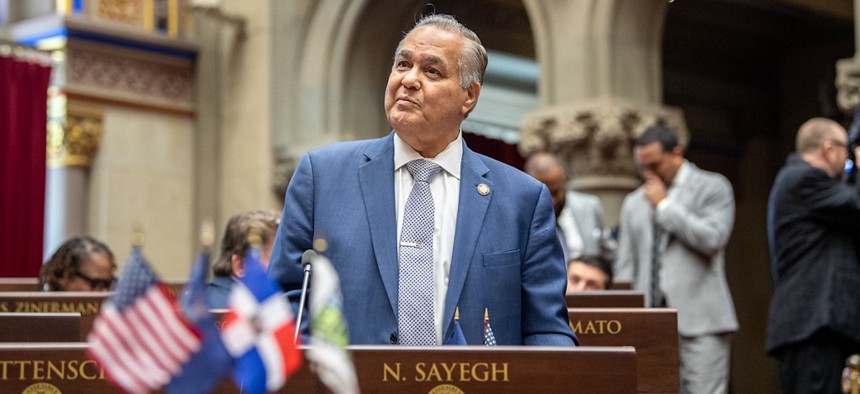
Assembly Member Nader Sayegh would need to give up his outside income if he stayed in the state Legislature, so plans to retire at the end of the year. NYS Assembly Majority



Quite a few state legislators are leaving office at the end of this year. They gave a variety of reasons for their exits, though only one so far has explicitly cited the soon-to-be enforced cap on outside income as a contributing factor. However, a handful of others would have been forced to give up earnings far exceeding their salary as legislators, including one who has only been in office for a year.
Of the more than a dozen state lawmakers who announced their retirement for public office so far, only Assembly Member Nader Sayegh has said he considered the impact of the limit on outside income before making his decision. Under the law, originally passed at the end of 2022, legislators approved a cap of $35,000 on most other income at the same time they gave themselves a sizable pay raise. After its legality got hashed out in court, a judge determined it would take effect at the start of 2027.
Sayegh runs a personal injury law firm outside of his work as a state legislator. Although he reported no income from the firm in 2024, the most recent year for which data is available, Sayegh made it no secret that the cap – which he has spoken out against in the past – drove his decision. “I think the intent was to avoid individuals that may benefit out of service in government,” Sayegh told News12 last month. “But I think there is enough ethics law, there is enough legislation that protects and allows individuals to avoid taking votes or decisions that may concern them personally.”
Based on financial disclosures filed by lawmakers, Sayegh isn't the only one for whom the cap may have proven a deciding factor. Perhaps most notable is Assembly Member Daniel Norber, who was only elected in 2024. The Long Island lawmaker unseated a Democratic incumbent to flip an area that hadn't gone red in 50 years. And he weathered controversy over his residency. Yet after just one year in office, Norber called it quits, citing a desire to spend more time with his family and the sacrifices demanded by public office.
He didn't mention the up to $350,000 salary he reported from his personal business Lions Den Enterprises in 2024. That would be more than twice Norber’s salary in the Assembly and a pretty penny to give up. Norber, like others mentioned in this story with high outside incomes, declined to expand on his reasoning to retire from office at the end of the year beyond his already public statements.
Assembly Member Brian Manktelow, who said he would not seek reelection to his Finger Lakes seat after seven years, actually joined the Republican-led lawsuit that sought to overturn the outside income cap in 2023. In 2024, he reported up to $250,000 from his family farm business. That fact didn't make it into his public statements on his decision. In fact, he didn’t offer a particular reason for his decision, only that it “wasn’t on his radar” two months prior.
One of the highest paid members of the Legislature also announced his retirement at the end of his third term. Long Island Assembly Member Keith Brown reported an up to $600,000 income as a partner at his own law firm. He called the decision not to seek reelection a difficult one, but asserted “it is time.” Brown didn’t offer any more about whether the upcoming enforcement of the outside income cap contributed to his thought that now is the right time to leave office.