

Budget
Mamdani and Menin join forces to call for Hochul to send more $$$ to NYC
And Gov. Kathy Hochul is not having it.
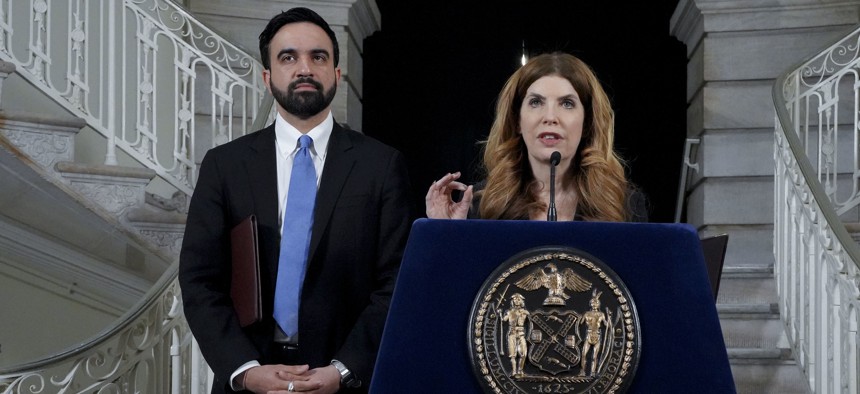
Mayor Zohran Mamdani and Council Speaker Julie Menin screamed into the void on Tuesday. NYC Council Flickr


After clashing over how to fix a multibillion budget deficit, legislation to create protest “buffer zones” and backing different candidates in a Tuesday special election, Mayor Zohran Mamdani and City Council Speaker Julie Menin appear to have found common ground again: They’ve got a plan for how Albany can help close the city’s budget gap. The only problem is the governor is not at all into it.
Menin and Mamdani came together for their first joint appearance in weeks to call on the state Legislature and the governor to reduce the city’s pass-through entity tax credit, or PTET, to 75% – a move they argued would generate nearly $1 billion in additional revenue that the city could use to help close its $5.4 billion budget gap. The move would impact high-earning New Yorkers.
Getting Gov. Kathy Hochul’s support for cutting the PTET credit will be crucial – but she told reporters in Colonie in no uncertain terms she won’t back the pitch from Mamdani and Menin. “It’s not happening … we’re not changing PTET,” Hochul said.
In the eyes of the governor, reducing the tax credit amounts to a tax increase on New York City residents. “That’s why it’s not happening,” Hochul said. And she reiterated the fiscal support she has already proposed for the city. “I think it's crystal clear that we already have helped them, and I wanted to do it early enough so they would have the clarity to know what resources they could count on from the state,” Hochul added.
The mayor and the speaker also announced an agreement to delay the release of the mayor’s executive budget proposal from May 1 to May 12 as the state budget stretches more than a month beyond its April 1 deadline. This, they said, would help give the city a clearer picture of what sort of bailout it can expect from Albany with the state budget now nearly a month late. Plans for Tuesday’s announcement were first reported by Politico New York.
Menin and Mamdani’s relationship has become increasingly strained as the two wings of City Hall have grappled with the city’s troubled finances. Things escalated in early April when the City Council released its budget plan, which Mamdani slammed, calling Menin out personally for not joining his calls to raise taxes on the wealthy. Late last week, the mayor vetoed a controversial bill championed by the speaker that would have required the police department to create and publicize plans to deploy security perimeters around schools during protests. The two leaders also endorsed different City Council candidates running to represent Manhattan’s West Side in an April 28 special election.
Their joint appearance Tuesday seemed to suggest that they’ve set the conflict aside, at least for now. Menin and Mamdani both downplayed prior disagreements, emphasizing their shared commitment to securing more funding from the state. While both Menin and Mamdani have separately proposed some version of the PTET proposal, Tuesday’s announcement was the first time they joined their voices together. They also outlined several other revenue generating measures, including asking the state to restore funding through the Aid and Incentives for Municipalities program, or AIM – which the city was cut off from in 2010 – and for relief on a costly state mandate to lower class sizes.
“The speaker and I have stood together before. We are standing together today. We will stand together again,” Mamdani said. “We're committed to delivering a budget that is balanced as part of our fiscal responsibility, and one that also delivers the working New Yorkers.”
Other disagreements remain. Menin still isn’t calling on the governor to raise taxes on the city’s wealthiest earners – something that’s previously frustrated the mayor and contributed to much of the tension between them. On Tuesday, Menin described the changes to PTET as a “short-term solution.” Mamdani gave no such timeline on how long he envisions it to be in place. Asked for clarity, a mayoral spokesperson also declined to give a number in years. “As the mayor said earlier today, we’re looking for structural solutions to the structural challenges facing our city,” mayoral spokesperson Dora Pekec said in a text. “We’re looking forward to our conversations with legislative partners.”
There’s also no guarantee that the state will honor Mamdani and Menin’s requests – even if they are making them in tandem now. While both legislative chambers included a proposal to reduce the PTET credit in their budget proposals, Hochul remains steadfast in her opposition.
Jen Goodman, a spokesperson for the governor, pointed to resources the state has already dedicated to the city, describing them as “unprecedented.” “Delays in the city budget are a choice,” she said in a statement. “The mayor and City Council need to work together, identify savings, and close the remaining gap.”
Hochul said she isn’t bothered by the decision from the city leaders to delay their own budget process. “I’m always happy,” she quipped. “I'm in a permanent state of happiness.” But she did take issue with any attempt to link the city’s budgeting timing with that of the state.
“(I’m) just sending out the message that what you're doing is independent of our budget process,” Hochul said. “We don't have to be done in order for you to do yours.” The governor said issues that require state legislative permission, such as amortization of pensions, can get done outside the state state budget process. “They just have to have this clarity by the end of June, so I presume it's going to all work out,” she said.