

Editor's Note
Editor’s note: An MLK Day to remember with Rep. Yvette Clarke
It was an enlightening experience traveling around with the member of Congress in 2020.
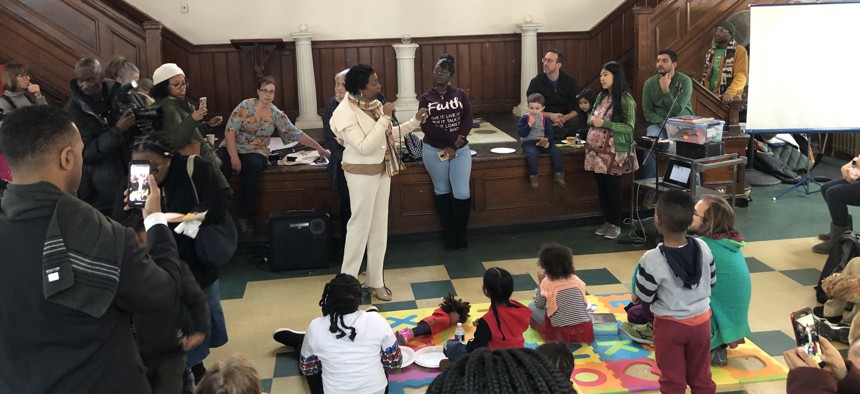
Rep. Yvette Clarke attends an Prospect Lefferts Gardens Neighborhood Association event at Grace Reformed Church of Flatbush on Jan. 20, 2020. Jeff Coltin


One of my most enlightening days as a reporter was on Martin Luther King Jr. Day in 2020, trying to keep up with Rep. Yvette Clarke.
The Brooklyn Democrat had been spooked by a primary challenge from young Harvard MBA Adem Bunkeddeko two years before, and she wasn’t going to let it happen again. So she invited me to tail her on the campaign trail.
Or as she put it to Salem Missionary Baptist Church Pastor James A. Thornton: “He’s going to shadow me today and see how much people love me.”
“And we do love you here,” Thornton responded.
The day continued like that. She’d already made a couple stops before we met up, and I joined her for six more, jumping from church to church, shaking hands and delivering variations on the same speech: “Washington, D.C., is a toxic place,” she said. “I’m coming home to detox.”
Clarke was a trailblazer in New York – in a city full of political dynasties, she was the first woman to succeed her mother in the New York City Council, the legendary Una Clarke. You can read more of her story, and other leading women in politics, in the 2026 Above & Beyond: Women.
Of course, a couple months after I shadowed Clarke, the world changed. COVID-19 hit, and New Yorkers took to the streets for Black Lives Matter protests. Clarke ended up winning comfortably in a higher turnout election, earning three times the raw votes she had the previous cycle.
I’d only met her in passing before that MLK Day, knowing her only as one of the city’s lower-profile members of Congress. But after our hours together, I had a feeling she had the race in the bag – she pounded the pavement, connected with voters one by one and made them feel like, in a messy political environment, she was on their side.