

Policy
Hochul draws the line on updating the state’s environmental review process
The debate to modernize the state’s environmental review process could hold up a final budget deal.
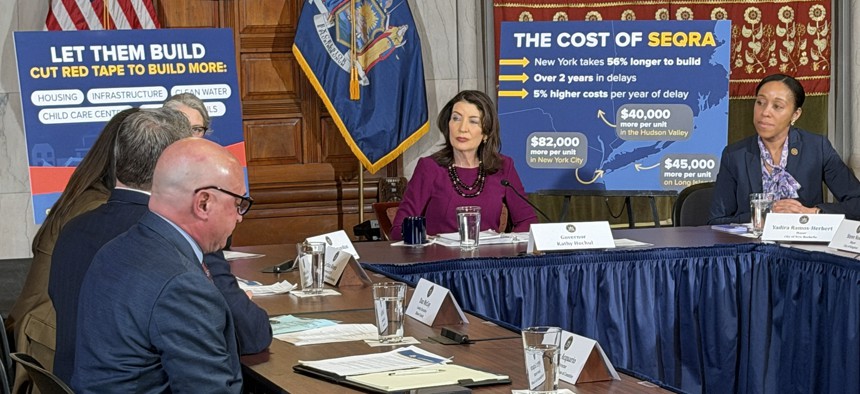
Gov. Kathy Hochul discusses the need to reform the State Environmental Quality Review Act on March 23, 2026. Kate Lisa


Gov. Kathy Hochul is working to drum up support for one of her top budget asks: reforming the state’s burdensome environmental review process that can impede housing and development.
County and other local leaders joined the governor in Albany on Monday to stump for her push to modernize the mandated review that’s known to slow project approvals – hoping to give their side a leg up in negotiations with the Legislature.
“We will get out of the way,” Hochul said of government at a roundtable she convened in the state Capitol on the issue. “The era of half measures and a little bit here, a little bit there, it’s just not working. That is the reason why people who want to stay in New York, many families and young people who want to build their lives here, they just can't find a home that they can afford.”
In her executive budget, Hochul has waged a war on the state’s regulatory maze of red tape, proposing changes to the State Environmental Quality Review Act. The governor said the law, known as SEQRA, can add up to two years of bureaucratic review on a project. Hochul wants to exempt certain projects from the required review process altogether to spur development, including mixed-use housing projects of up to 500 units in New York City, or up to 100 units outside the five boroughs.
The issue was expected to be a point of contention this budget cycle. The state Senate narrowed Hochul’s proposal in its one-house budget. The upper house created different categories for projects and exempted those with fewer than 10 residential units for municipalities without zoning regulations and projects of 50 units or fewer if not hooked up to existing water and sewer. The Assembly rejected SEQRA reforms in its one-house budget, but only because Speaker Carl Heastie usually removes unnecessary policy items from the discussion. In January, the speaker predicted the reform would be a sticking point during negotiations and likely delay a final deal. The $263 billion spending plan is due April 1.
New York State Association of Counties Executive Director Stephen Acquario said all 57 counties outside the city support the reform and are eager to see underutilized commercial corridors and former industrial properties converted into homes for working families.
“The currency for processing too often adds delay and unnecessary review without improving environmental outcomes,” Acquario said. “This is especially true for projects on previously disturbed sites where environmental risks are already well understood and heavily regulated.”
The governor and Senate’s proposals would exempt certain mixed-use development projects, and environmental groups are concerned about the consequences if the proposed changes become law.
Drew Gamils, a senior attorney at Riverkeeper, said both the governor’s proposal and the state Senate’s proposal are vague and lack clarity about which mixed-use development projects would be exempt from environmental review.
“The message we see a lot from the governor’s office is that this is just about housing, and it’s not,” Gamils told City & State. “Without clarity as to what nonresidential use could be allowed … you could have a data center surrounded by residential units that could be exempt under the governor’s proposal.”
Gamils agreed that the law needs to be updated, but said exemptions should be limited to affordable housing projects. “SEQRA is a planning tool used to evaluate if a project is appropriate for an area,” she said. “We’re being presented with a false choice between housing and the environment, and the decisions have to go hand in hand to achieve smart growth and development. We want to create developments in urban areas, we want walkable communities, but you have to find the right language to achieve those goals and really focus on what’s actually being proposed.”