

Opinion
Opinion: The light that shines behind the prison walls
Without external scrutiny, the state prison system will return to a state of opacity where inefficiency and neglect go unnoticed until it is too late, and too expensive, to fix.
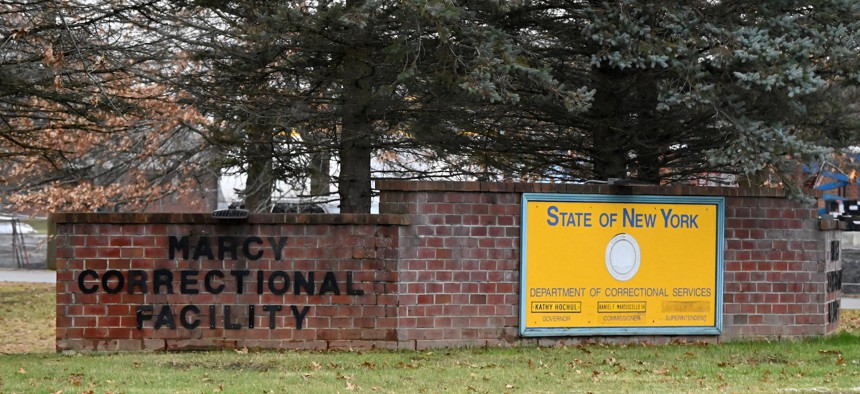
The Correctional Association of New York provides independent scrutiny of state prisons like Marcy Correctional Facility, where Robert Brooks was murdered by guards in 2024. Will Waldron/Albany Times Union via Getty Images


New Yorkers believe that our state is at its best when we lead with courage, transparency and a commitment to the rule of law. As someone who has run carceral systems in three different jurisdictions, including New York City, I have personally felt the profound operational challenges that confront the New York State Department of Corrections and Community Supervision. In the inherently closed environments of a prison, the absence of a disinfecting light from outside the walls can result in neglect, and the signs of an impending crisis can be missed.
Last year, Gov. Kathy Hochul demonstrated national leadership by making a $3 million investment in the Correctional Association of New York, or CANY. CANY was founded in 1844 by concerned citizens who wanted to improve conditions in prisons and was shortly after granted authority by the state Legislature to formally monitor state prisons. Hochul’s commitment was historic, both because it was grounded in reinforcing CANY’s long heritage and because it was a bold statement of intent that New York would not hide from its problems.
Regrettably, the proposed elimination of this investment in Hochul’s 2026-27 Executive Budget threatens to derail that progress. We must be clear – independent oversight is not a luxury; it is a cornerstone of good government. And, over the last year, CANY has proven that transparency works – not by sitting in an office and checking boxes, but by moving with urgency to transform this critical funding into a persistent and proactive program of correctional facility monitoring.
The proposed defunding of CANY comes at a decidedly inopportune moment when New York’s correctional system has been marked by profound instability following a series of deeply troubling events. The murders of Robert Brooks at Marcy Correctional Facility and of Messiah Nantwi at Mid-State Correctional Facility underscore the urgent need for independent oversight to identify and address safety failures before they escalate. At the same time, the system has weathered an unprecedented wave of staff unrest, culminating in an unauthorized work stoppage that disrupted operations and compromised stability. The deployment of the National Guard to help maintain order at a cost of $100 million per month, next to which CANY’s budget is a pittance, further illustrates just how strained the system has become. These events are not abstractions. They are symptoms of longstanding, systemic failures fueled by spasms of reforms that have repeatedly fallen short of establishing real accountability.
New Yorkers are practical people. We spend billions of dollars on our correctional system every year. We want to ensure those tax dollars are utilized efficiently and effectively. Without the external scrutiny provided by CANY, the system will return to a state of opacity where inefficiency and neglect go unnoticed until it is too late, and too expensive, to fix. CANY has used the governor’s investment to build a systematic data collection engine that provides taxpayers and policymakers with unbiased, accurate and firsthand information direct from the floors of our prisons, with new key performance indicators to track trends before they become sinks of instability and, ultimately, tragedies.
When CANY shines a light on these facilities, which are among the most hidden public institutions in our society, it ensures effective prison management and public accountability. And it also humanizes the daily realities of our prisons for those incarcerated there and their hardworking staff, who deserve a safe and professional workplace.
Hochul should continue to invest in CANY to fulfill its statutory mandate at a scale commensurate with the system’s needs, because a New York that is accountable is a New York that is safe, fair and strong.
Vincent Schiraldi is former commissioner of New York City’s Correction and Probation Departments, and former chief executive of youth corrections in Maryland and Washington, D.C. He is currently a visiting fellow at the Pinkerton Foundation.
NEXT STORY: Opinion: Council progressives call for rentals within reach